KLAS Research has interviewed hundreds of healthcare decision-makers about their ERP experience, and the same patterns keep showing up.
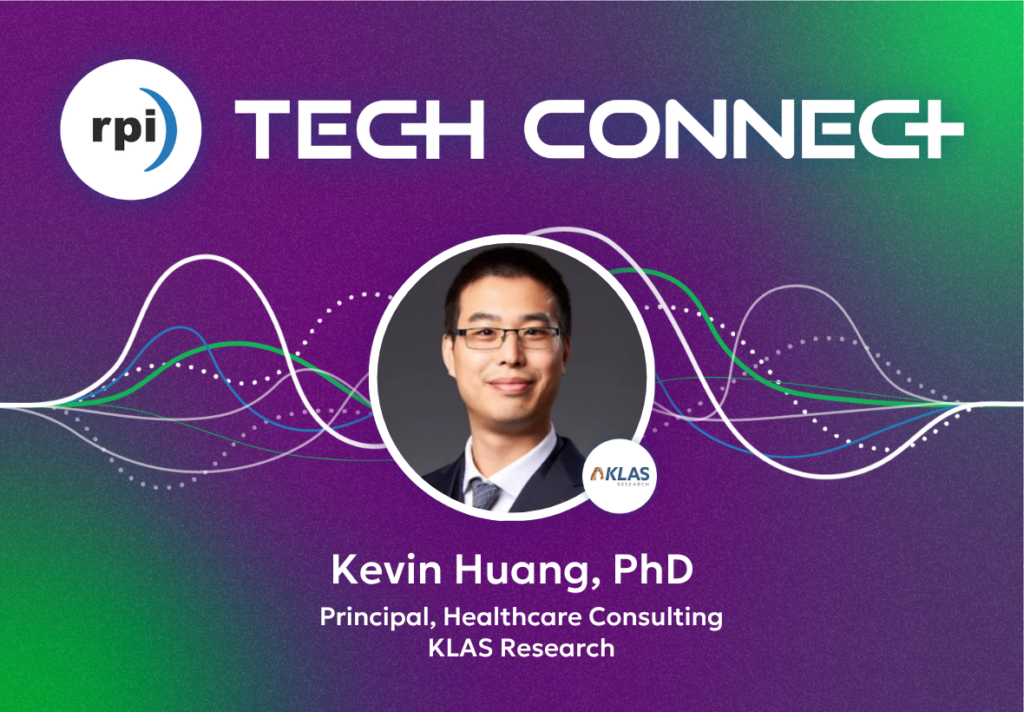
In this episode, Kevin Huang, PhD, Principal Healthcare Consulting Lead at KLAS Research, joins to share what his team has uncovered in recent years. He shares what the data reveals about why ERP outcomes diverge, and why the biggest gaps tend to show up around training, communication, and how well organizations and their implementation partners work together.
Kevin also previews forthcoming KLAS research on what health systems are doing after go-live, including where organizations are finding quick wins through tools like AP automation, and what the broader shift toward optimization looks like across the market.
If you’re in healthcare and wondering whether your ERP is delivering what you were promised, this one’s worth your time.
Interested in listening to this episode on another streaming platform? Check out our directories or watch the YouTube video below.
Meet Today’s Guest, Kevin Huang
Kevin Huang is the Principal for Healthcare Consulting at KLAS research, where he leads client satisfaction research and market insights. Kevin is passionate about leveraging KLAS data to push services firm partners to improve, share partnership best practices, and ultimately drive improved patient care.
Before joining KLAS, Kevin got his PhD in Neuroscience from the University of Utah. Outside of work, Kevin enjoys hiking, fantasy novels, and culinary experimentation.
Meet Your Host, Chris Arey
Chris Arey is a B2B marketing professional with nearly a decade of experience working in content creation, copywriting, SEO, website architecture, corporate branding, and social media. Beginning his career as an analyst before making a lateral move into marketing, he combines analytical thinking with creative flair—two fundamental qualities required in marketing.
With a Bachelor’s degree in English and certifications from the Digital Marketing Institute and HubSpot, Chris has spearheaded impactful content marketing initiatives, participated in corporate re-branding efforts, and collaborated with celebrity influencers. He has also worked with award-winning PR professionals to create unique, compelling campaigns that drove brand recognition and revenue growth for his previous employers.
Chris’ versatility is highlighted by his experience working across different industries, including HR, Tech, SaaS, and Consulting.
Show Notes
About RPI Tech Connect
RPI Tech Connect is the go-to podcast for catching up on the dynamic world of Enterprise Resource Planning (ERP). Join us as we discuss the future of ERPs, covering everything from best practices and organizational change to seamless cloud migration and optimizing applications. Plus, we’ll share predictions and insights of what to expect in the future world of ERPs.
RPI Tech Connect delivers relevant, valuable information in a digestible format. Through candid, genuine conversations and stories from the world of consulting, we aim to provide actionable steps to help you elevate your organization’s ERP. Whether you’re a seasoned professional or new to the ERP scene, our podcast ensures you’re well-equipped for success.
Tune in as we explore tips and tricks in the field of ERP consulting each week and subscribe below.

Transcript
Chris Arey
We’re back for another exciting episode of RPI Tech Connect. I’m your host, Chris Arey. Today I’m joined by Kevin Huang, PhD, a principal healthcare consulting lead at KLAS Research. Kevin and his team study the healthcare ERP market closely, tracking software, services, and the organizations that live in that space. His perspective on the healthcare ERP journey is all-encompassing, and I think it’s one that’s really going to resonate with our audience today. Looking forward to having a great discussion about the insights you’ve collected during your time with KLAS. So, Kevin, welcome to the program, sir.
Kevin Huang
Great to be here. Thanks, Chris.
Chris Arey
For those who haven’t met you, would you mind sharing a little bit about yourself?
Kevin Huang
Yeah, so I am the principal for healthcare consulting at KLAS. I’ve been with KLAS coming up on about five years. Before I joined KLAS, I got my PhD in neuroscience, and then my role essentially involves taking a lot of the client feedback and interviews that we do and turning that into valuable insights and thoughts around where the market’s going. I help our partners be the best versions of themselves that they can be.
Chris Arey
A very noble cause. Thank you for sharing that background. Before we get into the actual findings you have prepared today, I want to give listeners a little context on KLAS. Would you mind walking me through what KLAS does and how you gather your data?
Kevin Huang
Yeah, absolutely. KLAS is essentially an independent third-party market research firm. We go out and interview providers and decision makers in the healthcare IT space and put that onto our website to help people make better decisions. We’re kind of like Consumer Reports, but for healthcare IT — I think that’s maybe the best way to put it.
We do these interviews and gather scores around how satisfied people are with various healthcare IT software and professional services, with the intent of pushing the market forward and making sure people have the information and transparency they need to make good decisions. We also partner with firms to help them understand what their clients are saying and how to be better. The ultimate goal is to drive healthcare forward — to drive better patient outcomes and better patient experiences.
Chris Arey
I like the Consumer Reports analogy — that’s a very accessible example. And your focus specifically is on the ERP side, is that right?
Kevin Huang
I have ownership over almost all of our professional services partnerships, and that includes EHR, ERP, and the firms that do a lot of the implementation work there. There are some folks on our side who sit a little closer to the software and vendor partnerships. But I’m well-versed in those areas because all of the firms I work with do work there. So yes.
Chris Arey
Okay, cool. Thank you for clarifying. And you’ve been conducting research with KLAS for quite some time now?
Kevin Huang
Yeah, I’ve been covering the space for the last four years and change.
Chris Arey
So you’ve got a crystal ball into what’s happening in the healthcare ERP space. From where you sit today, here in June of 2026, where is the market? What does that landscape look like?
Kevin Huang
Taking that really high-level look at things, I would say last year was a year where we had a lot of anxiety around what the new administration was doing, what the policy changes would be, and how those would impact organizations. A lot of healthcare organizations were in a wait-and-see holding pattern as they figured out what was going on.
As we went through 2025, we started hearing a lot of concern about margin pressures due to reimbursement changes and policy shifts. As I look at where we are today in 2026, that has really shifted. It’s moved from projecting and preparing for tighter margins to actually feeling them. Hopefully organizations battened down the hatches to prepare — because now it’s where the rubber meets the road. Organizations really have to be disciplined and think carefully about what they should be doing, how they surf this out, and how they stay ahead of the curve.
Chris Arey
And so, given those policy changes and the administration’s impact on healthcare budgets — would you say ERP implementations have slowed down as a result? What’s the impact there?
Kevin Huang
I’d probably characterize it this way: we’ve seen a slowing of both EHR and ERP decisions over the last year. We actually track market share changes for EHR specifically. On the ERP side, we track major decisions and, when we talk to folks, we ask who they were considering — and those numbers are also a bit down going into this year.
But I think in general, we’re also seeing both markets reach a point where most of the large organizations have already made their decisions. There’s still some activity and some organizations that are still interested, but the EHR market is maybe two or three years ahead of the ERP market in terms of maturity. Most of those decisions are now about, hey, we’ve acquired a new hospital and need to put them on our same instance.
We’re starting to see the ERP market shift the same way. There was a lot of implementation energy as organizations got their EHR dialed in, and then said, okay, now I need to put time and effort into my ERP. A couple of those big waves have finished, and now those organizations are like, okay, I’ve got my ERP system, this is what I’ll be using for the next three to five years — let me start dialing that in, cleaning it up, and really leaning in to get as much value as I can out of it.
Chris Arey
So it sounds like there’s been a shift in priorities within healthcare — from selecting a new ERP to optimizing what organizations already have, getting more value out of it rather than going net new. Is that what you’re saying?
Kevin Huang
I would characterize it as: it depends on what part of the market you’re talking about. A big chunk of the market has made their decision and is focused on optimization. You still have some organizations that are asking themselves, should we, or shouldn’t we? What do I have right now — is it enough? Should I make the jump, or do I keep tinkering with it?
So I wouldn’t say implementations are over. I’d just say a big chunk of the market has made their decision and is in the optimization phase, while a smaller, more minority portion is still figuring out what they’re using and whether to make a switch.
Chris Arey
Got it. Thank you for clarifying that. I want to shift gears a little bit now and talk about some of the implementation realities you’ve found in your research. A lot of times organizations go into an ERP implementation with big goals and aspirations, and somewhere along the way that shifts into “let’s get through this project, get the lights on” — and once they’re live, they reassess and start getting more ambitious again. From what you’ve described before, there are some specific things that cause that to happen. Would you mind sharing what those are?
Kevin Huang
Yeah, absolutely. Looking at the market broadly — and these are generalizations — nobody goes into a new implementation just for the sake of doing it. They’re not fun; they’re big, expensive, and complicated. But everyone we talk to who’s doing one of these projects says, we need a new system, let’s get more efficient, let’s fix the things that are a pain, let’s save some money. There’s a lot of high-minded, aspirational energy behind it.
And then very frequently, as you go through it, things start taking longer than expected. You hit big landmines. We see a very common pattern where, halfway through or a year into a project, everyone is just tired and worried about being on time and on budget. It goes from “let’s transform and do all this” to “can we just make sure payroll goes out and the lights are on and we don’t drop any important balls?” And then the attitude becomes, when I’ve got more stamina, time, energy, and money, I’ll come back and fix the things I had to leave behind or lift-and-shift — because right now I just have to make sure we go live on time.
Thinking about that pattern and how big and complicated these projects are — one of the ways KLAS looks at some of these elements is that in both ERP and EHR, you need a solid foundation of technology. But within all of the leading technology platforms, I can find somebody who is at the top of client satisfaction — loving the experience, the software is doing everything they need, it’s humming along. And for every major platform, I can also find somebody who is struggling. Same system, same type of organization, same size — maybe an academic medical center or a children’s hospital — and they are just not getting what they need out of it.
In our data, we’ve seen the importance of the implementation itself, and part of what creates that delta is the ability to adopt change — the human element. You could have the shiniest, best technology in the world, and if people don’t use it, it has no value. As we’ve been looking at how to help people do this more effectively and more consistently, we’re starting to examine: how much of this comes down to the software platform? How much is the implementation partner? And how much — and I think this is the missing piece we don’t talk about as much — is the organization itself, the client?
Some organizations are more agile than others. Some of them do these big projects and are consistently more successful, and it may not necessarily be the amount of money they’re spending. Sometimes it’s the culture, the governance, and the internal muscles when it comes to making big changes. We’re hoping to shine a light on what those best practices are — what separates an organization that leans into transformation and tends to hit their goals versus one that sees IT as something painful that happens to them and just has to be endured.
Chris Arey
It’s interesting that you mention that — that one of the big differences between an ERP that gets endured versus one that gets adopted is this attitude you’re talking about, and the element of change management. It’s validating to hear, because it’s something we talk about all the time here at RPI. As much as these are IT projects, they are very much — and maybe even more so — about people. Like you said, you’ve analyzed data across different organizations using the same ERP and the outcomes were very different. And it sounds like the common thread, or the thing that’s missing, is an element of change management or something adjacent. Is that right?
Kevin Huang
Yeah. And this isn’t to let the software platform or the implementation partner off the hook. But it’s kind of like saying: we do a lot of research and measuring of those latter two pieces — the service firm partner and the actual software platform and how well they support the implementation. What we’ve done less consistently is say, okay, as an organization, how do you prepare and position yourself to take advantage of all the time, effort, and money you’re investing in these initiatives?
As we went out and had conversations and looked at our data, thinking around what the best practices are — and to your point about where we see a lot of value and room for improvement — I would look at two main areas. First, how are you communicating this change? And second — and I’d say training, training, training — that’s the lever that drives a lot of this change management.
Chris Arey
Very often, as you look through the data on client satisfaction with implementation partners, what do you hear?
Kevin Huang
I hear from both clients and firms that some of the first things to get cut are project management and training.
Chris Arey
Big mistake. We’ve seen that too. It’s the easiest thing to say, well, we don’t really need that — we can figure it out on our own. But that’s not the case, right?
Kevin Huang
And part of it is well-intentioned — if we can save money, great. But the other piece is that training and project management are such fuzzy terms. Aligning on what they’re actually doing and driving for you, and what you can handle in-house — that’s an important conversation to have.
The things that scare me most with these big transformational projects are the unknown unknowns — what you don’t know that you don’t know. And between that and your organization’s institutional knowledge around what it means to implement these big platforms: if you’re lucky, or maybe unlucky, you’ve done one or two of these before. But your implementation partner — ideally — has dozens or more under their belt. They’ve seen all the edge cases, they’ve got that breadth of experience, and they can guide you. One term I really like is that they help you “see around corners.” If you make decision X, you get outcome Y, or you’re at risk of outcome Z. That kind of guidance is super valuable.
I would highly recommend not skimping on those things unless you have really good reasons and really clear alignment with your firm that something is truly superfluous.
Beyond that, for the organization itself, there’s a real difference in how firms handle the communication element. If it’s something that comes out as a one-time email or a company newsletter item — nobody reads those, and it doesn’t really mean anything. What works instead is role-specific, tailored, individualized communication that says: we are doing this project, this is what it means for you and your role, here are the impacts, here’s how it’s going to make your life better, and here’s some of the dust that’s going to be kicked up along the way.
There’s a frequency component to this as well, and a modality component — is this coming from leadership, from peers, from a personal conversation? You don’t want it in just one place at one time. You want it many times, in different formats, from different people. And really, almost one-on-one for complex situations — let’s sit down, walk through this, address any concerns, and share how we’re thinking about things.
It’s what some people call internal marketing. You’ve got to get the buy-in there. You’re going in this direction, there are good reasons for it — bring people along for the ride, help them get invested, help them feel like this is the right thing to do.
Chris Arey
I’m so glad you mentioned that. It’s something we do here at RPI — branding the project in a way that inspires people and makes them care, and showing them how it’s going to benefit them as opposed to just “this is happening, deal with it.” It’s such a difference in how you communicate that message. And you have to consider that these projects can run two years or more — you have to build momentum and enthusiasm for it.
Kevin Huang
Absolutely. And even then, over the length of a project, you’re going to have turnover — people hopping on and off — and it’s worth having a plan for that. What does it look like when somebody turns over? Worst case, one of the original leaders on the client side leaves, and the new leader hasn’t been involved in all the early conversations about what you’re doing, the compromises you’re making, or the areas of focus. There’s almost a re-onboarding that needs to happen.
And think about how this cascades down to key stakeholders and even end users who come in halfway through. What are they missing from the kickoff communications and the early buy-in process? These are things worth planning for. When you handle all the low-hanging fruit and keep asking how else you can push this further, that’s where you get movement and keep pushing that envelope.
Chris Arey
The turnover example — that’s inevitable, it’s going to happen. But I’d be surprised if it’s something people are actively thinking about at the outset. And I think it’s another testament to the importance of having a good implementation partner to make sure you’re accounting and planning for those kinds of things. Is that right?
Kevin Huang
Yeah, and there’s a lot of partnership and coming together that I think really makes the difference. The organizations that do it well — both on the professional services side and the client side — are the ones I see landing in the 90s on our 100-point client satisfaction scale. Like, hey, this is awesome. We talked about this, we planned for it, we scoped everything out, we were looking around corners, we really understood what we were doing.
And within that partnership, it’s about being transparent — almost vulnerable — with your partner and saying, here’s what we want, here’s what we need. Because everyone I’ve worked with on the services side is so invested in their clients being successful. They want to do what’s right. And so many times, when I read through a transcript or interview, I find there was something the client wanted that clearly wasn’t surfaced, and the firm just wasn’t aware it would have made a real difference.
From where I sit, I push our firm partners on this: are you having these conversations? You need to be driving this. You know what makes a successful engagement. Your client, realistically, may have had a couple of these under their belt — but you’ve got dozens or more. You need to help them understand what they want out of this and what the expectations are.
And part of being a truly strategic partner is planning for contingencies. If it’s a 30-to-40 person team over two and a half years, you can do the math: you’re probably going to lose a few people. How many of those conversations are you having with the client upfront, being prepared to say, stuff’s going to change, folks will roll off, and here’s what we’re going to do to make sure that’s as seamless as possible?
On the client side as well — how are you making sure things are documented and people can pick things up? The more a living document gets carried from meeting to meeting and touchpoint to touchpoint, the better. Just checking in: how are we doing? Where are the yellow or orange flags? What needs more attention and energy to stay on track and on time?
Because in the end, these are marathons, not sprints. How do we keep that aspirational, transformational energy going without gassing out early and running out of steam before the finish line?
Chris Arey
The point you make about shared accountability and collaboration between the implementing organization and their partner — they need to be working together, looking out for blind spots, and being vulnerable with each other. If you’re withholding anything, you’re probably doing yourself a disservice. It’s going to come out at the end in ways nobody was prepared for, and that’s likely one of the reasons a project peters out or doesn’t reach the aspirational goal they set out to achieve.
Kevin Huang
Yeah, absolutely. As I look at our client satisfaction data, especially around implementations, a recurring theme is: something we didn’t realize was going to be a problem popped up and bit us. Or, I wanted these things but didn’t get them — and it may not have even been something that was set up front.
It’s so easy for these complex elements to go off the rails. Or maybe everything looked green across the board, and then a month before go-live, there’s a lot of stuff that was off track or delayed and nobody was being told about it — so you either have to push things back, turn on the lights with big chunks missing, or rush to patch things at the last minute.
And something else I hear often: my firm was amazing, they were great partners, they wanted me to be successful — but I wish they’d pushed me a little harder. Because we lifted and shifted some processes, and I hadn’t realized there were better ways to configure things, better workflows. We just thought of how we were doing things in the old system and put that into the new one, and that wasn’t the best thing for us.
How much of that is on the services firm for not being proactive enough? And is the client in a position to receive that kind of feedback? I think as a leader going into one of these projects, there is a ton of responsibility on the implementation partner to bring the things you don’t know that you don’t know — the best practices, industry standards, what your peers and competitors are doing. But it’s also worth having an open mind and asking: how much of what we’re doing is because it’s always been done this way? How much of this is actually an opportunity to simplify, standardize, and get back to a baseline that’s easier to manage and easier to use?
Are the ways your organization is unique truly unique — workflows that genuinely need to stay? Or is this a case where the process on the other side of the tunnel is easier and better, even if getting there won’t feel comfortable at first?
Chris Arey
I’m glad you mentioned that — as much as it’s about the partner being proactive and having those conversations, the client also needs to be in a state where they’re receptive to the instruction and guidance they’re receiving. They need to be working internally to lower that level of resistance and stay open-minded to the transformation they’re going through. It’s a “we” project.
Kevin Huang
Yeah. And thinking about that communication piece, the change management, the training — training really is the biggest lever, and it’s where you also want to think about modalities. You want to make sure people have the time, energy, and space to actually do the training and learn the new process.
If you’re doing train-the-trainer, you want to make sure the trainers are trained well, but also that there’s a plan for when the trainer turns over. A couple of years back, during the big staffing and labor crunch, so many organizations with train-the-trainer models struggled — and often fell on their face — because their super user or trainer left and there was no one to train and no clear path to get another one.
There’s also some great research we do on the EHR side through an initiative we started called the Arch Collaborative. Essentially, we go out and interview clinicians — physicians and nurses — about their satisfaction with the EHR.
That’s where some of our data comes from showing that for all of the mainline EHR systems, we have clinicians who say, “this is awesome, it helps me do my job, it helps me drive patient care, it helps me be more efficient and be the best doctor or nurse I can be.” And we have others who say, “this just gets in the way — there are so many clicks, it takes forever to do simple things, I’m at home documenting things at the end of a long day and it’s a nightmare.”
When we talk to the organizations that are doing really well and ask what good looks like and how they got there, the answer is: a lot of training, a lot of customization work, and we actually brought everyone off site so they had an entire day without emails, without seeing patients, without splitting their focus. We gave them the space and breathing room to say, I need to learn this to be effective at my job, so I’m going to put in the work to really learn it.
Chris Arey
The dedicated environment can make all the difference for folks who are learning something new — removing those day-to-day tasks and distractions and putting people in a focused setting for the next six to eight hours or whatever it may be. That’s something we’ve seen work well too.
So, Kevin — these findings about ERP realities and what determines project success: is that documented in KLAS research? Is there a specific place we can point people to?
Kevin Huang
Yeah, so we’ve been putting out research on these topics. We actually have an ERP report coming up that looks at the landscape of the ERP market — who the firms helping with implementations are, how they’re scoring, what they’re doing, and thoughts on what it means to be a good partner and how to drive that further.
Beyond that, we’re also starting up a new event: the Transformation Leadership Forum. The idea is to get all of these executive leaders on the provider side together with thought leaders and experienced folks from the professional services side and the large software platforms — put everyone in a room, elbows on the table, and ask: how do we as an industry drive change more effectively? What could we do from the vendor side? What could healthcare organizations do differently?
When we tested this concept with a couple of CIOs, we had a great conversation about training — what are you doing, what are the tips and tricks? Taking people off site, giving them time and space. One CIO said they take their rock stars from every nurse station — the people everyone naturally goes to with questions — and give them additional training, landing them somewhere between a regular user and a super user. That way, they absorb a ton of friction before it reaches everyone else.
So what’s the ERP equivalent of that? What are the tips and tricks that have worked well to drive more consistently successful implementations — or at least make success less of a grind than it sometimes ends up being?
Chris Arey
The Transformation Leadership Forum sounds very interesting, and I want to be able to point people to these resources. We’ll include show notes with direct URLs on our website at the end of the episode. I do want to shift gears here and talk a little bit about some research you’re doing right now on optimization. What can you share about that?
Kevin Huang
Yeah, so as we keep an eye on the market shifting toward optimization needs, that’s something we’re actively looking at. I have one report that’s about to be launched, essentially asking: if you’ve implemented your ERP in the last five or six years, how successful are you today? What did it take to get there? Between your implementation partner, your organization, and any optimization partner, what did that look like? And if you were giving advice to anyone thinking about doing this, what was really valuable — and what maybe wasn’t?
We’re hoping to collect that research and publish early next year. We’re also thinking about whether there are enough optimization engagements in the market to stand up a whole segment where we start stack ranking firms against each other — that’s something we’re actively looking at as well.
So if anyone’s interested in sharing some thoughts around working with a specific firm, or has an optimization project to talk about, I’d love to give you a link and have you come talk to us. We’re always open to picking people’s brains and finding out what that experience was like.
Chris Arey
ERP optimization post-implementation is something we’re seeing a lot of interest in lately as well. The research you’re conducting is super interesting — for me and I’m sure for the rest of the folks here at RPI, and hopefully for those listening in. It’s a great indicator of where people focus their energy after go-live.
One area I’ve heard come up as a common post-live lever is AP automation. And I know that KLAS recently performed research on AP automation, specifically looking at RPI’s Yoga solution for FSM. Can you talk a little bit about what KLAS found?
Kevin Huang
Yeah, absolutely. Let me just zoom out a bit first. We’ve been producing a set of “First Look” reports. Essentially, if somebody’s doing something really cool in the market, we go talk to some of the early customers and early adopters, get some validation, and before we worry too much about where it sits competitively or how it stack ranks, we just say: this is a really cool thing, more people should know about it, and here’s the actual client experience — what customers are saying about it. If this sounds like something that might have value for you, take a look.
So when we looked at the Yoga product, we went out and interviewed nine individuals from five unique healthcare organizations. All nine of them said, essentially, this is awesome. Their satisfaction was in the high 90s. They were getting a lot of value from the AP automation.
What struck me as I was looking at the report and the interviews — and I think this highlights something KLAS has come to see as the formula for success in healthcare IT — is that great technology alone doesn’t get you there. It’s great technology plus a great relationship and a great partnership. That’s what came through clearly when I was reviewing the Yoga first look.
This is not only a really solid automation suite and product, but the support and partnership from RPI was a key part of the story. It was that combination — the peanut butter and jelly — that makes the difference between something you get pitched, try to use, and have fall flat versus something where there’s real substance, real results, and a partner you can count on. That’s the formula we love to see in healthcare IT, and that’s what we saw with Yooz.
Chris Arey
I appreciate you calling that out. I also love how consistent it is with everything we’ve talked about today — the success of an ERP project is not so much about the software itself, but about the partnership and the people involved in getting it across the finish line. Great call out. Thank you.
We’re getting close to time, Kevin. This has been an absolutely great conversation. You may not know this, but before we wrap up, I always like to ask my guests for one key takeaway they’d like to share with the audience. What have you got?
Kevin Huang
If I’m thinking about all of the margin pressures hitting the market right now — layered on top of that, the number of AI solutions being pitched as transformative and game-changing — and thinking around how often we’re hearing ambient speech come up as something you “have” to be doing: I would say, number one, don’t let FOMO drive you to do things you don’t actually need to do.
But second, as we’re thinking about running pilots and adopting new technology, the AI wave is coming. And automating a broken process just gets you a faster broken process. There are times and places where doing something faster is still valuable, even if it’s not the optimal way. But given the margin pressures and an aging U.S. population, healthcare is too important for us not to be thinking about real transformation and continuing to evolve.
So I would say: lean into transformation as often as possible. Focus on your processes and workflows first. Any standardization and simplification you can do will pay dividends, even before you find the specific AI solutions to plug in and drive additional value. That’s my take.
Chris Arey
I appreciate that. You can tell you’re passionate about this topic. Thank you for taking some time this morning to chat through the research you’ve done, what’s on the horizon, and for sharing that takeaway.
For those of you listening in, if you have any questions about KLAS research or want to learn more about how RPI can help you with an ERP implementation, we would love to hear from you. You can contact us at podcast@rpic.com. Again, that’s podcast@rpic.com. This has been RPI Tech Connect, and we’ll see you next time. Thanks, Kevin.
Kevin Huang
Thanks, Chris, for having me. This has been really fun.