Most conversations about AI in healthcare focus on the back office but what happens when it enters the exam room?
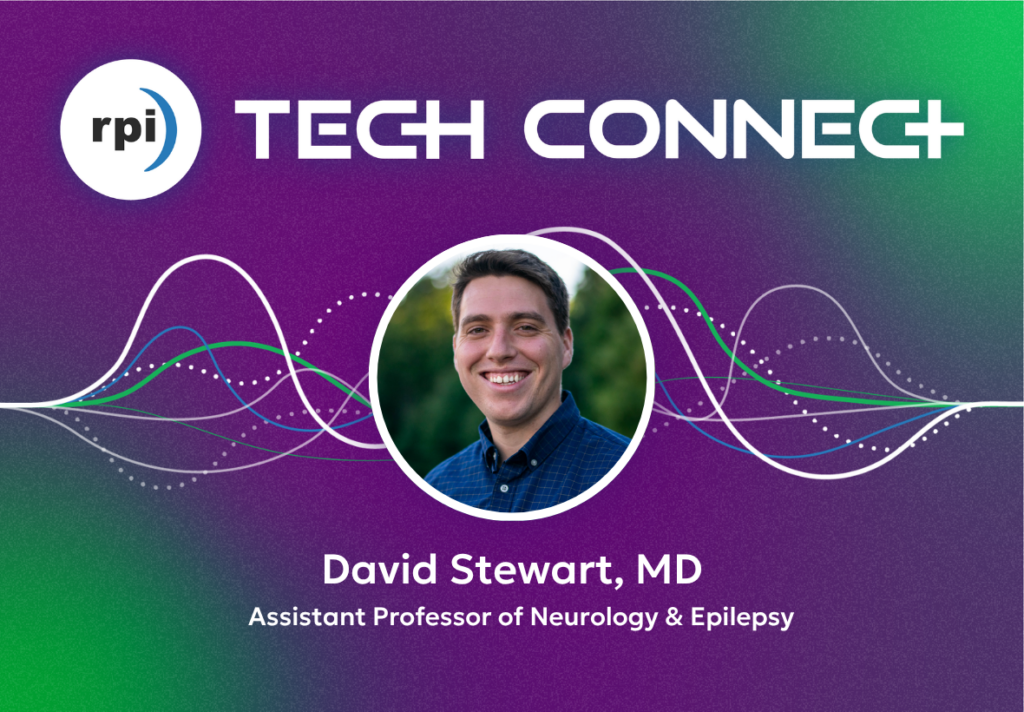
In this episode of RPI Tech Connect, board-certified neurologist and epilepsy specialist Dr. David Stewart shares how AI shows up in his daily practice, from dictation tools that let him face patients instead of a screen to quantitative EEG software that helps him screen hours of brainwave data in minutes.
He explains why these tools work as a companion rather than a replacement, how they’re chipping away at the administrative burden behind physician burnout, and what clinicians should know before bringing AI into their own workflow.
If you’ve wondered what AI adoption looks like on the care delivery side of healthcare, this conversation offers a firsthand view.
Interested in listening to this episode on another streaming platform? Check out our directories on the WRKdefined network or watch the YouTube video below.
Meet Today’s Guest, David Stewart
Dr. David Stewart is a board-certified neurologist serving as an Assistant Professor of Neurology & Epilepsy at Temple University Hospital. He completed medical school at Duke University School of Medicine and trained in Neurology and Epilepsy at Johns Hopkins Hospital. He treats patients with acute and chronic neurologic conditions, particularly epilepsy, in the hospital and outpatient clinics, and interprets epilepsy diagnostic studies.
He has particular expertise in the use of AI as a care companion tool and in specific epilepsy/neurology topics such as diet and dementia in epilepsy. His passions involve providing compassionate clinical care to patients and educating the next generation of doctors.
Meet Your Host, Chris Arey
Chris Arey is a B2B marketing professional with nearly a decade of experience working in content creation, copywriting, SEO, website architecture, corporate branding, and social media. Beginning his career as an analyst before making a lateral move into marketing, he combines analytical thinking with creative flair—two fundamental qualities required in marketing.
With a Bachelor’s degree in English and certifications from the Digital Marketing Institute and HubSpot, Chris has spearheaded impactful content marketing initiatives, participated in corporate re-branding efforts, and collaborated with celebrity influencers. He has also worked with award-winning PR professionals to create unique, compelling campaigns that drove brand recognition and revenue growth for his previous employers.
Chris’ versatility is highlighted by his experience working across different industries, including HR, Tech, SaaS, and Consulting.
About RPI Tech Connect
RPI Tech Connect is the go-to podcast for catching up on the dynamic world of Enterprise Resource Planning (ERP). Join us as we discuss the future of ERPs, covering everything from best practices and organizational change to seamless cloud migration and optimizing applications. Plus, we’ll share predictions and insights of what to expect in the future world of ERPs.
RPI Tech Connect delivers relevant, valuable information in a digestible format. Through candid, genuine conversations and stories from the world of consulting, we aim to provide actionable steps to help you elevate your organization’s ERP. Whether you’re a seasoned professional or new to the ERP scene, our podcast ensures you’re well-equipped for success.
Tune in as we explore tips and tricks in the field of ERP consulting each week and subscribe below.

Transcript
Chris Arey
This is RPI Tech Connect, and I’m your host, Chris Arey. If you’ve been following along with this podcast, you know we spend a lot of time talking about AI and how it’s reshaping back-office operations for healthcare. Today’s episode is different in a meaningful way. My guest is coming from the actual patient delivery side of healthcare. He’s not optimizing back-office operations. He’s in the room with patients making clinical decisions, and AI is part of his toolkit.
Dr. David Stewart is a board-certified neurologist specializing in epilepsy and neurological care. David, it’s an absolute pleasure to have you on the show today.
Dave Stewart
Thanks for the introduction, Chris. I’m happy to be joining you on the pod. For your audience, like you mentioned, I’m a board-certified neurologist. I went to medical school at Duke and completed my neurology training here at Johns Hopkins in Baltimore. I work as an epileptologist. That’s just a big fancy word for someone who specializes in the diagnosis and treatment of epilepsy.
What that means on a daily basis is that I have a lot of clinical responsibilities that really divide into three contexts. I see patients in outpatient clinics where I’m their neurologist and I help to diagnose and manage their neurologic conditions, especially epilepsy, longitudinally. I also see patients in the hospital who are experiencing acute neurologic problems, or who are there to have workup for their epilepsy.
And the third part of that is I spend dedicated time interpreting EEGs, which is our main diagnostic tool in the world of epilepsy. We use that as part of our evaluation for epilepsy.
Chris Arey
Thanks for sharing your background there. I’m really looking forward to our conversation today. You’re not our typical type of guest, but I think your perspective is a valuable one, and it’s going to provide more color to this healthcare ecosystem that we spend so much time talking about. A great place to start with today’s discussion, and it sounds like you’ve touched on it a little bit already, but I really just want to hear more about your day to day. What does that look like?
Dave Stewart
In terms of what that looks like, there are three different contexts, and AI is interfacing with all of those. When I’m seeing patients in the clinic, I’m there to take a history, perform a physical exam, provide insight into what’s going on, and plan out the next steps for the workup of whatever problem they’re experiencing and the next steps in the management of that problem.
Where AI fits into that is that we have dictation tools, things like Abridge, but there are many others out there that will listen in on the conversation and help provide an outline of it, determining what’s relevant and not relevant. When I’m discussing what’s going on with the patient and providing that insight into what I think is happening, it can also provide a summary of that thought process that goes right into our note for the visit, which I can then edit. It can also provide patient instructions that go along with it, based on the instructions I’m giving the patient in real time.
That tool exists in the inpatient setting as well. As you can imagine, at a big hospital like Johns Hopkins or elsewhere, we as neurologists are seeing patients all over the hospital, and it’s a pretty high volume. So having a tool like that can help increase our speed of seeing patients, because you’re not spending as much time on the computer typing things up in between visits as you go from patient to patient.
And then in the third context, when I’m sitting down interpreting EEGs, an AI tool is right there with me the whole way to help make my EEG interpretation more reliable and effective, and most importantly, it helps the efficiency of that interpretation.
Chris Arey
Thank you for sharing all that. It’s interesting to hear you wear lots of different hats in the way you’re caring for patients. I want to talk a little bit now about EEG data, exactly what that is, and the role AI is playing in helping you interpret that data.
Dave Stewart
Something that someone may be more familiar with is an EKG. What that is, is just the electrical rhythm of the heart. An EEG is something very similar, but for the brain. That’s what EEG stands for: electroencephalogram. It’s just electrical activity of the brain. We put electrodes usually on the outside, on the scalp, and then we get an electrical signal that gets fed into our computer.
When we’re looking at an EEG, every page we’re looking at is 10 seconds of brainwave activity. As you can imagine, we have patients in the hospital with this on for days at a time, and when we’re reviewing that EEG, we’re reviewing 24 hours of data. Reviewing that, when every page is 10 seconds, can take a while to parse through page by page.
So a tool like Persyst, which is the name of the AI tool we use for EEG interpretation, really helps us parse through those long pieces of data and allows us to be more effective in the way we’re looking through it, and more efficient as well.
Chris Arey
Wow, that’s like having a real-time research assistant right there with you, sifting through the information and identifying the anomalies or trends or things that require further investigation. Is that accurate?
Dave Stewart
Yeah, it can direct you into parts of the EEG in real time. I actually prepared a couple of slides just to show examples of what that looks like in practice. Let me share my screen briefly.
Chris Arey
You’re one of the first guests to come to the show with prepared slides, so I applaud you for that.
Dave Stewart
So you’re able to see them? All right. What is Persyst? This is a quantitative tool that is a companion to what we’re using to review EEGs. As I mentioned, EEGs are a study that looks at the electrical activity in the brain. Much like any electrical activity, it’s composed of things like frequencies and amplitudes, or voltage. What Persyst does is it first filters that data, and then quantifies those frequencies and amplitudes over longer stretches of time than that 10-second chunk I was talking about.
How can that help? It allows us to quickly screen for seizures and show the seizure patterns. It can allow us to summarize and identify different places where there are seizure discharges, which can be important in figuring out why someone has epilepsy and where the seizures are coming from, or hone us in on subtle asymmetries. It allows for quicker screening of raw EEG and recognizing changes to an EEG over time.
Here’s an example of what an EEG looks like. This is 10 seconds of EEG. The blue is the left side of the brain, the red is the right. And that buildup of activity you’re seeing from the left side of the page to the right side of the page, that’s a seizure on EEG. So that’s what that looks like.
Chris Arey
What are the green lines down below?
Dave Stewart
We have the left, the right, and then the left and the middle, and the right and the middle. And then this is the green in the middle. The green at the bottom is what we call the vertex leads, so right over the middle of the brain. And then the bottom line is the EKG strip, the heart rhythm strip as well.
The nice thing is that this is a patient who was having very frequent seizures. You can imagine that counting each of those individually, page by page, can take quite some time. So this is a view of Persyst for the same patient I just showed you, and this is a two-hour time window. You can see a summary of the EEG over that two hours of time.
Dave Stewart
What Persyst does is it has its own formula to determine seizure probability, and that’s these big red bars at the top. Sometimes AI tools like Persyst can over- or undercall seizures. In terms of its own predictive ability for what is a seizure and what is not a seizure, it has some value, but of course it needs to be utilized by someone who can evaluate the raw EEG as well and confirm those things.
But even if the program itself is over- or undercalling a seizure, it gives you a lot of helpful ways to look at the data yourself and determine, for a specific patient, what their seizure pattern is, because it’ll have a signature on something like Persyst. These two rows at the bottom are rows that I found helpful for this specific patient to look at, to identify where their seizures are coming from and also when they’re having seizures. This allows you to just count: okay, they’ve had so many seizures per hour over long periods of time.
It allows you to screen for seizures in real time, especially for a patient who’s in the ICU. The majority of the time, an epilepsy specialist, someone who specializes in seizures, isn’t the one reviewing the EEG every single hour. They’re seeing many patients. They’re responsible for many EEGs. But the person who’s seeing the patient at the bedside, who has less training in this, if we give them what to look for on a tool like Persyst, they’re able to more frequently screen that Persyst data and utilize it to determine when another treatment is needed for the patient, and also to assess whether or not there’s been an impact from the treatment you’ve just delivered.
So that’s one way it’s really helpful. Here’s just another example. You can see here again on the left side, because it’s in blue, this is a seizure going off. You can identify it here on Persyst with the areas I’ve circled. It also allows you to look and see where the seizures are coming from. You can identify that on Persyst, as well as what frequencies are involved and how the seizure is evolving.
Dave Stewart
Persyst also allows you to make custom trends. Because it’s taking in all of this quantitative data, you can identify, for a patient, what their seizures look like and where they are occurring in the brain, and use that to build your own trends. For this patient, where I’m showing this custom trend here, all of the normal trends it gives you and the normal ways it screens for seizures weren’t effective for finding their seizures. But I was able to very quickly, just based on knowing what their EEG looks like, make my own custom tool for this one patient that you can then use to screen for seizures over time.
Chris Arey
Wow. Dude, that’s absolutely fascinating, what you just showed us there, so thank you. How long has a tool like that been around? Persyst.
Dave Stewart
We’ve had some degree of quantitative EEG for a few decades now, but really it’s exploded in the last decade, especially the last five years. What these tools are able to do, and the ways they’re able to help us deliver patient care and deliver it more efficiently, that’s all continuing to evolve.
Especially in the world of EEG, right now this is allowing us to go through EEG more quickly and more effectively. Still at this point, an epilepsy specialist, a human, is needed to interpret this data and provide that interpretation to patients and to the other providers taking care of patients.
But living in the world still today, there are a lot of areas, both within our country and especially if you look more broadly throughout the world, where there are deserts, where no neurologists may be available and certainly no epilepsy specialists. So the future of tools like this may be to expand the amount of care we can provide to those lower-resource settings where providers may not be as available. In the short term, that means making it more efficient and allowing providers at bigger centers to deliver care more broadly within their state or region. And in the future, as these tools progress, they may be able to do a lot of the legwork with that interpretation that they’re not currently doing. So that’s the next horizon for a tool like this.
It’s a very similar parallel to what we’re seeing in the world of radiology, the interpretation of imaging within the medical space. If you go to any kind of science museum in the country, there’s always this little section on AI, and it gives you 10 x-rays and asks, can you find all of the fractures? I think in the world of EEG and in the world of imaging, we’re not there yet. We’re still at a point where AI is a companion tool, where it can allow you to screen things more quickly and also be a fail-safe, a backup. If you’re not seeing it, if you miss it, if that seizure is occurring on one or two pages of EEG and you miss it when you’re screening, this tunes your eyes to look more closely at that part. Same thing in the world of radiology. That’s how I view it, and I think that’s the future of it as well.
Chris Arey
What a crazy valuable tool you just shared there. Just seeing the first page of the reading, only 10 seconds, and then the next thing you showed was two hours.
Dave Stewart
Yeah, and you can stretch that out to 12 hours, and that can be really helpful. When our eyes are trained, you’re trucking along through all of that data over that 12 or 24 hours, and you may not notice if things are very slowly changing. Just like if someone is losing weight very slowly, you might not realize how much they lost. It’s the same thing. But when you can put that up to a 12-hour or 24-hour time window, you may be able to pick up that maybe this part of the brain is slower, not working as well. And that can affect treatment for a patient. You can identify things like vasospasm in the brain, where a blood vessel is tightening down and that needs to be treated urgently. So tools like this actually are part of the way we’re delivering care in real time.
Chris Arey
Wow. Well, Dave, that’s absolutely fascinating, so thank you for walking me through that. I can’t even quantify the amount I’m learning from this discussion, but thank you.
I want to take a step back and move a little bit away from the tech side of things and hear more about healthcare in 2026. RPI Tech Connect is a podcast that’s taken a lot of deep dives into different parts of the healthcare space. But one thing in particular that I want to talk about with you today is the environment that’s changing. Paint me a picture of what’s going on in healthcare. I know there have been staffing shortages and things like that.
Dave Stewart
From a patient perspective, even if you’re not someone in healthcare as a provider, you’re feeling this. You feel those wait times. It may take you six to 12 months to see a neurologist, as an example, and that number stretches out further depending on where you are in the country. There are areas where there may be no providers near you.
Despite relative stagnation in the workforce within medicine, at least when you compare it to the explosion in how many patients there are, when you compare those things, you start to realize why there are these long delays to care, and why providers are needing to see patients in much shorter time windows and not being given as much time to spend with them. I think that puts a strain on us as providers in order to feel like we’re providing the care we want to provide to our patients. And patients are feeling that strain as well.
While some of this may change with additional funding into these sorts of things, we already are the country that spends the most on healthcare. So we need to find solutions that enable us to deliver healthcare more effectively and efficiently, while retaining the human touch that patients need to feel like they’re being well treated and actually cared for. That’s half of what we do as providers. Delivering care is delivering that kind of care. That’s something AI can help us do, but it can’t do itself. That’s why we’re still always going to be needed.
Chris Arey
You mentioned something earlier in our segment about the dictation tool. With the staffing shortages and providers needing to see more patients, I imagine a tool like that is having an impact on your ability to do more with fewer resources. Can you share?
Dave Stewart
If you think about it, 30 or 40 years ago, before the advent of the electronic medical record, you went in to see a doctor. They took a few notes on their notepad during the visit and wrote a few orders. That was the extent of charting and order signing and everything.
Now, the electronic medical record provides a lot of benefits. It’s visible, it’s there, it’s accessible at times for other care providers and for the future. But it also has put a lot more onus on the providers. The amount we need to document has continued to expand and expand. That’s for billing, that’s for insurance to actually cover the things you want to do for a patient.
Up until recently, what that ended up meaning in practice is either a lot more time during a visit where you’re typing and not looking at the patient, or typing and kind of looking over at the patient, and still also having, at times, hours after you’re done with your whole day spent finishing charting and responding to messages.
Where AI dictation tools fit in is that, while there are human medical scribes who were doing this role before, that’s not something most providers can afford. This allows for a more affordable tool, where you essentially have the dictation software running and it helps build the note for you in a way that is useful for other providers and useful for making sure your things are being covered by insurance.
What I love about it is the same thing that patients have told me, which is that now I’m sitting facing the patient again, with my pen and paper, and I don’t have to worry about putting everything in the computer. I think it gives us a little bit more of that face-to-face time with patients.
Chris Arey
You can be present and really hear them.
Dave Stewart
It helps. I’ve seen a difference.
Chris Arey
Is a tool like that just, you turn on a microphone and it’s listening to the conversation in the room?
Dave Stewart
Yeah, that’s part of it. We get consent from patients, telling them I have this new tool, here are the benefits of it. It’s all HIPAA protected, so the recordings all stay within the medical chart. It gives you a transcript of the recordings, so if in its summary you feel like you missed something and you didn’t write it down, you can actually go back and look at the transcript of the conversation. So that’s really useful.
Chris Arey
Nice, very useful.
Dave Stewart
Very useful, and it has all sorts of different things that it’s building out. Like I said earlier, it can give patient instructions written out for the patient that you can copy and paste into the patient’s note for the day that you’re handing them at the end of the visit. So it can be a really helpful tool. Those who have been watching The Pitt have seen it is not without its pitfalls. You still have to edit it.
Chris Arey
Is that a pun intended?
Dave Stewart
It gives you a nice base framework. The other thing there is that it’s as good as you make it. The tools will grow with you, and they’ll get used to the way that you do things and get better at dictating. There are a lot of different ways you can hone in on it and allow it to do a better job of dictating as well.
Chris Arey
It’s so fascinating to hear about your experience with AI, because on this show we’ve talked about the tools of AI as a concept and as a way to help reduce administrative burden on teams that are feeling the pressure. It’s awesome to hear that you’re living that dynamic in such a meaningful way. You’re out there providing such important care to patients, and little tools like this are making such a massive impact, it sounds like.
Dave Stewart
Yeah, I think so. And I think the impact they have is only going to continue to grow. Right now we’re using dictation tools like this pretty widely. But for each individual tool, each individual way that we interface with patients or conduct our medical care, adjunct tools utilizing AI are being added on a daily basis.
As an example, one of the other major changes with the electronic medical record is the way we’re interfacing with our patients between appointments. For those who have Epic or whatever other MyChart they’re using to send messages to their providers, every single time you send a message to a provider, that’s five to 15 minutes of them reading through the message, reading through your chart, and providing advice. None of that’s billed to insurance or anything like that.
So while we want to provide real-time help to our patients, that does end up adding up. You can imagine that’s anywhere from two to three hours a day at times, on days where your inbox is really full. Tools that can help screen these messages and put together a preliminary response that you then edit with your own medical interpretation can cut down on those times and allow us to continue to provide real-time help to our patients without having quite as much burden after we’re done with our normal clinical responsibilities for the day.
Chris Arey
We’ve talked now about some of the various use cases of AI in patient care, and they all sound significant. Hearing about AI in patient care might be startling to some. For those who are maybe skeptical about this partnership, this two-way relationship, what kind of reassurances do you have to share that AI is a tool and not a replacement? What confidence can you instill?
Dave Stewart
I think that’s a good question. The main thing is that our goals as providers are always the same. Our goals are always to do the best job we can to provide the level of care and expertise we can for our patients. And AI is not dictating that care. It is not driving things. That’s still being driven by providers who have gone through usually more than a decade of training.
What these tools allow us to do, though, is account for the fact that we all are human, and there are things that we may all miss. It can be a fail-safe, like I was talking about with the quantitative EEG software, where it puts something else there that a provider can look at to make sure they’re not missing anything.
The other piece of it is that, like I was saying earlier, while we may worry about the way that tech and AI is infiltrating all parts of our lives, I’m viewing these tools as a way for me to get more face time with patients, more of that direct one-on-one care. I hope that the public will see that over the next few years, as these become more implemented into the day-to-day for providers, that they’re getting a little bit more of that face time back with their providers. That ultimately is what I’d like to see happen within medicine.
Chris Arey
I think that’s a really awesome perspective you have on AI in general, and the way it’s enabling you to reach your goals as a provider with greater ease. It very much is reducing some of the administrative burden and allowing you to have more face time with patients, and to be able to deliver care that’s meaningful, where people feel like you care.
Dave Stewart
Patients want that, but providers want that too. Spending the time with patients, talking to patients, that’s not what makes physicians burn out. It is all of these administrative tasks that you’re talking about. It is arguing with insurance about insurance approval for medications. It is the hours of documentation that we have to do after visits.
Chris Arey
That’s why you got into this business.
Dave Stewart
That’s the sort of stuff that leads mostly to burnout, I think. And that is what I view AI as helping us tackle, taking some of that off of our plates and, at the very least, making what is on our plates a more approachable task to complete.
Chris Arey
That’s inspiring to hear, honestly, because a lot of times you talk to folks and AI is a scary topic. It’s something we’ve talked about at length on this show, but the way you’re viewing it, and how it’s helping you do what you always wanted to do, is great. Very positive. I like that.
Last question for you, we’re getting close to time. For clinicians and healthcare administrators listening in who are maybe thinking about how AI fits into their world, what advice would you offer them?
Dave Stewart
The advice I’d offer them is the same advice I offer the medical students and residents I help teach these tools to, which is that I would welcome these tools. View them as a way for you to get that face time back with your patients, but know that the tools are only going to be as good as how you make them. It’s very easy to get frustrated when you’re thinking, this is messing up, look how bad of a history it wrote down for me. But some of that is just like any other tool. You have to learn how to make it work for you.
For each of these things, I have a set of things that I tell people. As an example, for our dictation tool, when I am seeing patients and getting a history from them, I do a lot of summative statements. If they’re giving me a long, rambling response where we’re weaving between topics, at the end of that, every few minutes or so, I may offer a summation line. Or if they’re describing one of their seizures, or acting one of the seizures out, I will explain what I’m seeing, in the way that I would write it down, out loud for the dictation software to hear.
These sorts of things that you can use to tweak it enable it to provide a better service to you and make it more effective. For each of these tools, there are a handful of different tips and tricks that you can use. If you work through it over time, you’ll find that it does a better job.
Chris Arey
That’s advice I’ve heard across industries, that AI is only as good as your ability to use it. Is that right?
Dave Stewart
Yes. And like any tool, use it responsibly. Know what its limitations are, just like you should know what your limitations are as a provider. And make sure you’re using the appropriate tool for the appropriate context. I would say that’s the last thing I would have in terms of responsible AI use in healthcare.
Chris Arey
Awesome. Well, thank you, Dave. This has been an enlightening conversation. I’ve learned a tremendous amount on today’s call, and I appreciate you taking time out of your schedule to talk through this.
For those of you listening in, if you have any questions about today’s conversation, or you want to learn more about how AI can fit into your world, we would love to hear from you. You can contact us at podcast@rpic.com. Again, that’s podcast@rpic.com.
Dave Stewart
Yeah, of course, anytime.
Chris Arey
This has been RPI Tech Connect, and we’ll see you next time. Thanks, Dave.