AI agents promise big savings but bolting them onto messy processes is a fast way to burn money.
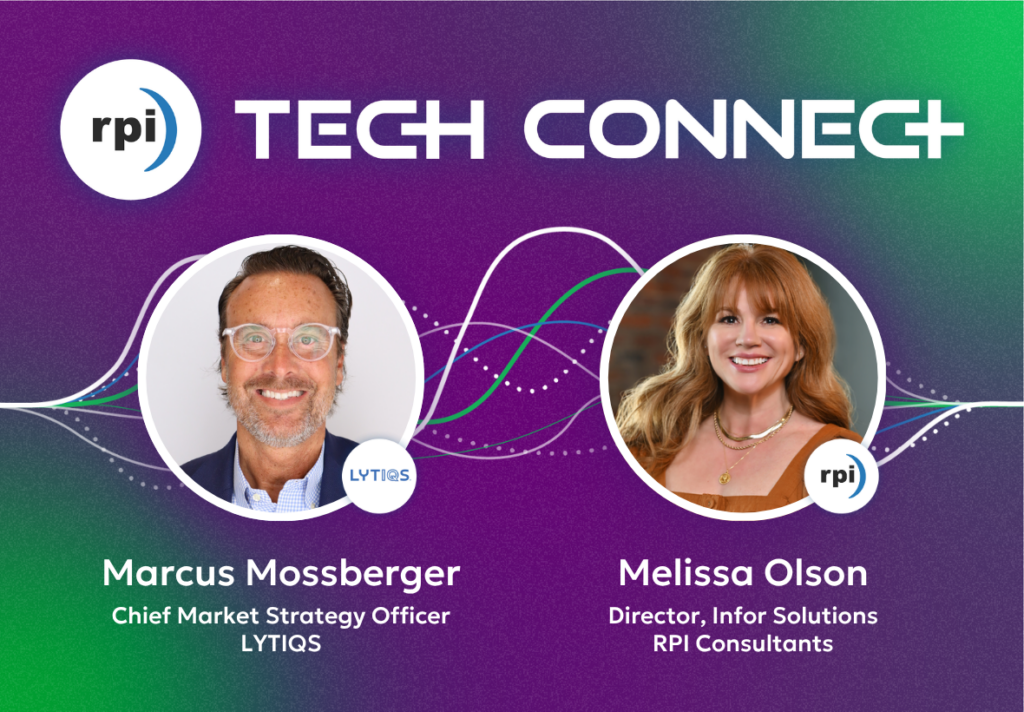
In this episode of RPI Tech Connect, Marcus Mossberger of LYTIQS and Melissa Olson, Director of Infor Solutions at RPI Consultants, break down why strategic workforce planning is now urgent for any organization weighing agentic AI.
They explain why standardized processes have to come before automation, how to balance the real cost of tokens against full-time talent, and why modeling multiple futures beats trying to predict one. As Marcus puts it, you can’t be right anymore. You have to be ready.
If strategic workforce planning is on your radar, or your finance team is already counting the savings from AI agents, this episode is the place to start.
Interested in listening to this episode on another streaming platform? Check out our directories on the WRKdefined network or watch the YouTube video below.
Meet Today’s Guest, Marcus Mossberger
As AI dominates headlines and the future feels uncertain, Marcus Mossberger is focusing on how today’s transformations can improve people’s lives at work. His genuine passion comes from time spent in a variety of disciplines including HR, strategy, marketing, product management and sales.
Marcus is frequently featured in publications and at industry events, as he consistently contributes thought-provoking ideas about the future of work. Today, his focus at LYTIQS is to channel his years of experience into redesigning how organizations plan, deploy and invest in their people.
Meet Today’s Guest, Melissa Olson
As RPI’s Director of Infor Solutions, Melissa Olson has been at the forefront of massive Infor CloudSuite and legacy Lawson implementations for well over a decade. Nowadays, you are likely to find Melissa in the role of Executive Oversight ensuring quality in HR Talent implementations and out in the community presenting, demonstrating, and connecting with clients.
Over the last 20 years of Melissa’s career, she has modified the Lawson code set as a programmer for a transportation agency, led an North American HCM implementation while tending to her day job as a HR Business Partner for a marketing and merchandising firm and built an HCM Practice with RPI from scratch while consulting.
With her unique mix of experience understanding organizational needs, deep knowledge of Infor People Solutions, and the boundaries of the Infor technical extension toolset, Melissa enjoys tackling organizational problems with solutions that are process focused more so than product focused.
Meet Your Host, Chris Arey
Chris Arey is a B2B marketing professional with nearly a decade of experience working in content creation, copywriting, SEO, website architecture, corporate branding, and social media. Beginning his career as an analyst before making a lateral move into marketing, he combines analytical thinking with creative flair—two fundamental qualities required in marketing.
With a Bachelor’s degree in English and certifications from the Digital Marketing Institute and HubSpot, Chris has spearheaded impactful content marketing initiatives, participated in corporate re-branding efforts, and collaborated with celebrity influencers. He has also worked with award-winning PR professionals to create unique, compelling campaigns that drove brand recognition and revenue growth for his previous employers.
Chris’ versatility is highlighted by his experience working across different industries, including HR, Tech, SaaS, and Consulting.
Show Notes:
About RPI Tech Connect
RPI Tech Connect is the go-to podcast for catching up on the dynamic world of Enterprise Resource Planning (ERP). Join us as we discuss the future of ERPs, covering everything from best practices and organizational change to seamless cloud migration and optimizing applications. Plus, we’ll share predictions and insights of what to expect in the future world of ERPs.
RPI Tech Connect delivers relevant, valuable information in a digestible format. Through candid, genuine conversations and stories from the world of consulting, we aim to provide actionable steps to help you elevate your organization’s ERP. Whether you’re a seasoned professional or new to the ERP scene, our podcast ensures you’re well-equipped for success.
Tune in as we explore tips and tricks in the field of ERP consulting each week and subscribe below.

Transcript
Chris Arey
We are back, ladies and gentlemen, for another exciting episode of RPI Tech Connect. I’m your host, Chris Arey, and today I’m joined by Marcus Mossberger of LYTIQS and Melissa Olson, Director of Infor Solutions here at RPI. For our session this morning, we’re going to be talking about something that’s moving very fast, and that is AI agents. Specifically, we’ll be talking about the cost, the impact that they’re having, and how organizations can start planning their future workforce around them.
So Marcus and Melissa, welcome back to the show. It’s been a minute.
Melissa Olson
Yeah, it has.
Marcus Mossberger
Thanks, Chris.
Chris Arey
So Marcus, let’s start with you real quick. Let’s set the stage. When you talk to HR and finance leaders right now, how are they describing what’s happening with AI agents and their workforce?
Marcus Mossberger
I think right now, Chris, they’re really in this exploratory phase. And I would even add IT to that mix too, because you’ve got HR leaders that are recognizing, okay, work is changing. We’re not only going to augment work, but we’re going to automate a lot of it.
What’s available? What’s out there? What’s it actually capable of doing? That’s the big question right now, Chris. What is AI actually capable of doing? There’s immense promise, but tangible ROI continues to lack.
And then the finance folks are like, wait a minute, are you saying I could use all these agents to do a huge portion of the work? And they’re counting the money already, like, this is amazing. We’re going to be so much more productive and so much more efficient. And then the IT guy gets involved and goes, okay, hold on.
Let’s see how this actually works, how it works with our existing infrastructure and our existing technology. And then the last piece, and I’m curious to hear Melissa’s point of view on this, is the people that are doing the work. I guess you would call them operations folks. Somebody needs to dig into the actual processes and the workflows and identify where we’re inserting these agents, and make sure that we understand how they will be supervised so that they’re not giving away products or saying crazy things to customers or whatever it is. So it’s so early days, it’s absolutely fascinating. I’m still very optimistic about the future, but it’s messy right now.
Melissa Olson
It really is. I think a lot of people have been trying to figure out how do we get value from AI, and the last couple of years have been about where are the use cases in the Infor software? Where are the use cases on the people side? There have been some great use cases on the supply chain and finance side, but because we’re people, all of our processes are not always exactly the same. There are always exceptions to most of the processes within HR. And when you have those exceptions, it’s harder for the RPA type of process, the process mining side of it.
But now that we get into the agentic side, we can start training. I was having a conversation with a client about this yesterday. We have policies. Humans don’t necessarily decide what to do when an approval comes to them; they’re interpreting the policy. So as agentic comes in, those agents can be trained on these policies, but there should always be oversight. And I think in the HR area, humans will always still be a part of it. So it might be these hybrid processes. What are the areas that we can have agents tactically complete? Because every HR professional I talk to on the client side has all these initiatives and they can’t get to them. They’re either trying to fix the processes, or get to the data and track the data they need in the system, or they’re just inundated with requests, everyday daily operations work. So this will finally free up those professionals to do some more strategic planning for their workforces.
Marcus Mossberger
One thing I want to point out that you said, Melissa, that’s really key, is this is a lot easier if you have standardization and consistency in your processes and your workflows. And a lot of organizations don’t, which is actually where I think Infor’s process mining tools become incredibly valuable, because that gives people insight into, ooh, yeah, there’s not a whole lot of consistency in how these things happen today. So until it becomes more consistent and standardized, it’s going to be harder to automate.
Melissa Olson
Yeah, and you even think about most organizations. All of these employees are legacy employees, so they get specific different treatment. And union employees, the contracts have been changed and those need to be updated. So there’s just so much movement. Even negotiations from leaders, negotiated rates, negotiated accruals. There are so many exceptions that it’s even hard to automate the processes in the software we have today. So what do you think, Marcus? Should they get to a standardization? I mean, we’re still talking about people. Do you think that should be the direction, or do we keep that exception-based, you know, people are special? We treat them specially when we hire them. They are the little pearl in the oyster. And that’s what HR is all about doing, trying to ensure that the employees feel appreciated, they feel valued, they feel they are compensated.
Marcus Mossberger
Yeah, I think the answer is both, Melissa. I think you need some degree of standardization where you’ve got a general track that you keep people on, but then there’s flexibility within that, because I do think people are expecting a little bit more of what I’ll call personalization in their experience at work. We experience a lot of personalization in our consumer lives, right? And I think we’re starting to see that expectation gravitate into our work life too. I don’t want to be treated just like Melissa, because I have different skills, abilities, a different personality, different preferences. And so that should come into consideration when we set these things up. So it’s a delicate balancing act, and it’s a bit of an art form, isn’t it?
Melissa Olson
It is. It’s what we kind of try and do in implementation, right? We try and standardize as much as we can. But we understand culture at the organization, and there are just a lot of factors that go into why not. So this’ll be one more shot at, hey, if you want to automate with agentic AI, then you need a little bit more standardization, or you need a lot more oversight over those agents.
Chris Arey
So we’re talking here about the impact that the AI agents are having in the workforce. And if I’m hearing y’all correctly, it’s that before you even get to a place where you’re inserting that into your workflows, you need to do some work up front, standardizing. Is that correct?
Melissa Olson
Yes.
Chris Arey
And Marcus, in your experience, I believe you mentioned a stat when we chatted previously, that a lot of companies right now aren’t really planning around agentic AI in their workforce and they should be. Is that right?
Marcus Mossberger
I think in general, what we’re seeing is that a lot of organizations aren’t thinking far enough into the future when it comes to what we refer to as strategic workforce planning. Recognizing and understanding that as AI capabilities continue to evolve, and they are, like daily, they’re getting better and better, that is going to have significant implications for your workforce.
So more and more of the tasks associated with certain jobs will be taken away and given to agentic AI. And so how do you then plan for the future relative to what becomes of that role if 40% of the tasks are now done by technology? Does the role get combined with another role in the organization? Does it go away? Does it become something completely different? So what we’re suggesting organizations start to think about is doing some scenario planning and modeling for the different futures.
It’s kind of funny. Melissa and I have been around long enough to remember, well, we just need the right person in the right role at the right time, at the right cost, with the right training. And you know what? I don’t think we can be right anymore, because we live in such a constantly changing world. We have to be ready instead of right. And ready means being ready for a variety of futures. So that’s again where we’re going to have to make sure we’re bringing people into the organization that can be adaptable and move around based on the changing needs of the organization. So it’s kind of funny, Chris, you’ve got to plan for the future, model these scenarios, but then be really flexible when the future shifts, and it inevitably will, won’t it?
Chris Arey
I really like that framing around not being right but being ready, because with the rate that AI is changing, it’s really hard to predict any one future. So you’ve got to predict a number of different scenarios. So I really like that. I want to talk now about something that you alluded to earlier, with the finance team getting excited about hearing that we’re going to save money because agentic AI is going to take over that task. But that brings up this conversation between talent versus tokens. And I think the reality is that tokens can be quite expensive, maybe so much so that they cost more than a full-time employee. What can you share?
Marcus Mossberger
Yeah, this is where again it’s a balancing act of how much do we invest in AI and AI infrastructure. And this is where there have been a lot of high headlines in the media about organizations that are laying off their workforce, in large part because I need money to go set the AI infrastructure up to buy the tokens. So this constant balancing act of talent versus tokens, Chris, I think what we’re seeing is it’s a bit of a pendulum, right? And I think right now you’re seeing a lot of organizations that have over-rotated to AI and have maybe some unrealistic expectations of how much they’re truly going to be able to automate. And I think it’s going to come back to an appropriate balance of, yes, you do have the ability to invest in AI to automate and augment a lot of what’s going on in terms of the work today, but the human piece is not going to go away.
It’s a matter of figuring out what is the appropriate balance for your organization. Melissa, you mentioned culture a few minutes ago. That has a huge impact on how organizations do this. And you’re seeing some with that kind of culture go, we’re all into AI and we’re letting everybody go. And then they realize, crap, we may have jumped up too soon into that. So I think this is where organizations are starting to experiment. Melissa, what are you seeing in terms of organizations trying to get that balancing act right?
Melissa Olson
Yeah, there are a couple of things, right? It’s both the Infor-delivered AI products, the Velocity suite, the process mining, the GenAI. Our Connect conference was last week, and there was a lot of buzz around the agents that had not been there previously. So there’s that discussion, but prior to that, there was the regular GPT, Claude. How are these organizations bringing them in? And they’re so excited about it. They think it’s going to be positive on their people, on their processes. People are excited to use it, from what I’ve heard. But again, there’s no standardization across it, right? So last year we had DOD issues with OpenAI, and this year it’s Anthropic with Fable 5. And if you do all of your development with one LLM, what happens when that LLM is canceled? You’re going to move to the next one, but now you’ve invested millions in Anthropic or OpenAI or Gemini or whatever it may be.
I think there is a push to have internal LLMs. I mean, that’s the safest thing, building them out, but that’s where the cost comes from. You’re not going to find somebody in your IT department that’s going to build out and tag and be able to build out all of your data within an LLM to be able to leverage without external company LLMs coming in. You’re still using tokens when you’re doing that. It’s just you’re not paying somebody else, you’re paying NVIDIA, you’re paying wherever you’re hosting it.
So it’s so early days, but I haven’t seen the trepidation that I expected to see around it. There are a lot of people that I’ve talked to that are going forward, and their organization supports either use of those other products. And then they’re really looking into how can we bring in the Velocity suite. How can we leverage it? Are we going to get this value? And I think Infor is trying to price things in a way that gives organizations a chance to try it, to build some things out with a limited amount of tokens within their license. And then if it works and they can build those business cases, then they subscribe to it, which is the FTE of a C-suite pretty much.
Melissa Olson
But if you really think about it like an FTE, and you really are looking at how much across the organization, can you quantify how much across the organization is being done with it, and does it equate to one leader’s FTE? I don’t know. Or maybe that’s two, maybe that’s three FTE if you divide that subscription cost out into salaries and benefits and all the other things. I think organizations should be looking at it that way, versus looking at it like it’s an extra X hundred grand on top of my licensing fees, right?
Chris Arey
For organizations that are listening in and wondering, how do I find the balance between tokens and talent, and what’s the right spread of each, that sounds like something that they need to be planning for, but that sounds like a difficult thing to do. Any thoughts or recommendations, best practice on how to begin that kind of process, Marcus?
Marcus Mossberger
Yeah, I think, well, Melissa, you started the conversation talking about value, right? And how do we quantify whether or not we’re getting value from AI. So I think we have to try to figure that out up front. And again, I think what’s happening is there’s maybe a misunderstanding that, well, we’ll just make these investments in AI and then we can let a bunch of people go, and that’s going to save us a ton of money. But those investments in AI are turning out to be as expensive, if not more so, than the actual people themselves.
Now, I think what organizations are betting on is that, yes, I’m making a ton of investment right now in AI, but that will come down over time, right? Which we historically do see. And I think that’s an appropriate expectation. The question is, how quickly does it come down and how far does it come down? And then at that point, will those investments have made sense for the value and the ROI we’re going to get out of them?
So I think that’s the debate and discussion that’s happening between HR and finance and IT: okay, how much should we be betting on this, knowing that it’s not actually fully baked yet and we don’t know exactly how much value we’re going to get? So I think that comes back to that scenario planning and modeling, and saying, okay, let’s assume this is going to happen and then let’s track that over time. Chris, this stuff used to happen once a year. It was funny, I was just talking to my wife about this the other night. She used to be in finance. And she was like, I remember when we used to do headcount planning, we wouldn’t even involve HR. We would just do it from a budgetary perspective, right? And it would be once a year, and we would control all of these people and all of these seats in the organization and then distribute the plan. And now it’s like it can’t be annual. It’s literally ongoing conversations about shifting people from here to here.
And understanding things, Chris, like the AI exposure rates in specific roles in the organization. That’s a new conversation that we’re having with organizations. If you look at this role, this one is very vulnerable to AI, meaning we’re probably going to take a lot of the tasks associated with that job and give them to AI. So let’s plan ahead for what we’re going to do with those individuals. Does that make sense?
Chris Arey
It does, yeah. I like that term of AI exposure too. Understanding it contextually here, it’s the types of roles that’ll be more susceptible to work being replaced by AI. Is that correct?
Marcus Mossberger
That’s exactly right.
Chris Arey
What a dystopian time. I mean, I have to call that out, right? We can’t ignore that we’re having a conversation right now about companies that are reducing their headcount in lieu of tokens, and it’s wild. I’m sorry.
Marcus Mossberger
No, using that term, dystopian, is appropriate. It’s made me recently, I literally went and got 1984, the book. I went and got Brave New World. I read that again. It’s wild to read these books that talked about this dystopian future and see some of this come to fruition. Having said that, again, I think the media is trying to sell papers and sell ads. And so I think there’s more made of it than needs to be. And I think what you’re seeing is some of that get pulled back in an acknowledgement. Maybe there’s not going to be a jobpocalypse. We are going to probably still have work to do. We’re not all going to be moving to universal basic income anytime soon. But it’s going to be different. And that’s, I think, the hardest part. That’s actually what I think is going to slow us all down the most, Melissa: the people side.
It’s what people historically refer to as change management. And I’ve mentioned before, it’s not change management, it’s change enablement. But is that what you’re seeing too, relative to how do we embrace some of this in a way that’s meaningful when the people side is going to slow us down?
Melissa Olson
Yeah, and it’s the dystopian, but it’s almost like we don’t know what it’s going to be. There’s some level, well, I think back to the other times something like this has happened at a lower level. It’s like the dot-com era, there’s just this explosion of new industry. We didn’t have hundreds of Amazon warehouses or distribution warehouses everywhere before Amazon, Kindle, whatever. So that all created a whole new industry.
So now there’s FedEx. You used to work for FedEx or UPS and you had a certain number of routes and they had a certain number of employees. But once the internet, dot-com boom, whatever we want to call it, happened, and everybody’s just doing next-day shipping, then those organizations just grew exponentially. So some brick and mortar will probably still grow. I don’t know if you know the stat, Marcus, about how many workers are deskless. They’re not in front of a computer. Infor was talking about this. How do we make the experience, the mobile experience, more unified and less clicks? But all of those deskless employees are not going to be replaced by AI.
Our healthcare workers, our transportation drivers, our mechanics. I’ve seen a swing back into vocational schooling for kids coming out of high school, because that is the one true thing that’s going to be there. So I think there is some security in knowing there are things that won’t change. And if you wanted that secure path, instead of joining the government and putting your forty years in for that pension, now it’s these vocational and deskless jobs that give you that security.
So yeah, I don’t know about the change within organizations, how they’re going to approach it. I think we’ve had this conversation around your software, Marcus, around how we’re going to have to reclassify jobs all the time. That’s going to be a new task that HR is going to have to be doing, and a human is going to have to do that, because they’re going to have to determine how has this job changed. I need to rewrite it, I need to reclassify it, what does it become? Is it still exempt, is it non-exempt? So there’s a lot of that type of work that will be happening. But who knows, AI might take that over too. I think we can talk all day about all of the ramifications that we’ll be seeing in the workplace.
Marcus Mossberger
The deskless workforce, I think, is an appropriate thing that you hit on, Melissa. And my understanding is the statistic is eighty percent of jobs on this planet are deskless, shift-based, hourly. That again, you’re seeing a bit of an explosion. And I don’t know if you saw what Meta’s doing now, their new training program. I can’t remember what they call it, like the American worker investment. I don’t know. But they are basically saying, we will fly you to training facilities, we will pay you for weeks and weeks of training. So you’ll get paid while you’re in training. We will guarantee you a job.
And it’s all around things like welding and electricians. It’s the stuff that they need to literally build the physical infrastructure to create these data centers. And so Meta’s like, I will guarantee you a job. I will pay for your housing. Because they recognize that, again, they’re going to need to continue to invest in people. But you also said something else that I think is interesting and important, and that is that HR is going to have to take on a different role in this new world. I think historically, and I’ve said this for a long time, that HR has the opportunity to move from being this administrative, transactional function focused on compliance to one that’s actually quite strategic. And one of the things I heard somebody else say the other day, I heard them say, HR needs to step up and say, I own the workforce.
It is my purview. It is my responsibility. It is not you, no offense, in finance. It’s not you in IT, although you’re going to supplement the workforce with some agents, and I appreciate that. But this is mine, and they need to step up and own it. And in more sophisticated organizations, you’re starting to see that, which I totally dig.
Chris Arey
Hell yeah. Let’s go.
Melissa Olson
I can keep going, but I know we’ll go into so many different directions. So I think, I know we want to have a little bit of a structure around this, because I represent RPI and Infor, you’re representing LYTIQS, and the tool sets that we’re trying to just get people either excited about, or learn about if they’re scared or they’re like, this is way too expensive. I think it’s all an educational period.
Marcus, your LYTIQS, we’ve spent a lot of time with it, and you’re giving all of the insights to make those decisions, right? It’s like, what does this workforce look like here? And if we had to make cuts, what are the types of roles that should be cut and what should be moved? And it’s not even roles that are cut, it’s like the budget changes, it shifts. So where do we move these people and what do their roles need to become? And I can’t make those decisions based on gut or whether I like you or not. It’s data-based.
And I know LYTIQS has something that I’ve never seen before, and it marries that finance and that HR and gives executives and leaders the insights into what they need to be able to do that, that is based on data that is quantifiable, that is bringing the skills in, knowing who your people are and what they can do and where to move them. So having those tools, having tools in Infor, I think that is going to elevate HR and the HR function for sure.
Marcus Mossberger
I agree. I think it’s the combination of the data points and it’s the signals. It’s the workforce-related signals that are out there outside of your systems, like in labor market data, inside your Infor systems, inside other ancillary systems. It’s aggregating that in a way that gives you those insights, as you said. So that, Melissa, you can avoid cuts to begin with. We’re hearing a lot about layoffs. Layoffs are a result of poor planning. Okay? That’s it.
That’s an oversimplification, I admit. But if you are good about understanding these different scenarios and models that you might expect, and then you track the progress toward them, then you pivot and you move this direction before you have to get to a mass layoff. These organizations so frequently are just lazy in not doing that planning, and then they have to make these huge cuts. So if you’re good about this from the beginning, you’ll never have to get to that point. That doesn’t mean you don’t have to redirect resources, and it doesn’t mean that it’s not complex. It certainly is. But it’s just a matter of being able to create that agility in your organization, but doing it from a data-driven perspective. You used that word multiple times, Melissa, and I appreciate that.
Melissa Olson
Yeah. It’s the only thing we could trust right now.
Chris Arey
I’m glad you brought up solutioning, Melissa, because we’ve been talking about workforce planning and modeling different scenarios and bringing in finance and IT and HR working together. So Marcus, I am curious to hear, does LYTIQS do those things? What does the solution do? It’s your thirty-second sales pitch.
Marcus Mossberger
Yeah, we do. I mean, at the end of the day, it’s about taking a people analytics platform, what we would call kind of a workforce intelligence platform, collecting all of the data, all of those signals from all over the place. And then we actually have the ability to use AI. It’s kind of funny, Chris. We’re actually using AI to plan for AI, because we’re aggregating all of this and then running these scenarios to see, in a strategic workforce planning perspective, what if this happens? What if this happens? And again, we’re combining workforce data with financial data, with operational data.
In the world of healthcare, for instance, we want to understand the clinical side of things and the implications for decisions that are made. And then we can figure out, okay, how do we adapt and change based on those different scenarios and models. So again, it’s far from perfect. Nobody can predict the future, right? That’s why we can’t be right. We have to be ready. And so that means aggregating all of this data in a meaningful way. And what’s remarkable, Chris, is that according to our friends at Gartner, 86% of organizations don’t do any form of strategic workforce planning. That’s got to change. It will change, because those organizations that don’t do it will continue to see mass layoffs, they’ll continue to make bad decisions, and they might not find themselves in existence anymore because they’re not planning for the future.
Chris Arey
That’s that stat I was looking for earlier. Eighty-six percent, or not ten. That’s a crazy high number.
Melissa Olson
Almost. Pretty surreal.
Marcus Mossberger
It is. And I think that’s going to change. It’s kind of like that Marshall Goldsmith book, What Got You Here Won’t Get You There. It’s actually a pretty good book. It’s a little bit older, but it’s basically like, hey, what you’ve been doing in the past is just not going to be good enough in the future. This is a very different world that we’re going to live in, in the next, not five years, in the next like one and two years.
Chris Arey
People need to start taking action now. This is not something they can put off. That’s what I’m hearing. Very good. Melissa, anything to add about solutioning?
Melissa Olson
No, I think it’s just the education, right? Whether it’s in the Infor tool and Birst analytics, or workforce, any kind of analytics coming out of WFM, or it’s LYTIQS, or there’s other tools out there, have those conversations, understand what workforce planning means, strategic workforce planning, what that means. And it’s not just scheduling and putting people and figuring out, you know, flu season’s around the corner, we need to staff up.
There’s a lot more to it than that. So just educate yourself. There are new tools every day. We try and stay on top of some of those trends and some of the tools that fill the gaps that Infor doesn’t have. So we’re always trying to find things that clients can use that’ll, again, use that elevate word, augment, whatever we want to use, because we have these tools that can do it. We don’t have to just depend on smart people doing hard work. We can have smart people doing hard work in augmentation with the world’s knowledge behind it to help make these decisions.
Marcus Mossberger
I like that, Melissa. You used the word education. That’s the challenge that we’re faced with right now, is that when I say those three words, strategic workforce planning, I get a wide variety of responses. So again, back to this idea of standardization and consistency, we need that in terms of what does that actually mean? And the short answer that I would point out is that it used to mean months and months of planning.
And as you pointed out, very smart people creating humongous spreadsheets and reams of data. And now what it means is pulling the data out of your existing systems into our system that actually gives you insights and perspective in minutes, not months. And so you don’t have to go through that incredibly manual, rigorous process. It’s actually something we’ve simplified so that, let’s get you to a starting point. It’s not going to be perfect, and then we’ll iterate along the way.
Chris Arey
Love that. Let’s go. Workforce planning. I’m fired up. We are getting close to time though, and I’m sure you both remember that before we wrap up, I always like to ask my guests if they have one actionable takeaway they want to share with today’s audience, what it would be. So this is your quick elevator pitch. You’ve got to know this after listening to the episode tidbit. So, Marcus, what do you got for us?
Marcus Mossberger
I would say the biggest thing that I’m realizing about my role is the need to be incredibly open-minded, because again, it comes back to things are changing so fast, so frequently. And I think historically we think we know what we’re doing and we’re like, I know how to do this and I know how to do that. And every single day I turn on my computer and go, my gosh, that’s different. And I think that we have to have a completely different attitude about work. And that’s why I said what I did earlier about HR and saying, this is ours. We need to own this.
And again, I heard the same guy that said that say HR has historically been willing to be passengers. Okay? And I was like, ooh, just sit with that for a second. We can’t be passengers anymore. We have to own this, and we have to be open-minded about doing it really differently than we used to. So that’s, for me, something that I’m trying to apply daily. And yeah, that means I use Claude a lot and ChatGPT a lot, and I’m like, okay, what else can I do totally differently? And again, I know it’s an overused term, but to truly reimagine what this function is and how we go about doing it, I think it’ll be in our best interest to do that.
Chris Arey
I like that. That’s a rallying cry right there. Open-minded, let’s go, own it. Time to think differently. Melissa, anything else you want to share?
Melissa Olson
It would just be that stretch, that growth. We’re going to have to do it no matter what. So right now people are afraid of agents. All the tools, ChatGPT, Claude, Loom, all the tools out there have the ability to make agents now. And do it with your personal life. Just build a little agent to manage your email or something, because when you have that knowledge and ownership over the way something works, it’s harder to be fearful of it.
So I think just go and learn, again, more the education, but build out some agents and then start thinking about how can it replace you, right? Because then you know how to shift, or you know when to shift, or you know how to automate yourself to move yourself to the next level. This really does let you. You wanted that promotion. If you automate some of your job, then you can show you have that skill set, as well as there’s not enough work for you to do, so move me up to the next level. Again, simplifying, but knowing what in your job can be taken over by AI, that exposure will help you have a little bit more control over your destiny, I think.
Marcus Mossberger
Well said.
Chris Arey
I really like that, Melissa. Do the scary thing. Do it. You’ll be better for it.
Melissa Olson
Scary thing. It’s good for your brain, right? Learning new things every day is helpful for brain health. So think of it that way too. PSA, wellness.
Chris Arey
Awesome. This has been a fantastic conversation. Thank you both so much for joining me again on the show. For those of you listening in, if you have any questions about strategic workforce planning, or you need help, or you want to learn more, we want to have a conversation with you. Please reach out to us at podcast@rpic.com. Again, that’s podcast@rpic.com. This has been RPI Tech Connect. We will see you next time. Thank you both.
Melissa Olson
Thank you.
Marcus Mossberger
Thanks, Chris.