An ERP implementation has a lot of moving parts, but one of the most overlooked is who’s actually looking out for you throughout the project.
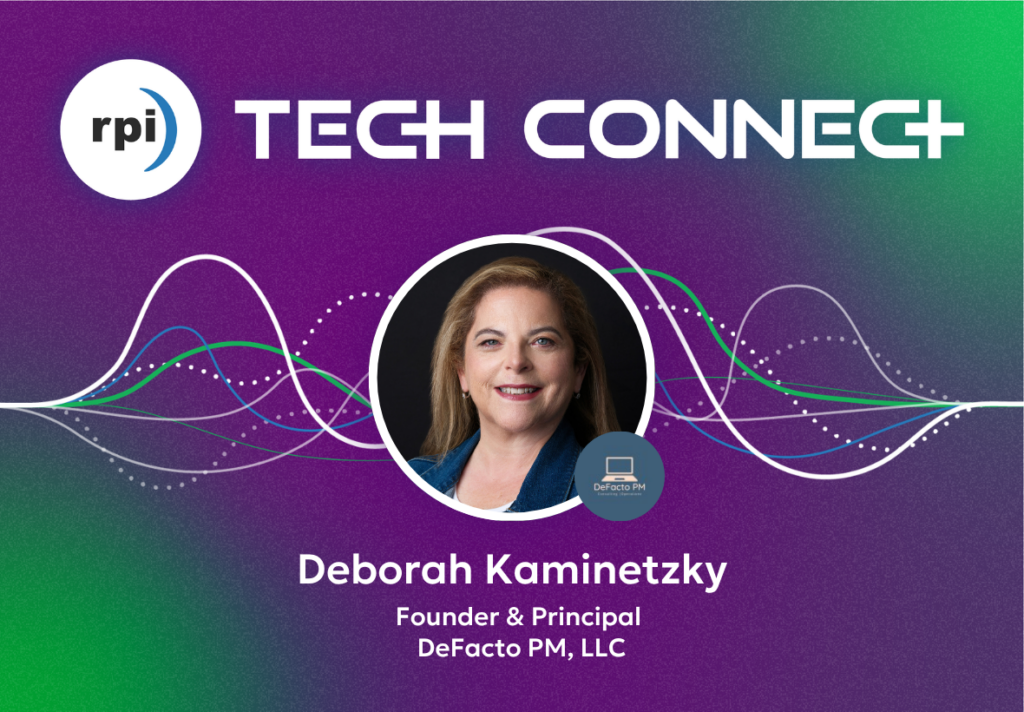
Your vendor brings a project manager to the table, but that person works for the vendor. In this episode of RPI Tech Connect, Deborah Kaminetzky, founder of DeFacto PM, joins to talk about what role a client-side project manager plays during an ERP project and why the difference matters more than most organizations realize.
Deborah has worked both sides of the table, and brings a refreshingly honest point of view on where implementations go wrong. The conversation covers everything from how to handle workarounds your team has built, to why including more stakeholders during discovery calls can save a project down the line.
If you’ve ever wondered whether your ERP project has the right people in the right roles, this episode offers valuable perspective on how to evaluate that.
Interested in listening to this episode on another streaming platform? Check out our directories on the WRKdefined network or watch the YouTube video below.
Meet Today’s Guest, Deborah Kaminetzky
Deborah Kaminetzky is a project management consultant and technology leader who helps organizations turn complex technology initiatives into clear, executable strategies. As the founder of DeFacto PM, she specializes in early-phase project leadership – guiding companies through scoping, stakeholder alignment, and implementation planning for ERP systems, software platforms, and integrated hardware environments. With particular experience in Microsoft Dynamics and the broader ERP ecosystem, Deborah ensures that technology decisions align with operational realities and long-term business goals. Known for bridging the gap between technical teams and executive leadership, she brings a pragmatic, results-driven approach that keeps projects moving and decisions grounded in outcomes.
What sets Deborah apart is her ability to translate across disciplines. A former attorney with deep experience in ERP implementations, SaaS, customer success, and cross-functional leadership, she understands both the technical architecture and the business stakes behind every project. She has worked with teams across the U.S. and internationally, making her especially effective in distributed, fast-moving environments.
Earlier in her career, she also led social media and thought leadership initiatives – experience that sharpened her ability to communicate complex ideas clearly, influence stakeholders, and position organizations as leaders in their space.
Meet Your Host, Chris Arey
Chris Arey is a B2B marketing professional with nearly a decade of experience working in content creation, copywriting, SEO, website architecture, corporate branding, and social media. Beginning his career as an analyst before making a lateral move into marketing, he combines analytical thinking with creative flair—two fundamental qualities required in marketing.
With a Bachelor’s degree in English and certifications from the Digital Marketing Institute and HubSpot, Chris has spearheaded impactful content marketing initiatives, participated in corporate re-branding efforts, and collaborated with celebrity influencers. He has also worked with award-winning PR professionals to create unique, compelling campaigns that drove brand recognition and revenue growth for his previous employers.
Chris’ versatility is highlighted by his experience working across different industries, including HR, Tech, SaaS, and Consulting.
About RPI Tech Connect
RPI Tech Connect is the go-to podcast for catching up on the dynamic world of Enterprise Resource Planning (ERP). Join us as we discuss the future of ERPs, covering everything from best practices and organizational change to seamless cloud migration and optimizing applications. Plus, we’ll share predictions and insights of what to expect in the future world of ERPs.
RPI Tech Connect delivers relevant, valuable information in a digestible format. Through candid, genuine conversations and stories from the world of consulting, we aim to provide actionable steps to help you elevate your organization’s ERP. Whether you’re a seasoned professional or new to the ERP scene, our podcast ensures you’re well-equipped for success.
Tune in as we explore tips and tricks in the field of ERP consulting each week and subscribe below.

Transcript
Chris Arey
Vendor PM, Client-side PM. What’s the difference and why does it matter? Today on RPI Tech Connect, we’re going to be talking about how a client-side project manager can make the difference between a smooth implementation and a painful one.
This is RPI Tech Connect and we’re back. I’m your host, Chris Arey. Today we’re going to be talking about project managers, and more specifically, why not all project managers play the same role during an ERP implementation.
ERP vendor project managers, client-side project managers, they sound interchangeable, same title, similar responsibilities, but who they advocate for is very different, and those differences can completely change the outcome of a project.
Today, I’m joined by Deb Kaminetzky, who has extensive experience working in organizations throughout ERP implementations. Deb, it’s an absolute pleasure to have you on the program today. Thank you for joining me.
Deborah Kaminetzky
Thank you so much for having me. I’m looking forward to it.
Chris Arey
For those listening in who haven’t met you before, would you mind sharing a little bit about yourself?
Deborah Kaminetzky
Sure, so I have a little bit of an unusual background for a project manager. I actually started out as a property manager, then was an attorney, and then went into technology project management.
I sort of came full circle, but I brought all of my experience, everything I learned in those various industries with me so that I feel it kind of makes me a better project manager.
Chris Arey
I was going to say, the legal background in particular, that’s got to come in handy when you’re navigating these contracts and client requirements and vendor stuff.
Deborah Kaminetzky
Yes, and people at Stakeholder Management 101.
Chris Arey
Right, right, of course. Well, thank you for sharing that about yourself. I think a great place to start today’s conversation would be to talk about the confusion that sometimes surrounds project management. Let’s start with this question here. Why do organizations assume that all project managers do the same?
Deborah Kaminetzky
Well, first of all, a lot of people and organizations think project managers only do one thing, which is to basically check boxes on tasks because there’s the whole on time, on budget idea.
The fact is, as project managers are dealing with people much more frequently. Yes, there’s technology, but usually the engineer or the the solutions consultant is handling that. To me, there is a very large difference between a project manager who is working for a vendor or a software company and one who is working for the client, who is going to ultimately be using that technology. On the other hand, the vendor will be in and out after the project is gone, so that’s a big distinguishing mark right there.
Chris Arey
Yeah, and you think that those two different roles you described probably have different priorities.
Deborah Kaminetzky
They absolutely do. And I will say that having been a practicing attorney, I’m always very aware of who the client is, because I understand the difference. If I am representing the vendor, which I do, sometimes I’ll come in as the vendor project manager. My goal is to make sure that the implementation goes smoothly from the vendor’s perspective.
From the client’s perspective too, but I’m not going to know the client as well. With ERPs, as you know, we go through extensive discovery processes so that we try as best we can to understand before actually designing the system.
You’ve got the whole analysis and design phase, but we’re still never going to know it as well as somebody who is on the inside. That makes a difference. When working with the vendor, I have often dealt with client project managers who know a lot about project management and their company.
What they don’t necessarily know a lot about is ERP. Sometimes they have worked with an ERP before, and sometimes it is the first ERP that organization has ever put together. You’re coming at this from very different perspectives. You are both trying to get the project done, but you will have different perspectives.
Chris Arey
Yeah, that’s a great point there. I’m happy that you mentioned that. It’s been a theme in a lot of episodes recently that I’ve heard from different guests with different backgrounds. It’s this idea that ERP projects are a “we” project. It takes a little bit from everybody to get it across the finish line and to get those successful outcomes that you’re looking for.
I want to talk now a little bit more about how you approach a project from the position of a client-side PM vs. vendor side. How do you approach that? Let’s start with the client side. What does that look like?
Deborah Kaminetzky
Sure, so the first thing, clearly, I’m not hired by the client as their full-time employee. I would be hired as a fractional. I’m doing the project for them, but I have done projects where I was an employee of the client. The first thing I would want to do is get to know that organization, understand the “why” of their implementation.
Sometimes they don’t have one and other times, they’ve grown and we need one. Sometimes they have one that they don’t like, have outgrown, or just want to try a different one. It’s clunky. It’s not doing what they want, and they want a do-over. Those are all the different scenarios, client side. I need to understand what their business goal is to make sure that that is going to be a successful project for them.
There’s a lot of that talking to not only the C-suite but also the people doing the work, people in the warehouse, all of those people. Believe it or not, they find workarounds if they don’t like the software, because they just need to get their job done and they’ve been told just get it done, so they do.
Chris Arey
Navigating those workarounds sounds like it can be a challenge. How do you resolve things like that?
Deborah Kaminetzky
Because I was an attorney and a mediator, I understand that most people are more likely to, let’s say, embrace a solution if they helped come up with the solution. Why do they have a workaround from the solution they’re supposed to be using, and sometimes they’re absolutely right, because whoever did the mapping exercises didn’t actually understand what it’s like to do their job.
It’s important to get to know your client and have them understand that their input will be used. This is not just a survey because we want to make you feel good and there’s a pizza party afterwards. We want to make sure that you are able to get your job done reasonably and according to the way that you think it should be. That’s not to say that the C-suite has no choice, but we have to make everyone somewhat satisfied, which is a true arbitration mindset.
Not everyone is going to be deliriously happy at any given time, but everyone will be either somewhat satisfied or somewhat dissatisfied. I try for someone satisfied.
Chris Arey
I’m hearing a lot now about the differences between a vendor-side PM and a client-side PM and how at the outset the priorities are different. I’m sure in your time you’ve been a part of projects where maybe the client-side PM was missing from that engagement. Can you talk a little bit about how maybe that project transpired? What was the outcome like in the absence of a client-side PM.
Deborah Kaminetzky
Yeah, I think we talked about this earlier. I was once managing a project, and it involved construction. An accounting firm was moving from one floor to another in the same building, and the person who was managing the project was one of the accountants. He was a very good accountant and was doing his best on this project, but there were certain things he just didn’t know and didn’t understand, so I tried my best to make it go well.
He was standing across the room, and I could see that the construction was not finished, because he had beautiful wood millwork above his head and a concrete floor. He was telling me they were ready for the next phase, which was us racking and stocking and bringing in all kinds of things. I said, are you putting flooring down? I suspect that you are, because of what I’m seeing.
He said, “Absolutely, it’s coming Tuesday.” I said, “hear me out on this”. If it’s coming Tuesday, we can’t come in and do this phase of the project, because everything you do Tuesday is going to create dust that’s going to ruin your new equipment. And he said “oh, okay”.
I ended up rescheduling them. I had 90 different clients I was working with at the time, as I was working for an MSP. We rescheduled that for two weeks later, and one of the other clients was happy to have their project moved sooner, so we were able to accommodate them.
But part of the reason I do both, I will work for the vendor, and I will also work for the client. Never at the same time, but I understand what the challenges are on each side. When I am working with someone who has chosen to not have a project manager managing their project, we call that a de facto PM, because it’s the person who’s been voluntold and has given it to a de facto PM, that is why I called my company DeFacto PM, because it’s the person who’s been voluntold to take on the project. That’s who I usually help. They need to understand that.
Deborah Kaminetzky
I am going to at least call out that risk. To a degree, you want the people to be happy with the solution and use it. Not everyone’s thinking along those lines though. There are a lot of times project managers are thinking about only what they have to do. I bring the client’s perspective to the table.
Chris Arey
Yeah.
Deborah Kaminetzky
I want them to be successful.
Chris Arey
Yeah. That’s your construction example there. The person you were talking to didn’t know any better. Having the foresight to be like, hey, wait, before we do this next phase, we need to do this other thing first. I think that’s a great metaphor for what the client-side PM brings to these projects, especially for those organizations who have never gone through an ERP project before. They don’t know until it’s too late. And then it’s a mess. People are pointing fingers, angry and it’s an expensive nightmare.
Deborah Kaminetzky
What they do have is that institutional knowledge that comes from being on a ton of other projects. You must approach them with the respect that they are a good project manager and that they do have a lot of knowledge. It is harder with someone who’s never done an ERP implementation, just in terms of the tools that you’re using to collaborate.
I had somebody who didn’t understand why a spreadsheet that they had downloaded onto their desktop Teams was not showing up in the Teams channel, because they needed to actually use it in SharePoint.
I showed them how to do it and now they’ve got a new skill that they can take with them everywhere.
Chris Arey
I see. I like that you raised that too. You need to work with people within the organization who know the requirements and know how they’ve been doing things. The requirements are so important for the outcome here, right?
Deborah Kaminetzky
Yeah, they’re essential. Understanding why they want the software at all and how they’ve been doing things. Sometimes they want everything to be exactly the way that they have. Sometimes they want to make some changes. They say, if we’re already going to make one change, we might as well make another.
Now that can lead to all kinds of other things and scope creep, which we’re not going to get into. We just redid the living room and now the den looks shabby, right? So.
Just understanding what the requirements are and how they normally do it. A lot of times, especially with the rescue projects, they know that they’re not doing it the way that they want to. They had an idea, but it didn’t translate well. I usually translate well between tech and industry because I do understand both sides having not been in tech originally, and having to constantly get people to come together and have a true, this is a legal term, meeting of the minds, meaning we are agreeing to the same thing.
I’m sure you have been in projects where people say the same words, but they don’t mean the same thing. They think they’ve agreed, but they actually have not.
Chris Arey
How do you navigate something like that? Like what is the process for like you think you’re saying the same thing but you’re not actually and then you know a problem happens. What is the solution there?
Deborah Kaminetzky
Well, so one of the mediation skills I brought with me into project management is repeating, okay, so I heard you say X, Y, Z, is that what you meant, right? You might say it a slightly different way and then everybody has an opportunity to say, yes, that was what I meant or no, I meant something else and explain that, but the idea is to be sure.
I was once doing mapping exercises with a firm and the vendor was basically saying, we can put a free text field here. We can put a free text field there. I said to the client, do you understand what that means? I don’t think you’re going to be happy with the free text field because later when you do dashboarding and reporting, you’re going to want to be able to draw from something.
This is just not going to serve you. It’s going to be easy to put it in. But then when you want to do anything with your data, you’re going to have some difficulty. So let me explain to you.
What is the radio button? What is a drop down? What is conditional logic? And we did all of that and then they understood what it was they needed to make the decision on and they were able to make an informed decision.
Chris Arey
Did they end up going with the free text field?
Deborah Kaminetzky
They did not
Chris Arey
So that immediately, showing the value of the client-side PM to explain, hey, this sounds good in nature now, but when you’re going to want to report on this later, it’s going to be not what you’re looking for.
Deborah Kaminetzky
Exactly. It’s just, it’s a place to get the information up there, but then you have no way to move it around. It’s like throwing everything into a suitcase without using packing cubes, right?
Chris Arey
You’ve got a lot of great metaphors. I got to tell you, I’m learning a lot from you and I’m going to remember it because of these examples that you have. Question for you, I’ve heard a lot of house and construction things today.
From your perspective, is an ERP implementation like building a house?
Deborah Kaminetzky
Thank you.
Yes and no, but I will tell you a full disclosure here. I repainted a bathroom three times because I didn’t like the color. A construction project in theory should be what we call waterfall, which means every single aspect of it is known and you’re continuously building. There, you have to do work like repainting the bathroom.
In contrast, an ERP really should be more hybrid or agile waterfall instead of waterfall. You may tweak something, you may set it up, and then during testing realize, I actually don’t like the way this looks, it’s too difficult, and I want change it slightly.
It’s got to be a little bit fluid, but the basic requirements are still going to be there.
Chris Arey
So it’s clear. The client-side PM is an invaluable role during one of these projects. I think something that organizations might get hung up on though is that this is an additional cost. Bringing in a client-side project manager can feel like an added expense front. Why should organizations not think about it like that?
Deborah Kaminetzky
Let’s put it this way.
It is an added expense. However, with the model that I have at DeFacto, it’s fractional, so they’re not taking on a full employee. We know ERP projects usually last a year, a year and a half. They’re long. You could, in theory, hire somebody for a year and a half. But then you’re also having them for 40 hours a week, and you may not have 40 hours of work that you need them to do, plus all the other expenses that come with having an employee. Tax, vacation, health, all that.
My fractional model essentially eliminates all of that. If you need someone for 10 hours a week on a project for a year, or year and a half, that’s exactly the kind of thing that I can fulfill. It will be less expensive than an employee, but I do feel that if you’re investing hundreds of thousands of dollars in something that is going to be the heart and soul of your company, you need it to work for both you and your customer.
For example, people in the warehouse. If you have a system that’s not working well and the people in the warehouse are doing workarounds, you know, the salesperson may tell them to expect a process that then doesn’t happen because the people fulfilling are not actually using that process. They’re using a different one. From my perspective, if you are going to do this project at all, you should do it right.
Chris Arey
It’s really true.
Deborah Kaminetzky
And you should do it right the first time. I enjoy working with people and I want them to be successful in the project. I think it makes sense to do it correctly rather than to say, we’ll just handle it ourselves and hope for the best.
Chris Arey
Thank you. Very, very clear on what the value is here. Hearing you explain the role of a client-side PM on a project like this, it’s almost like a form of insurance, right? You have a background in legal affairs, so is that a fair comparison or no?
Deborah Kaminetzky
I look at insurance as more as a mitigation step for in case a risk happens. For instance, can you go to the supermarket and buy a cake mix and make a cake? Sure. Is it going to be as good as a cake that you’re going to get at the bakery? No. Is it going to be a cake as good as you made from scratch? Well, that really depends on your skill. So if you are not a baker and you say,
I want the cake that I saw in the window and I’m going to do it myself. Chances are you are not going to get that result. If you want a certain result, then you have to get the professional, and it’s really a matter of needing them just for that one thing. You don’t necessarily need a project manager for all intents and purposes for the next 50 years in your business. But for this, it’s really important.
Or like surgery, you wouldn’t say, I can do my own surgery. Right. You would go to a surgeon. You’d go to somebody who knows what they’re doing.
Chris Arey
I think that’s a good point you make there too, not only in terms of skill, like who’s supporting the project, but also understanding the trickle-down effects of this ERP implementation. It’s the heart and soul of your own business, but also it’s what helps you serve your customers. This is a really critical, important project that you’re embarking on, and it can span upwards of two years in length.
You really are going to want to have the right people supporting it. That includes spending a little more upfront to have someone advocate for you. Why wouldn’t you do it?
Deborah Kaminetzky
Agreed. I mean, this is my whole company’s reason for existing, so of course I agree with you, but I do find that sometimes people say, wow, this is going to cost us $400,000 and we don’t want to spend an extra $50,000. From my perspective, that extra cost could be the difference between making that $400,000 well spent or it being a complete waste.
Chris Arey
Yeah, it’s not something to be taken lightly. I appreciate you sharing that, Deb. For those of you listening in, if you want to learn more about client-side or vendor-side project management support, we’d love to hear from you.
Deb, we are getting close to time here. One of the things I like to do before we wrap up is ask my guests if they have one actionable takeaway they’d like to share with today’s audience, what it would be. What’s your one big statement for today?
Deborah Kaminetzky
My one big statement for client-side is that even though it may seem wasteful to have say, the workers on the floor or in the warehouse participate in some of the discovery, I think it sometimes does make sense. They have information that you would literally never know because they are part of that process. That one little thing you don’t know could be the one little thing that really becomes a huge problem later.
Chris Arey
Is the action there to involve those people early on?
Deborah Kaminetzky
Yes, and not necessarily for all the discovery calls, for everything, but just to include them. It helps with adoption because they understand that we’re going to be having something new. They understand that they are a part of this new initiative, and their pain points are being expressed, which will in turn make their work more enjoyable later on.
Nobody wants churn. Everyone wants to keep their employees. Everyone wants to keep their job. And it just works out better for everybody if we’re all in this together.
Chris Arey
I think that’s a great note to end on. Thank you for sharing that. Folks listening in, you want to learn more about the role of a client-side project manager, we’d love to hear from you. You can contact us at podcast@rpic.com. Again, that’s podcast@rpic.com.
This is RPI Tech Connect, and thanks for joining us today. Take care, Deb.
Deborah Kaminetzky
Thanks so much for having me.