Most companies don’t realize how much can go wrong in an ERP project before the software is even chosen.
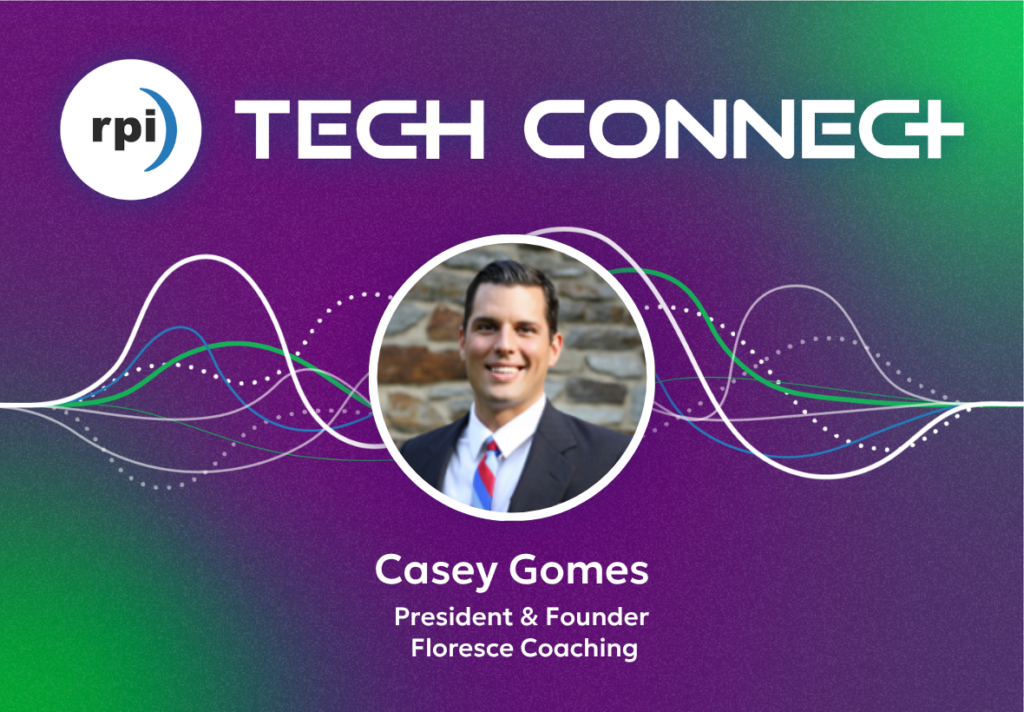
In this episode of RPI Tech Connect, change management consultant Casey Gomes shares why so many large IT initiatives fail to deliver and what organizations can do differently from the start.
With 30-plus implementations under his belt, Casey walks through three principles that separate projects that stick from ones that stall: getting the right people in the room early, aligning the executive team around a shared vision, and giving the initiative a “why” that motivates people.
He also makes a case for bringing in outside help before system selection and explains exactly what you’re risking if you wait.
If you’re in the early stages of an ERP project, or about to be, you won’t want to miss this conversation. Interested in listening to this episode on another streaming platform? Check out our directories on the WRKdefined network or watch the YouTube video below.
Meet Today’s Guest, Casey Gomes
Casey Gomes is an executive coach, consultant, and facilitator with over 20 years of experience leading organizational transformations across more than 150 companies. He specializes in helping senior leaders navigate complex change — from large-scale ERP implementations to full organizational redesigns.
Casey is the co-founder of Floresce and co-author of Confront and Conquer. Outside of consulting, he’s performed on stage and screen, including a principal role in an HBO mini-series. He lives in Maryland with his wife and business partner Remy and their two kids.
Meet Your Host, Chris Arey
Chris Arey is a B2B marketing professional with nearly a decade of experience working in content creation, copywriting, SEO, website architecture, corporate branding, and social media. Beginning his career as an analyst before making a lateral move into marketing, he combines analytical thinking with creative flair—two fundamental qualities required in marketing.
With a Bachelor’s degree in English and certifications from the Digital Marketing Institute and HubSpot, Chris has spearheaded impactful content marketing initiatives, participated in corporate re-branding efforts, and collaborated with celebrity influencers. He has also worked with award-winning PR professionals to create unique, compelling campaigns that drove brand recognition and revenue growth for his previous employers.
Chris’ versatility is highlighted by his experience working across different industries, including HR, Tech, SaaS, and Consulting.
Show Notes
About RPI Tech Connect
RPI Tech Connect is the go-to podcast for catching up on the dynamic world of Enterprise Resource Planning (ERP). Join us as we discuss the future of ERPs, covering everything from best practices and organizational change to seamless cloud migration and optimizing applications. Plus, we’ll share predictions and insights of what to expect in the future world of ERPs.
RPI Tech Connect delivers relevant, valuable information in a digestible format. Through candid, genuine conversations and stories from the world of consulting, we aim to provide actionable steps to help you elevate your organization’s ERP. Whether you’re a seasoned professional or new to the ERP scene, our podcast ensures you’re well-equipped for success. Tune in as we explore tips and tricks in the field of ERP consulting each week and subscribe below.

Transcript
Chris Arey
This is RPI Tech Connect. Welcome to the show. I’m your host, Chris Arey. Today we’re diving into one of the most talked about and most misunderstood parts of any major IT project: change management. And I don’t mean the dry, check-the-box version. I mean the kind that actually moves people and organizations forward.
My guest today has spent over 20 years partnering with executive leaders and global organizations to make changes stick during some of the most complex transformation projects out there. He’s got three principles he’s going to share to help organizations get a better handle on change management. Ladies and gentlemen, Casey Gomes. Casey, welcome to the show.
Casey Gomes
Hey Chris, good to be here. Thanks for having me.
Chris Arey
For those who don’t know you yet, would you mind sharing a little bit about yourself?
Casey Gomes
I’m Casey Gomes. Most importantly, I’m married and I have two amazing teenage kids that I adore. We’re looking at colleges for my son, my daughter’s in middle school, and my wife and I have been together for 20 years. Very proud of them and our life together.
On the work side, I am a professional consultant. I graduated from the Johns Hopkins Carey Business School — they renamed it, so I’ve got to say the new name, not the old one. And I’ve been self-employed as a consultant in the tech and management leadership space for 20 years.
Chris Arey
Awesome. Love to hear that you’re a family man first and a consultant second. Critical detail. So I think a great place to start today’s discussion is with a statistic — it’s a pretty powerful one. Upwards of 55% of ERP projects fail or underdeliver. In your experience, why is that stat so high? What’s going on there?
Casey Gomes
That’s a good stat. I’ve heard it range, depending on how you slice it — ERP specifically or big tech overall? Just ERP?
My experience says it’s higher. If you look at whether it was pushed back, whether it went over budget, I feel like it’s way higher. Did it eventually deliver success? Yes, but not always within the same framework.
The biggest reason is that organizations drastically underestimate how much of a change it’s going to be for their people and how much time and money it’s going to cost. They think they can do it in less time and less money. And they’re just bigger than I think most organizations think.
And I’m going to limit this to big IT — Oracle, SAP S/4HANA, Salesforce. A lot of times those things are happening at the same time. Organizations drastically underestimate how much of a change it’s going to be for their people and how much time and money it’s going to cost.
Chris Arey
And so it sounds like the cat’s out of the bag — the software works. It’s not a software or a technical issue. It sounds like it’s a people problem. So how do you approach an engagement from the beginning to set it up for success through implementation?
Casey Gomes
Yeah, you nailed it. I always say, spoiler alert: when you plug it in and turn it on, it’s going to work. They’ve got armies of developers at SAP. They’ve got armies of really smart developers at Oracle. They test and retest their software. They don’t put anything out that doesn’t work. Are there bugs sometimes? Of course, but the things work.
The problem is the way that organizations implement it. It’s too often seen as a technological change that is being implemented to a company, as opposed to an organizational transformation with people at the center — people who are going to use IT to do their jobs. It almost never gets sold that way. It’s sold as a widget that people are going to adapt to, instead of saying it the other way around: the widget has to actually adapt to the people. The people have to drive it. And it doesn’t get teed up right — not always, but a lot.
Chris Arey
I really like the second definition there. The first one — the technological piece — sounds so transactional. Like, you’re just going to do this thing and it’s going to work and it’s going to be fine. It’s like, no, man.
Casey Gomes
Yeah, and again, if you’re doing something like Hyperion, budget software, or time and entry tools, those are big, but you’re not transforming your whole infrastructure. Those can be seen more like a Windows upgrade or Office 365. You’re not leveling or restarting your business. Those are widgets.
But when you’re talking a big ERP, big IT, Salesforce, major master data governance — you’re changing the infrastructure of your company, and you happen to be doing IT.
Chris Arey
Yeah, good distinction there. So I think we can segue now into these three principles you have for making change management effective and making sure these projects go according to plan. The first one is getting the right people in the room. Can you share more about that? What does that process look like?
Casey Gomes
My ideal — which I don’t always get to do — is that I’m partnered with executive leadership at the start, meaning they haven’t yet figured out what software they’re implementing. They haven’t made a software decision. They haven’t decided which of the big five or which SI — system integrator, for those unfamiliar — they’re choosing yet. I’ve had the opportunity to be involved at the start and advise them when they’re just getting ready.
When I get the chance to do that — and sometimes I have to retrofit this if I’m brought in later — you’ve got to get the entire executive team in the room to start. If you find yourself in a room with a bunch of IT people and no one from the business, or it’s the CFO and the CIO but it doesn’t really affect the other VPs — “who cares about supply chain, we’ll bring them in later” — it’s just not going to work. Not every executive has to be at the exact same level of development, nor should they be. But again, with big IT, you’ve got to get them all in the room.
One of my favorite activities — I’m an OD guy, an applied behavioral scientist who works in IT — is surveying. Surveying and interviewing people is critical to that work. I’ll start with very simple five-question surveys of an executive team. Question one: what is the goal or objective of this project, or what does wild success look like? I survey them, put the results up on a PowerPoint in front of the room, and usually within a minute and a half, they’re laughing hysterically. The CFO is like, “We’ve got to cut costs and be more efficient.”
The Marketing VP is like, “We need our brand to be stronger than ever.” And you’re like — well, what is it, people? What are we doing? Who’s right? It usually ends in laughter. And I have a couple of follow-up questions where we say, “All right, if you all aren’t aligned, how in the name of God’s green earth are we going to transform thousands of people — sometimes tens of thousands — with this initiative?”
I say: when we leave here, you all need to be able to recite the objective of this initiative in unison before a match burns out. I hold up a match — you all have to say it. If you didn’t get it, we’ve got to do it again. We’ve got to be united. And if you’re not, this has a much greater chance of failure than it does success — because you’re going to argue later when there’s more money on the line, or when you’re behind schedule.
Chris Arey
I love that tee-up because it sets up your next principle really well. And that is alignment on goals and vision first. You’ve got representation from all these different folks in the same room. How do you get them to come together? What’s the strategy?
Casey Gomes
Starting with the first part, you’ve got to peel it back. Okay, we have the concept — that doesn’t get us a vision yet. All right, we’ve got the overall objective clear. What I then do is start a very simple drill-down. You can use SMART goals if you want — that’s age-old and well-used — but you want to break it down into areas.
There’s usually a financial component — reduction in financial oversight, a smaller budget. There’s usually something around turning orders around faster, or supply chain costs coming down, or manufacturing turnaround taking too long, or customer satisfaction varying from coast to coast based on the ability to fulfill orders.
So you start to see things that get really specific: finance, supply chain, manufacturing, and an overall sales growth target with specific sub-bullets for what you’re going to hit and what percentages you’re shooting for. It becomes a one-pager. You clean it up, PDF it, put the company name on it — whatever you want to do — and use it as your guiding principles. When you’re making decisions later, you’re able to go straight to it.
And I’ll add: I’ve had to do this sometimes a year in, a year and a half in. People are annoyed when that happens. They’ve often had a false start and they’re getting back on track. Sometimes I’m the last guy they want to see because I’m saying, “Listen, we’ve got to hit the back button here. What are we doing?” But when you do it at the start, it becomes a clear, unifying document and process for the executive team to co-own and lead throughout. It becomes a true north for them.
Chris Arey
Yeah, so a question about the timeline of an exercise like this. Getting people in the room, surveying them, outlining the SMART goals, working on that shared vision and aligned goals — what does that timeline look like?
Casey Gomes
It’s a great question. I break it into parts. The first one — if I’m billing it out to a client — I’ll usually bill it as executive facilitation sessions over the course of a couple of days, then a retreat. We usually go off campus: grab lunch, sit in a conference room at a cool hotel. If they’re in the office, I say, “We need to be sequestered. I don’t want you near your physical department.”
That first part — the why are we doing this, the five-question relay — we’ll do in about a day of prep and setup. Then depending on how deep they want to go on the one-pager, that can take another day or two, or sometimes another week or two. Executives will often say, “I want to get my director of supply chain. I want to get our six or eight manufacturing leads from different markets involved. I want to get the head of sales in.” So the group in the room can grow to about 15 or 20 people — a more representative sample of the organization.
If they go that route, it usually takes about a month, spread out over a week or two of sessions. You do the first meeting, come back a couple weeks later. It takes about a month and four to six days of actual working time for me to pull it together, depending on how much they want to do.
Chris Arey
And do you feel this has to be done in person? Would remote just not have the same impact as everyone being physically in the same room?
Casey Gomes
For the first part, yes — I want all the executives looking each other in the eye. There’s just a different vibe. Now, look, I’ve done global initiatives where I’m working with someone in Beijing, someone in Belgium, someone in Ireland. But there’s usually a time when they come together anyway, and it’s like, “Let’s just do it during the leadership meeting. We’ll pull off to the side for a few hours.”
I want the core group, especially if North American corporate headquarters is leading it — those executives need to be looking each other in the eye for that first part, for sure. The second part, I’d still want a critical mass in person and then can phone people in. But if it’s all remote — and I’m all for remote work generally — I think that part’s just too hard up front. You need to feel the energy coming off someone else. You can flip up a whiteboard, put sticky boards on the side, debate and argue. It’s hard to do that over Zoom at that level.
Chris Arey
Yeah, you’re missing the body language, the presence of the person in front of you. That makes total sense. So the third principle here is branding the project around the why. That’s very interesting. I feel like I know what that means, but I want to hear it from you. What’s that process? What’s the benefit? Why should organizations spend time on it?
Casey Gomes
The person who really cornered the market on this is Simon Sinek — and I saw him do it early on, before he was as well-known as he is now. One of his first videos was concentric circles with a “Why” in the middle, going outward. He talked about how that’s how Apple builds products. I’ve used that video so many times I’ve got it mostly memorized.
I use it because he says it so well and it lends credence to my view: the why drives the how and the what, not the other way around. Another great example comes from a book called The Real Business of IT by Richard Hunter — and no, I’m not getting paid to plug his book; I’ve just met him, he’s great, and the book is fantastic. He does an example I love and have seen him present in person.
He puts a picture of a treadmill up on the screen and asks, “What’s that?” Everyone says, “It’s a treadmill.” He asks, “What objectives do you achieve by using it?” People say, “You run.” He says, “No, that’s what you do on it. What else?” They say, “You get movement, you can get in shape.” And he says, “We’re getting warmer, but that’s not your why. Your why is that in six months you have your high school reunion and you want to look really good in those skinny jeans.”
Nobody gets up at five in the morning for the treadmill project. You get up because, come hell or high water, you’re fitting in those jeans. You’re going to look great at your 20-year reunion. That’s what gets you up at 4:30, 5 AM when you don’t want to. That’s your why. The what is that you run. The how is that you follow a plan, you run faster, you adjust your diet.
He ends by asking: why do we call every big IT implementation our version of the treadmill project? “We’re implementing ERP” — as exciting as a treadmill. As exciting as a root canal. Nobody gets out of bed for that. So stop naming it for the machine and name it for what the company is becoming: Acme Company’s Transformation, A Bigger and Better Future, Changing the World One Conversation at a Time.
I’ve been through branding initiatives with companies where we branded it almost like a product. If you’re going to invest 50, 60, 70 million dollars in it, give it a cool name — give it something that’s going to inspire people. The ERP project doesn’t do anything for me, does it? It’s just a shift. Simon Sinek and Richard Hunter both do a great job of describing that in a way that really resonates.
Chris Arey
That’s a great point. And a question for you: when you’re going through that branding process, do you give it an overarching name like you’re describing, and then tailor the messaging depending on who you’re presenting to? What’s going to motivate supply chain versus HCM, for example — how do you thread that needle?
Casey Gomes
Great question. This is also how I can get marketing in the room. For big companies, marketing and sales aren’t going to use an ERP system that much — it doesn’t affect their daily lives as directly. But this is where I say, “All right, let’s bring the CMO in and their team to actually build our brand. Let’s get web and creative involved.” I’ve done that more than a handful of times and it’s magic, because they lead a branding initiative.
And to your point, what happens is it shifts the conversation. I’m no longer defending my turf as supply chain. We’re all building something that makes the company better together, and we’re unified in that. We have our jobs — manufacturing costs go down, corporate finance improves — but you change the conversation.
When you rebrand it around the why, it invites people. It invites their employees at the next level down to join something bigger than themselves, something with a cool name that’s changing the company and, depending on the work they do, maybe even making the world better.
I’ve worked with Conagra Foods, Hershey’s, the FDA, USAID — organizations doing jobs that are literally changing people’s lives. When you make it about that, when you frame it as “we’re going to be able to do this work even better” — that becomes a powerful rallying cry.
Chris Arey
It’s how their work ladders up to a larger initiative that’s going to have an impact on something bigger than themselves. I like that. You’re so right to think about what’s going to keep people motivated and inspired over something that’s 18 to 24 months long — sometimes even longer.
It’s going to take real dedication and commitment, and you want people inspired going in from the beginning, because that’s ultimately going to have such an impact on the outcome. Okay, so we’ve talked about this in theory and we have the principles. I’m wondering if you have an example you can share from your time consulting.
Casey Gomes
I was working with a large staffing company, and it’s a real success story. That’s actually where I found Richard Hunter — I didn’t find him on my own; I love this stuff but someone pointed me to him. What was so cool about this company is that the CIO — and he would tell you this himself — said, “I’m not an IT guy. I don’t have a background in IT.”
He saw his role as being a leader of people, not necessarily just an IT leader. And he was leading a huge transformation — paradigm-shifting initiatives across the organization that were going to change the way they worked, involving Salesforce, a major ERP, and more.
He had actually already read The Real Business of IT. He bought a copy for all of the IT leaders and all the business leaders — it’s a multi-billion dollar company with different subsidiaries and operating companies — and brought them all together. Then Richard Hunter came and spoke to us in person and did the treadmill exercise with the group.
I’m geeking out, right? Because usually I’m the one having to sell the CIO on getting everyone together, laying out the agenda, facilitating the conversation. I didn’t have to have that conversation this time. So it became: how do we get the most out of this? It was super fun. And in just the first half hour to an hour of the retreat, you could see the mind shift, feel the energy shift in the room.
IT was relieved because they weren’t going to have a million ad hoc requests heaped on them from the business. The business felt heard because they were understanding at a better level why certain things get prioritized in the backlog and why the PMO works the way it does. And now everyone was united around the fact that this was all going to change — how they do work, how they operate.
It was a real success story. He took it two to three levels down in the organization, and using OCM terms — a stakeholder analysis, a change network — we had already established a movement. A force of people that represented the global organization was in place on day one and two of that retreat. Everyone looked each other in the eye and said, “All right, let’s go.” We still had one-pagers to build and a full plan that took weeks. But everyone left saying, “Cool. Got it. Let’s roll.” That’s huge. It’s transformational. It was inspirational to see — and it was great not to have to be the engine pushing the CIO. He was visionary enough to get it and want it on his own.
Chris Arey
Do you know what’s really cool about this example — and today’s entire discussion, really — is that this is about change management, but you’ve barely even used that phrase. It’s like there’s an aversion to it, and the real way to do it is… I’m going to use a Harry Potter reference here. Change management is like Voldemort. You don’t mention it, and then it’s working. You know what I mean?
Casey Gomes
First time I’ve ever had change management compared to Voldemort. I like that. Don’t mention it. It’s not magic, though. But yeah, I like that. So this is where my OD background shows.
My master’s is in organizational development — OD. Change management is a techno-structural intervention within the broader field of OD. If OD is the whole practice of leading transformational change in organizations, there are different types of interventions you can enact within it. There’s a whole school of thought around Lean Six Sigma and process interventions, for example.
Change management is one application — a way to get people to change behavior. It’s garnered support as a buzzword, in some cases for better, in some cases not, in the world of IT projects. People generally think of it as the way we get people involved, and that’s true. When I get hired now, I’m often brought in more as a PMO lead or overall project lead. But in my early years in the IT world, I was an OCM lead a lot.
I would always tell people: OCM is what we’re going to do — it’s a skill set, there’s a certification, there are deliverables. But I always bring it back to the applied behavioral science of large-scale transformational interventions with large groups of human beings. OD — it used to be called industrial-organizational psychology, which gives you an idea of where it came from. Change management is an application of that, and we do it a lot in IT.
Chris Arey
It’s just fascinating how much of these projects are really about people and not about software. It’s not an afterthought, but it can be secondary. Maybe.
Casey Gomes
Yeah — can I add something here? It’s secondary, but it still has to be in the driver’s seat. I’m also a PM, so I’ve led testing, I’ve worked with really brilliant technical leads and solutions architects. I don’t want to leave things off on a note that diminishes how important the technical side is — it’s huge.
However, the technical side usually gets all the oxygen. And it needs a lot of oxygen. But it needs to be wrapped with the people element and done together. Often it’s not done that way. It’s technology, technology, technology — and then we’ll do the business process documentation three weeks before go-live, or three months before go-live. It’s like…
Chris Arey
I want to go back to something you mentioned very early in our conversation: that you like to get involved before system selection — during that process, before the technology has been chosen. Why is that?
Casey Gomes
Great question. I’m a control freak and I just can’t let go — which is kind of true. I’m kind of a control freak. Even the most experienced, well-funded, long-standing companies in the world are not experts in doing big IT transformation. If you’ve worked internally your whole career, even across a couple of companies, you might be part of one or two ERP implementations in your career. I’ve done 30 — and that’s not including the subsystems.
So when even a really seasoned, brilliant executive enters this world, they’re in territory they have very little knowledge of, and they’re bringing in people who are way more knowledgeable than them. First, the software company — and their job is not to make it go well; their job is to sell you software, so don’t kid yourself. Then you bring in an SI, a system integrator. They’re way smarter too. But the company can’t advocate for itself. They don’t know what questions to ask.
And frankly, they don’t do the best job assessing themselves upfront. When I get a chance to be involved early, I’m like, “Listen, let me help you out here. You’re really weak here. You don’t have enough training resources. We’re going to need at least 15 backfills in your PMO to keep other projects afloat while you do this.” They’re not doing that work on their own — and it’s not that the SI or the software company is trying to lead them astray. Most of them really are great and smart.
But the organization itself needs to advocate for itself. I always tell them: you need to keep tension on the line. It’s a pull. You’ve got to advocate for yourself, do a real assessment of how many people you’re going to need, what you’ll backfill, and how much it’s going to cost. You just need a guide. It’s like wanting to climb Everest. You’ve worked out your whole life. But you’ve never done this before. You’ve got to hire someone to get you in shape, train you, and then you need a Sherpa while you’re there.
You want someone who helps you upfront. And that’s why I love it — because I can help them put together a decision matrix, an RTM matrix, a requirements traceability matrix, engage the business early, do a lot of that homework with them. So that when we start looking at software and bringing in an SI, we’ve got that network built and some thought leadership around it. I can help guide those decisions. I don’t always get to do that — I’ve done it a bunch, but not as often as I’d like, which is kind of a bummer.
Chris Arey
Yes, I totally see the value in bringing in experts from day one — before you’ve even chosen the software. Like you said, this is not your area of focus. You haven’t done it, you have other priorities. So why not enlist the support of people who spend their lives helping businesses through these transformations? Why not?
Casey Gomes
And I’ll add: if they’re paying me, I’m beholden to them. If you’re the VP and you’re paying me, I’m not beholden to a software company. I’m going to tell it to you like it is. I don’t care who you hire. When you bring in someone else — again, not that they’re trying to mislead you — but they’re going to look out for their own interests. So I often become a right-hand resource for the CIO or CFO.
And I have to have a trusted relationship with them, because I also have to be willing to say, “Look, you agreed to do all this stuff and it’s not getting done. Your people aren’t showing up, they’re not doing the work — we’ve got to fix it.” I’ve got to have that relationship to have that conversation. I cherish it when I get to do it, because I’m beholden to them — to making sure the initiative goes well on their terms, with my help.
I think it produces a better result, because now they’ve got someone in their corner who’s done this for a long time: someone who can help them sort what’s critical from what’s not, and guide some of those decisions.
Chris Arey
This role you’re describing is something that we call internally — or what it sounds like, anyway — a client-side project manager. This is the person representing the business: whoever the ERP vendor is has its own project managers, and you need somebody representing the organization going through this change at the table as well. For all the reasons you outlined — there’s just so much you don’t know that you don’t know — and that person is there to tell you.
Casey Gomes
Exactly. And we’re all ignorant about something. All of us — me, you, everyone. Ask me to explain emerging markets and I’m like, “What?” Ask me to do a financial analysis — not my world.
Chris Arey
So Casey, thank you so much for your time this afternoon. Before I wrap up, I always like to ask my guests if they have one takeaway for today’s audience — your 30-second most important thing from today’s discussion. What have you got for us?
Casey Gomes
Number one — and I put them in order intentionally — get the right people in the room from day one. Even if you don’t facilitate it perfectly, just getting the right people together: not just IT, but the executive leadership team and a representation of the business, in the room at the start. Do it at the start.
If you do that for these big initiatives, your chances of success go way up. You’ll start those difficult conversations early. You’ll have more perspectives in the room. And you won’t get to a place where someone’s upset because they weren’t included or you missed something.
So if you take nothing else from this — from the OD wolf in sheep’s clothing in an IT world — get the right people in the room. Get the executive team together. Get the leaders engaged from the beginning.
Chris Arey
Awesome. I love the enthusiasm you have for that — it’s going to make such a difference. For those of you listening in, if you have any questions about today’s segment or want to learn more about Casey or how RPI can help you with your next project, we’d love to hear from you. You can contact us at podcast@rpic.com. Again, that’s podcast@rpic.com. This has been RPI Tech Connect, and we’ll see you next time. Thanks, Casey.
Casey Gomes
Thanks, bud. Take care.