Healthcare costs keep climbing, and the systems meant to manage them are straining under the weight.
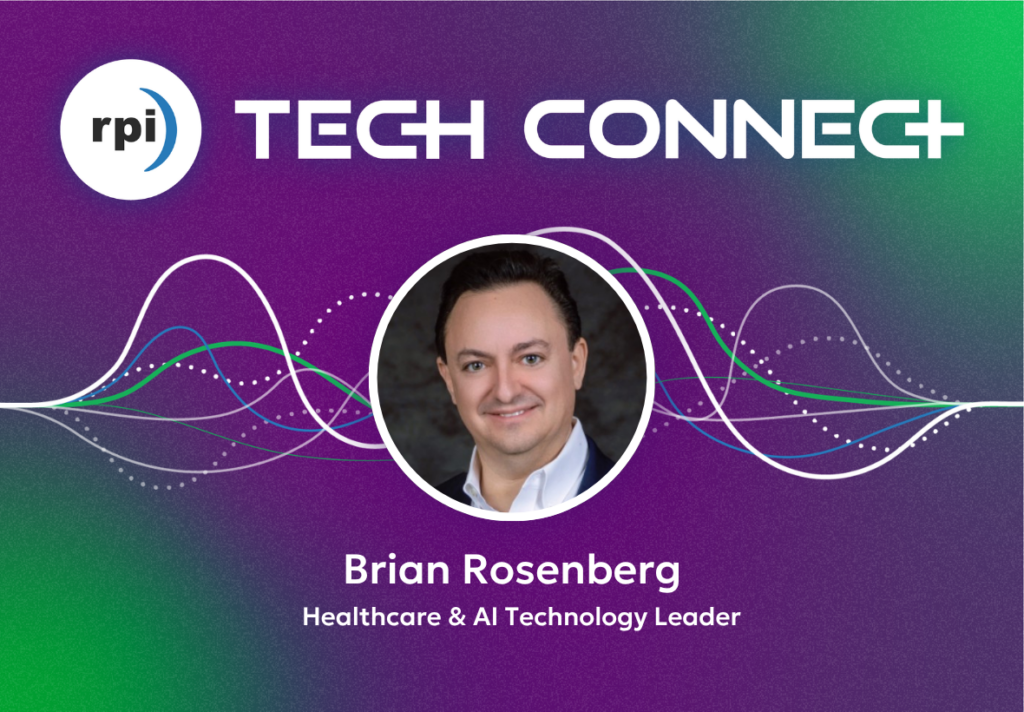
In this episode of RPI Tech Connect, healthcare technology leader Brian Rosenberg returns to explore why healthcare is so expensive and where the real opportunities to bring costs down live.
From AI-powered ambient documentation to smarter supply chain management to back-office automation, Brian makes the case that operational efficiency is the lever most healthcare organizations aren’t pulling hard enough. He also shares why the conversation needs to shift away from who’s footing the bill and toward fixing the underlying cost of care itself.
If you work in healthcare and want a grounded, practical perspective on where to start, this discussion is for you.
Interested in listening to this episode on another streaming platform? Check out our directories on the WRKdefined network or watch the YouTube video below.
Meet Today’s Guest, Brian Rosenberg
Brian Rosenberg is founder of RPI Consultants, and has over 20 years of experience in building successful consulting practices as well as designing, deploying, and optimizing enterprise software. He is a recognized expert in adoption of technology with deep expertise in the healthcare industry.
His many accomplishments include leading implementations of ERP and EHR solutions, design and build of shared service operations, founding of a charter school, leader of clinical technology strategy for a Big 4 firm, and founding several successful companies.
Brian currently teaches at the UNLV School of Public Health, is President of HIMSS Nevada, Honorary Commander at Nellis Air Force Base, and is known as one of the Las Vegas AI Guys, amongst other projects.
Meet Your Host, Chris Arey
Chris Arey is a B2B marketing professional with nearly a decade of experience working in content creation, copywriting, SEO, website architecture, corporate branding, and social media. Beginning his career as an analyst before making a lateral move into marketing, he combines analytical thinking with creative flair—two fundamental qualities required in marketing.
With a Bachelor’s degree in English and certifications from the Digital Marketing Institute and HubSpot, Chris has spearheaded impactful content marketing initiatives, participated in corporate re-branding efforts, and collaborated with celebrity influencers. He has also worked with award-winning PR professionals to create unique, compelling campaigns that drove brand recognition and revenue growth for his previous employers.
Chris’ versatility is highlighted by his experience working across different industries, including HR, Tech, SaaS, and Consulting.
About RPI Tech Connect
RPI Tech Connect is the go-to podcast for catching up on the dynamic world of Enterprise Resource Planning (ERP). Join us as we discuss the future of ERPs, covering everything from best practices and organizational change to seamless cloud migration and optimizing applications. Plus, we’ll share predictions and insights of what to expect in the future world of ERPs.
RPI Tech Connect delivers relevant, valuable information in a digestible format. Through candid, genuine conversations and stories from the world of consulting, we aim to provide actionable steps to help you elevate your organization’s ERP. Whether you’re a seasoned professional or new to the ERP scene, our podcast ensures you’re well-equipped for success.
Tune in as we explore tips and tricks in the field of ERP consulting each week and subscribe below.

Transcript
Chris Arey
We’re back for another episode of RPI Tech Connect. I’m your host, Chris Arey. Today we’re tackling a question that affects just about everybody listening. Whether you work in health care or you’re simply a consumer of it, you know that costs continue to go up.
Today, we’re going to talk about what’s happening inside health care and what can be done to make it more affordable. I’m joined by returning guest Brian Rosenberg, who has spent years working across health care technology and operations and brings a grounded perspective on where costs come from as well as how to reduce them.
Brian, welcome back to the show. For anyone who’s meeting you for the first time, would you mind sharing a little bit about yourself?
Brian Rosenberg
Sure, I’m happy to. Thanks for inviting me back, Chris. My name is Brian Rosenberg. I have been working in technology implementation in the healthcare industry for about 27 years now.
I have been involved in ERP implementations and was the founder of RPI way back in 1999. I have helped with projects ranging from implementations of Infor and other ERP systems, electronic healthcare record deployments, building shared service centers, and many other projects leading change and transformation in the industry.
I currently teach and am on the board at the School of Public Health at University of Nevada, Las Vegas. I’m the vice chair of the Health Information Exchange here in Nevada. I’m an honorary commander at the Hospital of Dallas Air Force Base and the president of the Health Information Systems Society, more commonly known as HIMSS.
I’m very involved in the health care industry and speak and write about issues in our industry often.
Chris Arey
I was going to say, Brian, you cover every area within healthcare, too. It’s not just backend, it’s care, it’s politics, it’s everything. Yeah?
Brian Rosenberg
It’s easier as you get older to have all that experience, but yes it has been quite a career.
Chris Arey
Well, I’m looking forward to hearing your thoughts today. I think a great place to start today’s discussion is with this very big, simple, and important question, and that is, why is healthcare so expensive?
Brian Rosenberg
Well, that’s certainly a big question. I think that people think that healthcare is expensive because doctors and hospitals are getting rich, but the reality of it is that hospitals work on extremely thin margins, usually single percentages, often one, two, three percent kind of numbers.
In many cases, unfortunately, hospitals are operating at losses. I think we assume that they’re doing really well. Individual doctors as well. Certainly, doctors are well paid in comparison to much of the rest of population, but they also have very heavy debt load that comes with that education.
Certain types of doctors are paid much better than others. And the reality of it is that the doctors who provide us with primary care, the first line of support, are often the lowest paid in the industry. I think that there’s a perception that because we pay a lot for healthcare, that that means people who provide healthcare make a lot of money, but the reality of it is much more complicated.
Chris Arey
Mm-hmm.
Brian Rosenberg
In healthcare, there are certainly many factors. Healthcare is expensive because it’s complicated. We have very large and expensive software systems. We have very complicated processes to track billing and to bill all the insurance companies under all different rules. We have to provide care in very particular ways to meet lots of regulations that are very valid and have good reasons to exist, but they create complexity.
I bet you a major focus of our discussion today will be around the idea that health care is expensive because it isn’t necessarily efficient. There are many different reasons for that. We don’t do a very good job as an industry of sharing medical information for the purpose of providing better care, something that I can get passionate about.
As a result, we have challenges with duplicate care. We have challenges with people waiting to get care until the last possible moment when it’s most expensive to provide. People not understanding the right place to get care, going to the emergency room for something that they could go to an urgent care for, for example.
All these are factors when we get into all of this. And then there’s just general efficiencies with the back-ups. And one interesting stat that I’ve shared in different presentations is one from the Brookings Institute, which shows that one-third of the cost of care is related to the overhead of healthcare, not actually providing healthcare itself.
In short, there’s a lot of answers to that question, and we can dive into many different aspects of that reality.
Chris Arey
When you say overhead, is that like, you know, operating the building and the machines and the staff who work with the hospital or?
Brian Rosenberg
Getting into everything from back office to billing functions. It’s interesting too, the healthcare landscape has shifted with the arrival of IDNs (Integrated Delivery Networks). These are healthcare systems that have many hospitals, making it so that there are less and less private/independent hospitals in the industry.
IDNS build large, shared service operations that provide efficiency. But the smaller, independent hospitals struggle increasingly to be able to be efficient in the complex world that they operate in.
I had led an Epic implementation for a hospital that was a 550-bed independent hospital. The CEO would ask me, why do I have to have so many people in IT? I would tell them that they had all the complexity of a healthcare system hundreds of times their size without any economies of scale.
It’s become harder and harder for independent hospitals to be able to keep their costs reasonable in many aspects, everything from supply costs to efficiency of staff. That relates to the costs of running IT, to running billing, to running registration, to scheduling, to all these functions that ultimately are necessary in order to be able to allow patients to be able to get care.
These are things are somewhat invisible to somebody who may be a patient in the industry. But in the end, everybody’s affected by these costs.
Chris Arey
Yeah. Is there an oversimplification of the problem here? I feel like a lot of times people like to point at one thing in particular when theorizing about why healthcare is the way that it is. What are your thoughts on that?
Brian Rosenberg
Yeah, I think absolutely that there is an oversimplification. I think that, when we look at this politically, and I won’t get into debating political issues, but I will say that our politics tends to focus a lot more on who should be paying than it does on the cost.
Chris Arey
Hmm.
Brian Rosenberg
Right? So it’s a lot about what patients should pay for, what insurance companies should pay for, and what the government should pay for. However, that’s not what I want to get into today. The question really is ultimately your original question. Why is healthcare so expensive to begin with, regardless of who’s paying for it? I think there’s more visibility into this lately because insurance deductibles are going up.
You know, I personally, I have three kids and a family of five. And my insurance rates were going to increase by 40 % this year, to keep the exact same plan. That is more than the average, I believe the average in our state was more of a 20 to 25 % range, but the plan that I had was increasing 40%. To get to that point where my insurance only increased by about 20%, I had to go from a $5,000 deductible to a $9,000 deductible.
Chris Arey
Man.
Brian Rosenberg
I had to go to a plan that effectively doesn’t pay for anything until I hit my deductible, go with an HSA, which means that I’m now a true consumer of healthcare and I pay for the majority of it myself until ultimately the insurance is there if a crisis occurs. But I think more and more people are making those kinds of trade-offs. And as a result, they’re becoming more aware of the cost of care directly because they see the bill.
I think that one of the reasons there’s a misconception about healthcare costs is that in healthcare, we have a dollar amount that is sort of the default price and then what people actually pay. There’s a big gap between those. In the industry, we refer it as gross revenue versus net revenue.
Basically, there’s an off-the-rack price, if you will, and that is not what actually gets charged to an insurance company or to a cash payer. What gets reimbursed is negotiated with the insurance companies and tends to be significantly lower.
Chris Arey
You mentioned something there that I think is a great way to think about this discussion. It’s not pointing fingers at who should be paying more for the cost, but rather how do we bring the cost down as a whole? I think that’s the right way to think about this issue.
Brian Rosenberg
And if we solve that problem, then who’s paying is less significant of a factor because in the end we worry about who’s paying because it’s so expensive, right? If we can solve the problem of the cost of providing care, then ultimately the who becomes easier.
Chris Arey
Yeah. You mentioned something there about earlier on folks sometimes not knowing where to get care for what type of procedure or diagnostic. It seems like there’s maybe this lack of general knowledge on what their health insurance entails and how to make use of it effectively.
I believe you had a stat you mentioned once before about like people using ChatGPT to understand health insurance. Could you share that?
Brian Rosenberg
Yeah, let’s talk about this issue, because I think there’s a lot of fundamental issues around cost of care, and we can dig into the different aspects of it. First, I want to mention the idea of ownership of medical records for a moment because there’s something fundamentally broken within our industry, the idea that healthcare providers own our data.
We need to take control of our own medical information. As I mentioned, I’m on the board of the Health Information Exchange in Nevada, Healthy Nevada, which is a not-for-profit, which facilitates the exchange of medical records between providers. Here in Nevada, like a lot of states, we do not require providers to share medical records with other providers through the Health Information Exchange.
If you’ve ever been to a doctor’s office and filled out a form and had to remember everything about your medical history, it’s because they’re not pulling up that information electronically, though it is available within the Health Information Exchange.
There are Health Information Exchanges In 49 states, so you do have the ability to get access to that information, but is it complete information? Is it fully accurate? It depends on some of the rules and how that information is collected.
If my doctor doesn’t know the results of an MRI that I had because they can’t get them or because it’s going to take weeks for them to get them, then they are probably going to order another one. And we end up getting a duplicate test, which directly affects the cost of care.
When you think about it, we are unable to make the best medical decisions when we don’t have the most updated information available. Tying that into that question about ChatGPT, OpenAI announced ChatGPT health just a few weeks ago. There’s a lot of fear about that solution in the healthcare industry, a lot of concern. But here’s the reality.
Patients have been self-diagnosing for thousands of years, well, pretty much since the beginning of the existence of man. The question then becomes, what tools do we use to do so? It could be as sophisticated as something like OpenAI’s ChatGPT solution. It could be using WebMD. In many cases, people are calling up their grandma and saying, what should I do? And she says, yeah, this is what you need to do. It is the reality that we do this. And why have we been trained to do this is an important question.
Chris Arey
Because it’s cheap and because it’s free maybe?
Brian Rosenberg
Cheap, free, and there’s one more I would add to that, and that’s fast. Even if healthcare was free, that doesn’t necessarily mean you get an appointment in a timely manner. Anybody who’s been a parent knows their kid gets sick. You try to take them to the doctor for a bit. You can’t get an appointment for two weeks. You’re not going to wait until your doctor’s appointment to try to treat your kid, right? You’re going to make a decision. You’re going to make a judgment call as to what’s the best thing to do.
There’s a question of can I afford to go to the doctor? There’s also, can I afford to wait to go to the doctor? That leads people to self-diagnose a lot. We’ve somewhat been trained to self-diagnose as a result. A lot of things can be self-diagnosed.
Futhermore, a doctor who has five minutes with you may not be able to provide the same level of depth of looking at your situation than a solution that has all of your medical records, right, and all of your history, and can ask you questions about your conditions and knows everything about your past conditions and can help you understand the potential diagnosis.
It’s reasonable for people to think that, right? The best answer, ultimately, is going to turn out to be combining a physician who is accessible and affordable with automation tools that allow both the physician to be able to provide care more effectively and the patient to come into that care more informed.
When they get the time with the doctor, they can ask smarter questions. They can have a better understanding about which parts of their history they should bring up. There is a place, a very important place for these solutions. What you don’t want is ultimately people putting off care. That’s the worst case.
When we think about the “who should pay” question, there is a a lot of debate right now about who should and shouldn’t be on Medicaid. An important aspect of that is to realize that just because somebody doesn’t have Medicaid or any insurance doesn’t mean that they don’t get healthcare.
What it means is that they wait until because they can’t get healthcare until eventually, they show up in an emergency department with a much more serious condition. And at that point, the hospital’s not going to turn them away, they’re going to treat them. They’re just not going get reimbursed for it. When they don’t get reimbursed for it, what do they do? Well, they have to increase the cost for everybody else. Inevitably, the incentive for everybody should be to provide people with the right care at the right point and time to prevent those issues from becoming more serious.
Chris Arey
Wow, there were a lot of layers to everything you just said there.
Brian Rosenberg
There are a lot of layers to this problem.
Chris Arey
Yeah, and I want to talk now a little bit more about the solutions that you touched on there, like AI being able to provide your medical record history into the solution so that the physician is better equipped and knows more about your history before you get there.
At the same token, the person who arrives is better informed to ask smarter questions with the limited time that they have. What does implementing something like that look like on the hospital’s backend? Is that expensive? Does it take time? I’m sure the answer to those questions is yes, but how do you recommend that they think about doing something like that?
Brian Rosenberg
Well, there are very specific solutions around care of electronic health record systems that are commonly used for clinical and scheduling and other areas. But what you’re going to see a lot of is AI driving enhancements to these applications, both AI put out by those providers, those platforms, as well as AI from third party solutions.
I think it’s an incredible opportunity in AI to make care more efficient at every stage. This goes into the front office of healthcare, patient-facing stuff, and it goes in the back office of healthcare as well.
From a front office perspective, if we can schedule online, it becomes more efficient. If we can use AI to help to find an appointment using natural language to make it easier for someone to schedule, it becomes more efficient. If we can use AI to make sure that the bills are right before they go out the door, so the insurance company doesn’t reject it, then we are making care more efficient.
There’s a lot of aspects of that. But within the care environment itself, one thing that I think we are going to see a lot more of is what’s called ambient documentation, which is where you go to a doctor’s appointment and the doctor may ask for your permission to record it. Instead of the doctor typing into the computer the whole time they’re talking to you, the ambient documentation is listening to your appointment, creating the notes for the doctors, even transcribing the orders for the doctors, in some cases now.
The doctor can look at you while they’re treating you, and they can spend more time with you because they don’t need to spend the time documenting in-between appointments or after what’s called pyjama time, when they’re working at home, completing the documentation for the patients that they’ve seen for the day.
Those things free up the caregiver’s time, allowing them to spend more time with us or to see more patients. Ultimately, I think that’s where there’s so much opportunity in AI. It possesses the ability to make care faster, more efficient, and more effective.
Chris Arey
So it sounds like AI is a part of the solution here. If implemented correctly, it saves time and completes some of those manual tasks like taking notes during the actual appointment and providing care more effectively in a shorter amount of time. I want to talk about another aspect of the overall healthcare costs, and that’s this administrative portion.
One stat I’ve heard floating around is that roughly 20% of healthcare costs are administrative. What’s baked into that stat? What can you share?
Brian Rosenberg
Yeah, and I think it’s higher. look at more like a third, know, administrative, you know, basically think of it as back-office functions. I can divide that up into two sections. There are back-office functions that ultimately support the clinical operations, you know, in terms of the scheduling, and billing functions that typically are done on the health directorate of solutions.
Then there are back-office functions like HR, finance, and supply chain that are typically done in an ERP solution. When you look at the ERP side of it, there are many different aspects. For supply chain, a lot of it is about keeping track of what we have and making sure we have the right product delivered to the right place at the right time.
I think in that case, this is again, something that’s not necessarily visible to a patient directly, but when a surgery gets canceled because the product isn’t available, the pandemic, I think, taught healthcare organizations a lot about how dependent they had become on the distribution channels that serve healthcare.
For those who may not be as familiar, healthcare is heavily served by just-in-time inventory models. We have distributors who stock large quantities of products that you commonly use. And those distributors operate in nearly every major city or within driving distance of every major city in America. Healthcare organizations became very used to the idea of being able to order products just in time and be able to get it the next day. And when the pandemic hit, many products disappeared from the supply chain and healthcare organizations had to learn how to source in real time.
Inventory management became significantly more important. Understanding, what do we have, what do we need, and we’ve learned lessons from that and learned that we need to be smarter as an industry about stocking the right amount of product and having multiple different sources for different products so we’re not reliant on a single vendor. Doing a better job of understanding substitutions, and doing a better, I mentioned those integrated delivery networks, gaining a better understanding of what we have within our healthcare systems.
One thing that a lot of providers didn’t really know early on the pandemic when they were looking at masks and other things was where do I have product within my own system. There weren’t good processes in place to move inventory within those systems and they had to adjust all of that.
There’s this whole idea of inventory intelligence and really understanding what we have, what we need, predicting what we need based upon what surgeries and other things we have coming up. Seasonal needs, like during flu season, we typically need more of this product and therefore need to have it in. I think that this creates an incredible opportunity for us to better manage and understand supply chains and sourcing better to understand: where can we get product? Where’s the right place to get it?
Sometimes it’s not as simple as who has the lowest price, because we have to think about rebates we have negotiated, or volumes we have to give to certain vendors. That requires much stronger analytics and AI to be able to understand what’s happening.
And HR staffing and optimizing staffing, particularly with nurses and other areas where moving around staff is a very important factor.
Optimizing the people that we have based upon need, which, know, in a geography, we may be short on nurses in one hospital and have an excess at another hospital. Being able to move that around reduces the cost of care and reduces the dependency on travel nurses.
In an area like finance, having real-time visibility into our costs, being able to, you know, understand how to better manage cash flow so that we are paying things at the optimal time, which might be paying on time, might be paying late, depending on our cash situation, might mean making sure we’re taking all of our available discounts.
These are all examples, and I’ve realized that I’m throwing out a lot of them. But each of these are different areas that need to be looking at how do I run at the maximum level of efficiency while still having a systematic view, right? We don’t want to make the trade-off of keeping inventory low if it means that we’re not going to have the right inventory at the right time. You need to look at the end-to-end impact of these decisions.
At the same time, how do we make each of these operations more efficient? Use AI as a tool when appropriate to increase efficiency and give us better information to make informed decisions. Every aspect of that process impacts that cost of care.
If we’re to get that one third down to 15 % or 10%, everybody needs to be all in on that. And looking at their areas and driving that kind of cost improvement and process improvement throughout.
Chris Arey
It sounds like then like the back-office operations are an important lever for healthcare organizations to try and cut down costs. Does that mean that a good ERP plays a critical role in driving down healthcare costs? Can we draw that conclusion?
Brian Rosenberg
Absolutely. I think that a good ERP, I mentioned that there are two aspects of that. There’s the software itself, right? One thing that is really important to realize is I don’t care if you have Infor, Workday, whatever ERP you’re using, Oracle, it doesn’t matter in terms of that your responsibility around that ERP did not end the day you went live.
Chris Arey
Yeah.
Brian Rosenberg
You have to optimize these solutions. Optimizing solutions is not even a technical thing. I think that’s often thought of, IT’s job, it’s technical. Optimizing, to me, is using data in the system to drive continuous improvement in your organization. While an IT role could be making that data available and good reports and dashboards and creating visibility, the operation needs to be defining what we should be looking at.
What actions are we going to take using that information, setting goals and targets that are not unrealistic, nor are they too easy, right? We want to establish realistic, attainable goals and measure people towards that and build an environment.
And I apologize, I’m a Lean Six Sigma, Master Black Belt, so I talk about this kind of thing a lot. The idea of creating a culture of continuous improvement, never accepting that the status quo is good enough. Always trying to make it better. That’s the whole concept of Six Sigma. Constantly driving improvement. What you’re doing now is never good enough.
Now you may focus on one thing as opposed to another thing now because of priority, but always driving improvement. Every overhead function should be thinking about that every day and how they make those numbers better. But what numbers should they be looking at? What are the numbers? What do they do with those numbers? That’s part of what we need to help people to understand.
Chris Arey
Earlier you said it didn’t matter if it was Workday or Infor or Oracle or some other system. Previously, I heard you mentioned that healthcare is one of the biggest industries still using the fax machine.
Does the lag in modernizing systems say something? Like, are there a lot of hospitals that are maybe operating on-prem still? Should they move to the cloud? Is that part of the solution?
Brian Rosenberg
Yeah, there are a lot of people still on-prem.
Chris Arey
Yeah, go ahead.
Brian Rosenberg
I think in healthcare you see a higher percentage of organizations operating on-prem, and it’s time to get into the cloud. I think we’re past understanding the resistance points to that. Right? It lowers costs. There’s plenty of effective security. As a matter of fact, I would sleep a lot better if I was a CIO at night knowing that my information was in the cloud where a vendor who has extremely large investments in security is maintaining it.
Worst case scenario, something happens, there’s somebody to hold accountable for that, right? As opposed to the realities that, vulnerabilities that can happen with their own staff if it’s on-prem are just so real. And I think that that is a fundamental factor.
Then when it comes to modernizing and using AI tools, there’s just going to be more restrictions on on-prem. They’re already incapable of using a lot of the tools like AI that are out there in many different solutions. There absolutely are right and wrong ways to use these tools. That might be a whole conversation in and of itself.
However, they are a part of how we need to be providing care and if you don’t do so you’re just not going to be competitive anymore. I mentioned ambient documentation. Doctors are going to get to the point in the next few years where they’re not going to want to work at hospitals that don’t have ambient because it’s more work for them if they don’t.
That shift is going to be happening across every role. We need to be teaching our staff how to use the tools, including AI, including data, better. Cloud environments are just better prepared to provide us with that and to allow people to focus on what’s important, which is driving down the cost of care, not maintaining service.
Chris Arey
You know, there’s probably a hefty price tag on some of these items, but implementing them sooner rather than later is going to help you down the road in curbing costs, is that correct? Is that your belief?
Brian Rosenberg
It’s hard to get the priority on these things. I think it’s important to realize that this is what matters in us being able to provide better and more affordable care. You have to invest in these things to impact the bottom line, because investing a few million dollars in upgrading an ERP to the cloud is going to be peanuts in comparison to being able to better manage your staff and make them more efficient.
Being able to make sure you lower your cost of your supplies and make your financial statements more accurate. Healthcare operates at such a large scale that smaller healthcare organizations still have revenues in the hundreds of millions or billions of dollars.
As a result, this isn’t financially relevant to the big picture. I think there’s always the aspect of what I talk about sometimes, from Stephen Covey’s habits to sharpen, if you’re familiar.
Chris Arey
I remember.
Brian Rosenberg
I probably referenced this in our prior conversation because it is so fundamental.
Chris Arey
It’s still relevant.
Brian Rosenberg
And for those who are not aware, sharpen the saw as a habit, where the story is that there’s a guy walking through the forest to see somebody trying to cut down a tree with a dull saw. And he says, hey, why don’t you sharpen the saw? And the guy responds, “I don’t have time on two visit trying to chop down this tree. And it’s so applicable to healthcare, to some extent to every industry.
We don’t take the time to sharpen the saw. We don’t step back and fix our fundamental issues because, and no industry experience, this is probably more than healthcare. The patients, the fires of the day, what walks in the door of a hospital every day is unpredictable. And it distracts us from getting that work done. You have to have dedicated people getting these projects done, whether that be a system upgrade to Infor CloudSuite, whether that be driving continuous improvement and finding ways to reduce our supply chain costs, whether it be improving the scheduling process or implementing ambient documentation.
The what doesn’t matter for the purposes of conversation, you have to have people dedicated to that or you get stuck cutting the tree down with a dull saw.
Chris Arey
Well, Brian, I love that we’ve talked about this one lever that can be pulled to help drive down healthcare costs, and that is looking internally, looking at your backend office operations and seeing where you can implement AI, automation, maybe it’s a cloud ERP in itself. These are the things that are going to set up your hospital for greater success down the road.
Thank you for sharing this with me here today. We are getting close to time.
Brian Rosenberg
Let me just address the AP Automation that you mentioned just briefly, just because it’s something that I personally have a lot of history with. I had the opportunity to design many accounts payable shared service centers during my time with RPI, including many large healthcare providers, all the way up to Common Spirit, one of the largest healthcare providers in the United States.
I think it’s important to realize that that’s a good example of an area where there’s so much opportunity for automation that we have. That paying on time means taking discounts, means getting rebates, which means negotiating better discounts with vendors, means more visibility into financial information. It’s a good example of something that people don’t think about that has so many opportunities.
I do want to call out specifically the Yoga solution that RPI has because I find it an extremely impressive application and a good example of something that combines automation and process improvement with learning to make it more effective.
To just take a process that is something that happens in the back office that people don’t think about usually until it’s broken and make it more efficient. I think it’s the kind of solution people should be looking for at every level of the organization.
Before you close out, I do want to mention this because it’s important to me that medical record information sharing is so vital to all of us to lower the cost of care. Get control of your medical information. Get all of your medical information in one place. Support the need for electronic sharing of medical information in your state. It is vital to driving down costs, it’s vital for controlling your own care, and making sure that your providers are delivering your care with the best possible piece of information.
Chris Arey
For people listening in who are thinking about ways they can run their healthcare organization a little bit more efficiently, is accounts payable a good starting place to reduce costs?
Brian Rosenberg
That visibility is key. You need real-time information, you need metrics. I think it’s a good place to start. I think where you start may be less important than the fact that you start. I would say start in many places. That’s one good example.
It comes down to that idea building a culture, having metrics that you’re driving each of these teams off of, that they’re focused on improving. AP is an example where everything that happens in AP affects what happens in purchasing and vice versa.
It is important to understand the upstream and downstream implications of what you’re doing, so that when you fix things, you are not creating a problem somewhere else. That requires visibility and consistent sources of information. Truth and data are essential to everything that we do.
Chris Arey
I love that you made that distinction clear there. Accounts Payable is a great place to start, but what’s most important is that you just get started, right? You have get this thing going. Don’t put it off anymore.
Brian Rosenberg
I think that’d be a good key takeaway: start and look at this from every aspect. Create the example, work with your peers in other areas.
I think we used ERP as an example, upgrading to Infor CloudSuite is a part of that process. But don’t end there. Process improvement is a never-ending exercise that we all need to embark in because we’re never perfect and we need to constantly make things better, drive down costs, and give more value.
Chris Arey
It’s a phrase I use time and time again between blog posts, social media, and podcasts, but ERP is a continuous improvement journey. It doesn’t end. You’re not done at go-live. There’s always more to be done. I was going to ask you what your one takeaway is, but I feel like I may have just heard it. If you had to distill it down into a 30 second nugget, what would you share?
Brian Rosenberg
I think for the practitioners out there, continuous improvement, drive improvement, use data, experiment with uses of AI to help with that. Though it’s not always the right solution. For patients, get control of your data, understand your own health. Ultimately, you’re the only one who’s going to truly care. And a big part of that is having control over your medical records.
Not your providers, not your electronic health or record solutions, but having true control. And if you don’t have the ability to do that, then support people in your state, politicians in your state who support you having that access.
Chris Arey
Awesome. Both really great actionable takeaways for both audiences. I have one more question for you though. I don’t think we alluded to it earlier, but you have a stat on ChatGPT.
What is the figure of folks who use chat GBT to understand their health insurance?
Brian Rosenberg
I had that, I think that they said it was something like 30%, I apologize.
I had that number somewhere, it’s very high. And I think that it’s even higher than people would think.
I think that there are going to be more and more consumer-facing products that allow you to have your medical records in a safer and secure environment, and to ask questions about your own health.
You can use the publicly available tools, but I think that certainly you don’t want to be sharing your medical information. There will be better and more specific tools for this purpose coming all the time.
Chris Arey
We might have to have a follow-up discussion on that when we’re seeing more of that out there.
Brian Rosenberg
Absolutely.
Chris Arey
Thank you so much, Brian. It’s been an absolute joy chatting with you again.
Folks listening in, if you have any questions about today’s discussion or you want to learn more about how ERP can help lower the health of health care, we’d love to hear from you.
You can contact us at podcast@rpic.com. Again, that’s podcast@rpic.com.
This has been RPI Tech Connect, and we’ll see you next time. Thanks, Brian.
Brian Rosenberg
Thanks, guys.