
If you’re evaluating cloud Supply Chain Management (SCM) solutions, you’ve probably come across Workday. And you’ve probably seen a range of reviews on it too. One camp says it’s the future of healthcare supply chain and the other says it struggles with the messy reality of a hospital.
The honest answer is that Workday SCM is a highly capable application for healthcare, and it’s ready for most health systems today. Whether it’s ready for yours depends less on the software and more on how well your organization is prepared to use it.
That distinction matters more than the list of features as well. So, let’s take a look at where Workday delivers, where you’ll need a plan, and what separates successful implementations from challenging ones.
Why Hospital Supply Chains Need Better Tech
Supply chain makes up 37.3% of the total cost of patient care, according to a Gartner study. For most health systems, that’s the second largest expense behind labor.
Despite this, plenty of hospitals still run this critical function on aging materials management systems that struggle to connect to the general ledger, the contract repository, or the clinical applications where supplies get consumed. And to make matters worse, demand forecasting lives in spreadsheets, supplier payments lag, and teams don’t fully trust the on-hand counts.
When disruption hits (and it always does), fragmented systems leave supply chain leaders scrambling. That’s one of the problems Workday is designed to solve and why hospital supply chains need to invest in better tools. Fortunately, with the Rural Health Transformation Program running through 2030, there’s never been a better time than now to consider it.
Below we highlight what modern SCM platforms like Workday can deliver for healthcare.
What Hospitals Gain with Workday Supply Chain Management
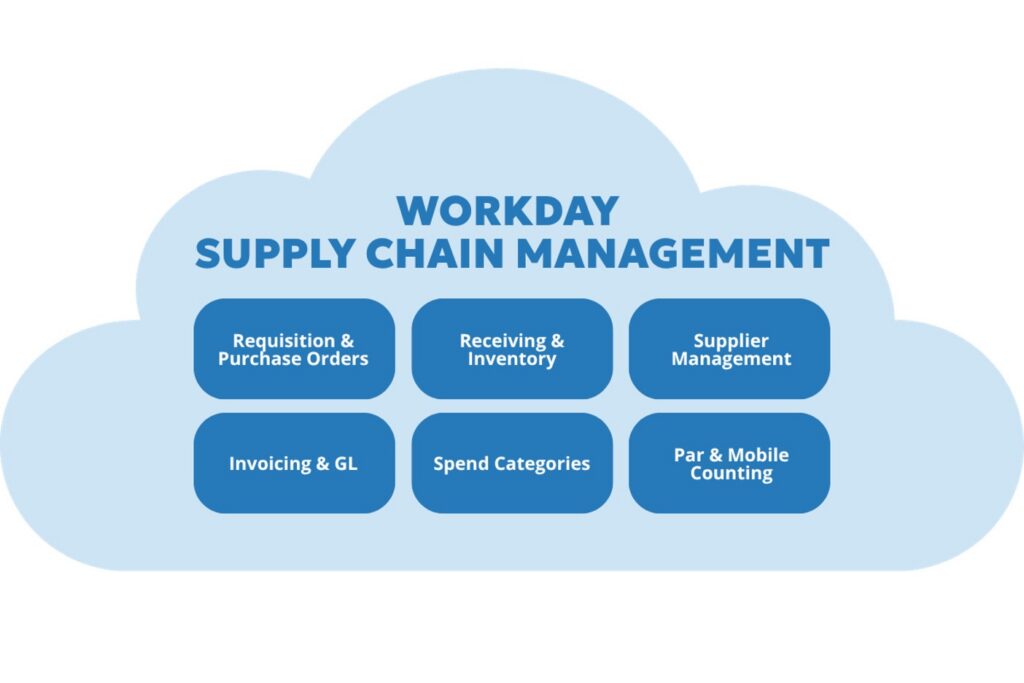
Workday built its supply chain product with healthcare in mind, and it shows. A few strengths stand out on implementations, including:
● One platform for shared data. Requisitions, purchase orders, receiving, inventory, and invoicing live in the same system as your general ledger. Supply chain spend connects to finance without interfaces, batch jobs, or month-end reconciliation projects.
● Spend categories that do real work. Workday’s spend categories tie directly to commodity codes, and the mapping runs both directions. That means you can assign a whole commodity range to a category or point a specific code at one. Supply chain teams tell us this simplifies punchout too. Instead of asking each vendor to map categories and send the file back, they map on their side and vendor spend lands in the right category automatically.
● Business process designed with control. Every transaction follows a defined business process, and you decide who touches each step. The interface is clean and configurable, and the Purchase Items page pulls everything you need to know about an item into one view.
● It plays well with third parties. Bolt-on point solutions connect and run well. Accounts payable automation platforms, like Yoga Flexible Software, pair nicely with Workday, so the platform grows with you as you automate more of the procure-to-pay cycle.
For organizations coming off a legacy materials management platform, the day-one visibility that Workday SCM provides can feel like a different world.
Where You’ll Need a Plan
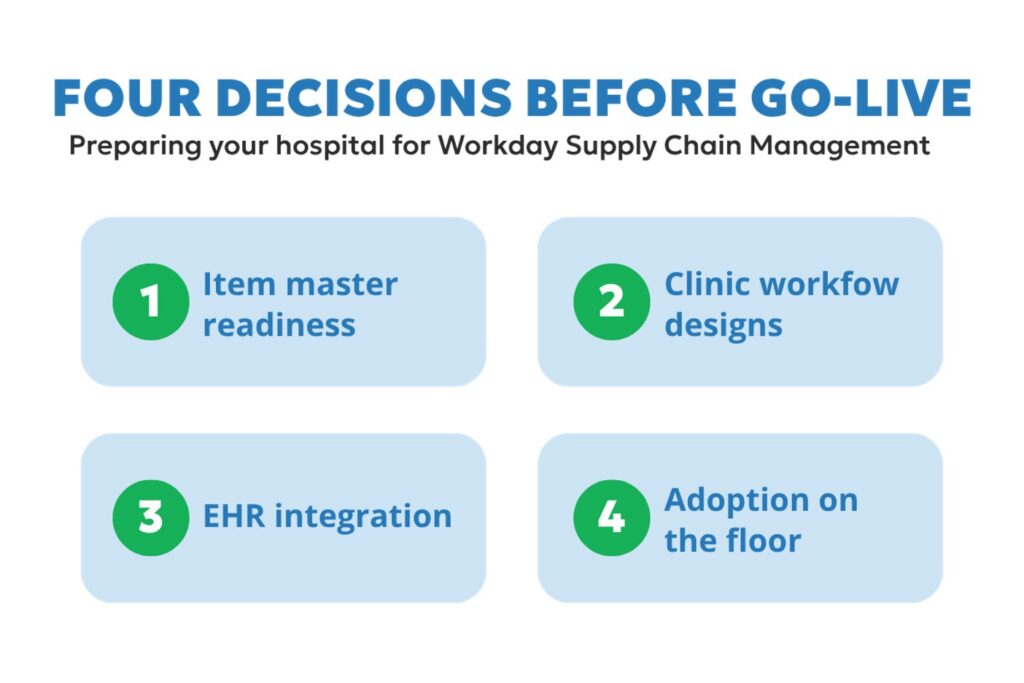
The aforementioned benefits are the tip of the iceberg when it comes to Workday SCM’s benefits. But of course, simply signing the contract and purchasing the software doesn’t guarantee success with the system. Four areas consistently determine how well Workday will deliver for you
Item master. Workday will faithfully automate whatever data you give it, including the duplicates, expired contracts, and mystery part numbers accumulated over 20 years. But like any modern cloud system, cleaning and rationalizing the item master before conversion is the single highest-return task in the entire project.
Complex clinical workflows. Core distribution and procurement are well covered. Procedural areas are harder. Bill-only implants, case carts, and point-of-use consumption in the OR require deliberate design decisions, and sometimes supporting tools, to get right. Hospitals that scope these workflows early avoid expensive surprises later.
Integration with clinical systems. Workday connects to Epic and other EHRs, but the connection is built, tested, and governed during your implementation. How supply data flows to charge capture and clinical documentation deserves as much attention as any financial configuration.
Adoption on the floor. New requisitioning workflows touch nurses, techs, and department managers who never opened the old system. Training and change management decide whether the platform gets used as designed or worked around within six months.
Notice what these four have in common. None of them are software defects. They’re organizational readiness questions, and every one of them is solvable with planning.
Software is Only Half the Implementation
A supply chain platform is only as good as your organization’s ability to use it. Configuration choices made in month two will shape your operations for the next decade, and hospitals rarely have staff sitting around who’ve made those choices before.
That’s where an experienced implementation partner earns their fee: bridging the gaps between what the software does out of the box and how your hospital runs, and knowing which gaps are configuration problems, which are process problems, and which need a supporting solution.
So, is Workday SCM a capable solution for your hospital? Yes. But is it the right fit? That’s a question you’ll have to answer after reviewing your current processes and future-state needs. As you evaluate options, consider enlisting the help of an industry expert like RPI.
RPI Consultants has worked in the healthcare space for over 25 years. We know the legacy systems hospitals are migrating from, the operational reality on the receiving dock and in the OR, and the decisions that separate a supply chain transformation from expensive software. Contact us below to learn how we can help.