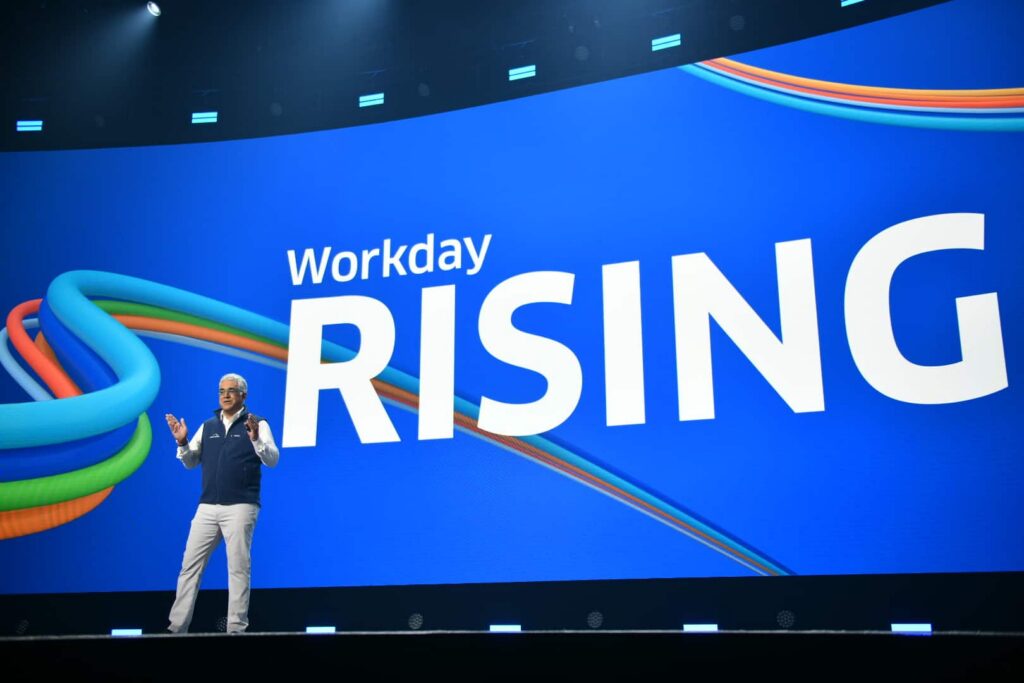
A group of RPIers took to Las Vegas to attend the Workday Rising conference earlier this month. The leading cloud-based ERP provider demonstrated its plans for product evolution, with an emphasis on healthcare first solutions.
While many keynotes open with the future, Workday spent a part of its Rising 2026 keynote on the past, providing an update on what it promised the year prior. User experience and an open platform were on that list, and so were agents.
It was a smart move that set up a great framing for the week, which was all about humans and AI agents working together, built on Workday’s data.
In this post, we’ll take a closer look at the five most prominent takeaways from the annual event as they relate to Workday customers. In addition, we’ll spend some time on what you can use today and what’s on the way.
1. A Single Platform for Everything AI
It wouldn’t be a conference 2026 if AI didn’t take center stage. Workday’s case for AI starts with a single version of the software. That gives it a large data foundation and the enterprise context AI needs to give useful answers. Day 2 of the event reiterated this point, emphasizing that being on a single platform is a much lower barrier for entry and allows customers to put AI to work with greater ease.
For customers eager to explore the AI functionality, be sure to first review your data quality. AI is only as good as the data feeding it and agents will work with whatever your tenant holds today, so data cleanup is worth putting in the legwork now.
2. Guardrails Are Necessary
With AI being such a capable tool, it follows that disciplined governance is an absolute must when deploying it across your organization. During the event, Workday acknowledged the risks, and pitched lawful, secure, auditable AI with “deterministic rails.”
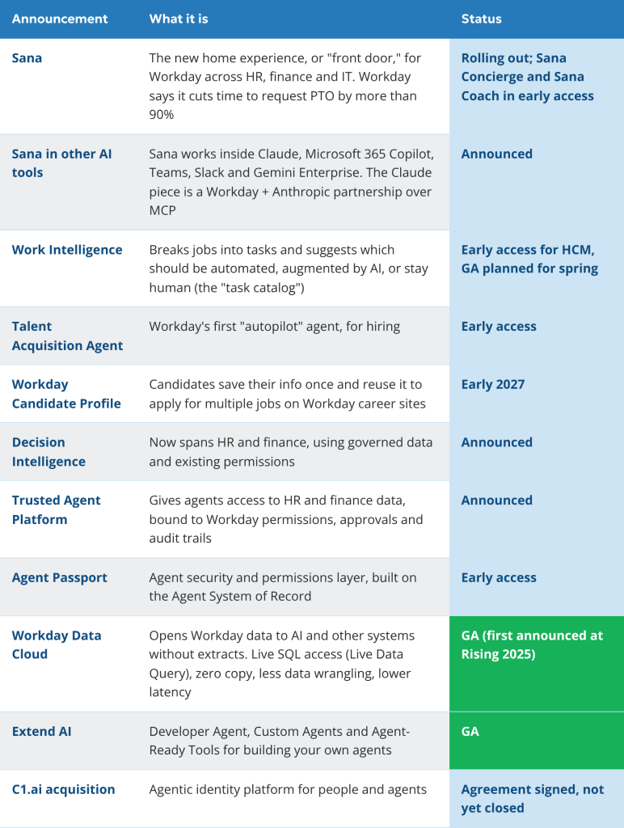
Two announcements reinforce this messaging. First is the Trusted Agent Platform, which gives agents access to HR and finance data, bound to Workday permissions, approvals, and audit trails. Second is Agent Passport, now in early access, which provides a security and permissions layer for agents, built on the Agent System of Record.
Before an agent ever touches payroll or hiring, there needs to be ownership around what it can see and do. That decision belongs to your security and functional teams, and early access is a good time to start holding folks accountable.
3. Four Ways to Use AI, One System of Record
The keynote laid out four paths for using AI: Workday’s own agents, APIs, Extend AI for building your own agents, and Data Cloud. All four run through the Agent System of Record. Workday also cited 17 out-of-the-box agents on stage.
Extend AI and Data Cloud are both generally available now. Extend AI includes a Developer Agent, Custom Agents, and Agent-Ready Tools, so teams with in-house developers can start there.
Workday first announced Data Cloud at Rising 2025. It’s now generally available with Live Data Query: live SQL access to Workday data, zero copy, less data wrangling, and lower latency. It opens Workday data to AI and other systems without extracts. For anyone maintaining extract jobs to feed other systems, this is the announcement closest to daily work.
4. Sana Becomes the Front Door
Also introduced at Workday Rising 2026 was Sana—the new home experience for Workday users. With this addition, Workday says it cuts the time to request PTO by more than 90%! It’s rolling out now, with Sana Concierge and Sana Coach in early access.
Sana also works inside Claude, Microsoft 365 Copilot, Teams, Slack, and Gemini Enterprise. The Claude piece is a Workday and Anthropic partnership built on MCP. Employees can make requests without leaving the tool they already use.
Interface improvements like this are just one-way customers can improve the employee experience for their teams. It also shows that Workday is constantly working toward a home screen that meets employees wherever they already work.
5. Planning Shifts to Work
Finally, Workday wants customers to redesign processes around AI at full scale, and Work Intelligence is the tool for it. The solution breaks jobs into tasks and suggests which should be automated, which augmented by AI, and which stay human. Workday calls this the task catalog. Work Intelligence is in early access for HCM, with general availability planned for spring.
Two hiring announcements put this into practice. First is the Talent Acquisition Agent, Workday’s first “autopilot” agent, which is in early access. Second is Workday Candidate Profile, which lets candidates save their information once and reuse it across applications on Workday career sites. That one arrives in early 2027.
Workday’s messaging also kept returning to the idea that customers using these AI tools won’t need consulting. That’s hard to square with a full-scale redesign of operations. A task catalog can suggest what to automate, but deciding which roles, approvals, and handoffs change, and bringing people along, is change management. That work lands on your team either way, and it goes better with a plan in place.
Workday Announcements & Roadmap
As mentioned above, Workday Rising 2026 proved to be an exciting time for customers, regardless of industry. Below we detail some of the major enhancements now available and on the roadmap:
Moving Beyond Workday Rising
Rising 2026 gave Workday customers more to evaluate than to switch on today. Data Cloud and Extend AI are generally available now. Most of the rest is in early access or still ahead. For health systems, Data Cloud is the practical place to start: it’s generally available, and Intermountain is already using it.
That leaves a window to decide who owns agent permissions and which processes deserve a redesign. Customers who use it will be ready when early access becomes general availability.
Workday’s new AI tools are rolling out on a schedule, and the organizations that plan ahead will see the most benefit. RPI can help you sort which announcements fit your roadmap and get your tenant ready for them. Contact RPI to talk through where to start and get more from your cloud investment.