The healthcare industry is at a crossroads. Staffing shortages, supply chain bottlenecks, and fragmented systems are driving up costs and driving professionals to burnout. But smarter technology could be the antidote.
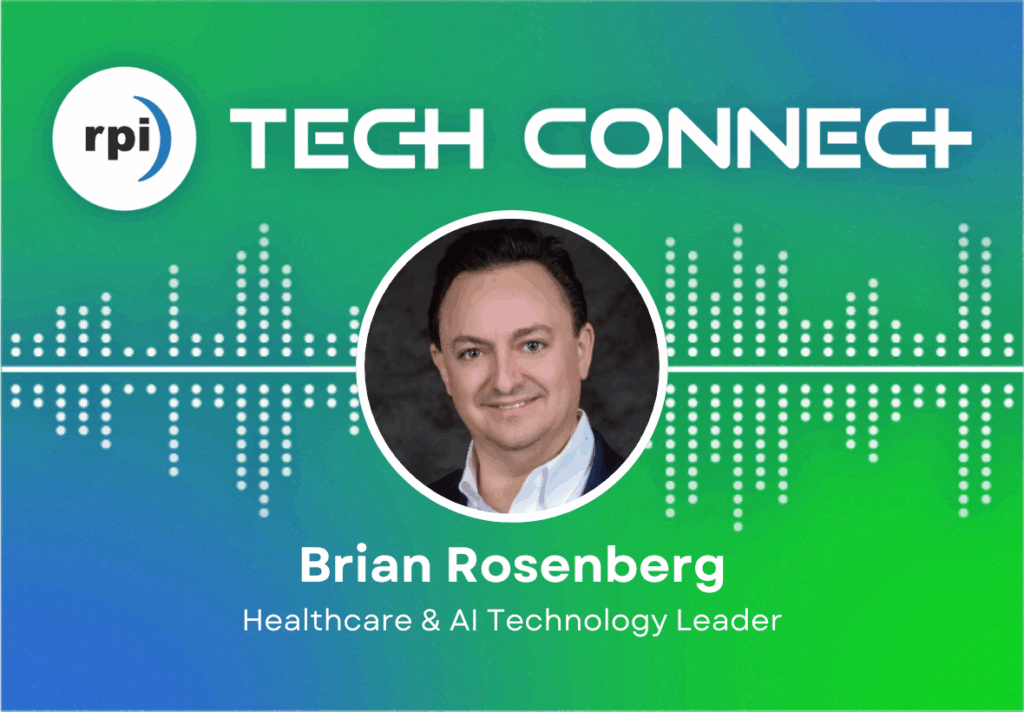
In this episode of RPI Tech Connect, longtime healthcare tech leader Brian Rosenberg joins the program to explore how AI and ERP systems—like Infor’s new Velocity platform and RPI’s own Yoga—are reshaping everything from patient scheduling to invoice processing.
Tune in for a candid discussion on why providers see tech as a “necessary evil,” how ambient AI is giving doctors back their time, and why continuous improvement—not just go-live—must be the goal. Whether you’re on the front lines of care or behind the curtain, this episode offers insights on building a smarter, more sustainable future for healthcare.
Interested in listening to this episode on another streaming platform? Check out our directories on the WRKdefined network or watch the YouTube video below.
Meet Today’s Guest, Brian Rosenberg
Brian Rosenberg is founder of RPI Consultants, and has over 20 years of experience in building successful consulting practices as well as designing, deploying, and optimizing enterprise software. He is a recognized expert in adoption of technology with deep expertise in the healthcare industry.
His many accomplishments include leading implementations of ERP and EHR solutions, design and build of shared service operations, founding of a charter school, leader of clinical technology strategy for a Big 4 firm, and founding several successful companies.
Brian currently teaches at the UNLV School of Public Health, is President of HIMSS Nevada, Honorary Commander at Nellis Air Force Base, and is known as one of the Las Vegas AI Guys, amongst other projects.
Meet Your Host, Chris Arey
Chris Arey is a B2B marketing professional with nearly a decade of experience working in content creation, copywriting, SEO, website architecture, corporate branding, and social media. Beginning his career as an analyst before making a lateral move into marketing, he combines analytical thinking with creative flair—two fundamental qualities required in marketing.
With a Bachelor’s degree in English and certifications from the Digital Marketing Institute and HubSpot, Chris has spearheaded impactful content marketing initiatives, participated in corporate re-branding efforts, and collaborated with celebrity influencers. He has also worked with award-winning PR professionals to create unique, compelling campaigns that drove brand recognition and revenue growth for his previous employers.
Chris’ versatility is highlighted by his experience working across different industries, including HR, Tech, SaaS, and Consulting.
About RPI Tech Connect
RPI Tech Connect is the go-to podcast for catching up on the dynamic world of Enterprise Resource Planning (ERP). Join us as we discuss the future of ERPs, covering everything from best practices and organizational change to seamless cloud migration and optimizing applications. Plus, we’ll share predictions and insights of what to expect in the future world of ERPs.
RPI Tech Connect delivers relevant, valuable information in a digestible format. Through candid, genuine conversations and stories from the world of consulting, we aim to provide actionable steps to help you elevate your organization’s ERP. Whether you’re a seasoned professional or new to the ERP scene, our podcast ensures you’re well-equipped for success.
Tune in as we explore tips and tricks in the field of ERP consulting each week and subscribe below.

Transcript
Chris Arey
What if smarter tech could help fix what’s broken in healthcare? From staffing shortages to supply chain chaos, today’s episode dives into how AI, ERP, and innovation are reshaping the future of healthcare. Stick around. This is RPI Tech Connect.
This is RPI Tech Connect and I’m your host Chris Arey. Today we’re heading into a sector that touches all of us, and that is healthcare. From frustrating appointment delays to confusing bills, we’ve all experienced the pain points.
But behind the scenes, healthcare organizations are grappling with some very serious challenges, ranging from healthcare workforce shortages to supply chain stress. To explore how technology can fix what’s broken and build what’s coming, I’m pleased to welcome someone who helped lay the foundation for much of what we do here at RPI and is who is uniquely positioned to talk about our topic today.
That would be Mr. Brian Rosenberg, the “R” in RPI Consultants, and longtime leader in the healthcare technology space. Brian, it’s an absolute honor to have you on the program today. Thank you so much for hopping on.
Brian Rosenberg
It’s a pleasure to be here, Chris. Thank you for inviting me.
Chris Arey
Yeah man, where are you calling in from today?
Brian Rosenberg
I’m in Las Vegas where I moved out here about 12 years ago now. I like it out here.
Chris Arey
Awesome. I love to hear that. Anything else you want to share about your background before we dive in?
Brian Rosenberg
Yeah, sure.
Over the past 12 years, I’ve been involved here in Las Vegas in the healthcare community extensively, and I’ve been involved in implementing healthcare technology for almost 30 years. I’ve had the opportunity to lead implementations of ERP systems, as well as implementations of electronic healthcare records such as Epic.
Anybody in the healthcare industry will probably know what that is, but for those of you who are not, Epic is the dominant player in electronic healthcare records with 270 million patient records stored on Epic Systems in United States.
I’ve been a part of building shared service operations. I’ve helped with selecting ERPs, doing QA over ERP projects. So that’s kind of all in the work life. Beyond that, I’ve been involved in outside of healthcare, involved in being a founder of an education technology company. I was a founding board member of a charter school here in Las Vegas.
I also had the opportunity to lead clinical technology strategy for a big four consulting firm and currently teach at UNLV, where I teach project and change management, something important to me. So I do a lot of speaking and writing about healthcare technology topics. I’m the president of the HEMS chapter here in Nevada. I’m also a board member of the Health Information Exchange and honorary commander at the hospital in Ellis Air Force Base.
So, through all of those things, I have had the opportunity to see lot of different perspectives of the industry. From the perspective of a technologist helping companies with adopting technologies to talking to healthcare leaders all over the world about the challenges they have and some of the different ways that they’re trying to solve those problems.
Chris Arey
Awesome, Brian. It’s an inspiration to hear all the different things you’ve had an opportunity to work on. I’m really looking forward to hearing your insights during today’s discussion. Thank you for sharing a little bit about yourself there.
I think a great place to start today would be to talk about the patient experience. It can be a pain sometimes, getting an appointment can be tough, and it seems like you’re filling out the same form repeatedly. By the time you finally understand your bill, it’s in collections.
Why is the healthcare experience so fragmented? What are the factors leading to this experience?
Brian Rosenberg
It’s interesting you mentioned the filling out the forms over and over again, because my mother has told me that the number one problem I need to solve in the industry is not having to fill out the same forms repeatedly.
And I have been working for a long time to do that and haven’t fully eliminated or solved that problem. Part of it is that we have so many disconnected systems in our industry. Everybody has different systems that don’t speak to each other effectively. We have mechanisms to share medical records with each but we don’t all take advantage of them within the industry.
There’s also a general perception in the healthcare industry that the healthcare system owns that data as opposed to the patient owning the data. And so not every healthcare system shares information.
As a result, you have some health information exchanges like we have here in Nevada, but there’s no law requiring a medical provider to share their medical information with health information exchange. And as a result, not all information is available.
And that’s part of the reason that you need to fill out those forms every place you go. And in some cases, they do have that information, but the habit of filling out the forms is so ingrained that they aren’t necessarily taking advantage of what is available to them. There are a lot of different aspects to what’s going on there. And I think, you know, it’s interesting to start with that patient perspective because it’s something that we all can identify with, right, whether you’re a part of the healthcare industry or not.
Chris Arey
Yeah.
Brian Rosenberg
You understand that experience and you want to have the best experience possible. But healthcare is also burdened with a very complex revenue cycle because what insurance company you have determines what gets paid for and what doesn’t. The billing process can be completely different.
You’ve got big disparities in what technology might be available at a hospital versus a hospital chain versus individual physicians’ offices. And in general, providers tend to see technology more as a barrier than a helper. And I think that there’s reasons for that, and I agree with some of that sentiment to a degree, but in general I think that healthcare providers see technology as more a necessary evil than something that is a helper to them getting their jobs done.
Chris Arey
Ooh, unnecessary evil, is that because they feel like they have to spend more time on the computer and less delivering care? What is it?
Brian Rosenberg
Yes, if you’ve ever been to a doctor’s office and you see the doctor is sitting in front of you typing on the computer looking information up or taking notes, they’ll refer to that as treating the computer screen rather than treating the patient. This is especially true when you get into primary and specialty care where you’re spending a lot of time with the patient.
And you know, from meaningful use, our government created funding to allow organizations to adopt electronic healthcare records. A lot of people adopted them because they wanted to, and others adopted them because there were financial penalties if they didn’t. But we were successful in creating large-scale adoption of electronic medical records.
In that area, the United States is ahead of much of the world in electronic healthcare records adoption. The challenge is that many of those systems either don’t have the capabilities for streamlined workflows that allow the physician to be able to spend more time with the patient, or they’re not using the latest capabilities because they implemented this technology years ago.
But ultimately, there’s often a gap between the technology’s capabilities and what’s adopted. And in general, providers feel that it is a burden. They understand why it’s needed and that it triggers a lot of things about how they bill, but they would rather be spending time talking to the patient and looking and less time typing into the computer.
Chris Arey
On the computer, yeah, that makes sense. You said something there too that I’m glad you clarified. From the healthcare provider’s perspective, they’re dealing with payments from two different parties, right? There’s the patient, and then there is health insurance. So, I feel like that all gets messy too, right?
Brian Rosenberg
Right, and you think about it in the sense that every state has different health insurance companies, different mixes of them, and so when you go into a physician’s office, the insurance that you have might determine the medications that will be paid for, whether or not you’re eligible for particular tests, and they have to factor that all in to their care decisions.
And we tend not to think so much about the price of care as consumers, but I think that that is starting to change, particularly with high deductible.
But, you know, the exact care that you’re getting depends upon the insurance company and how that position works. And this is one of the aspects of our system that not only makes care different based upon your insurance provider but also makes the whole process just complicated.
Every provider has different billing processes and steps. And so what you don’t see as a patient is the hundreds of people that might be working at a hospital to do the billing to make sure those hospitals get paid for the services they provide you.
Chris Arey
Man. Okay. So let’s take a deeper dive here into the provider side. Healthcare systems are facing massive staffing shortages. I think that is known now and probably a result of the pandemic.
Not just nurses and doctors, but schedulers, billing staff, and supply chain teams. are all areas that are feeling the hit right now. What are you seeing in terms of operational strain? How are those things? Yeah.
Brian Rosenberg
There’s a lot of aspects. I mean, first off, there are the reimbursement rates, which are lower than they want them to be. There’s also the fact that part of what they’re getting paid affects their ability to deliver higher quality care.
But probably the most significant thing, particularly that has become much worse in the last few years, is the cost of labor, shortages in labor. And we have shortages on the nursing side and on the provider side.
The exact level of that shortage can vary from market to market. Here in Las Vegas, it’s particularly challenging, but every market faces some element of this. And you also have, you know, challenges with things like, you know, lot people don’t realize that hospital staff, a lot of those physicians are contracted.
As a result, getting them to use all the technology and follow all the different parts of the process the way that the healthcare systems want to do things is difficult as they aren’t necessarily feeling the same obligation that an employee might.
And the technology to do this is expensive. You know, when you look at electronic healthcare records, especially when we’re talking about clinical care, it can cost a large healthcare system hundreds of millions of dollars to implement an electronic healthcare record system. And this has a significant impact on the cost of care.
That same system might require hundreds of people to maintain it within that hospital after it’s been implemented. One of the reasons that I moved out here to Vegas is that my father lived out here. Lost him last year.
My father and I used to have interesting debates about the idea of implementing package software solutions versus custom building solutions because he actually had built the first payroll system used by the State Department. It paid every employee in every embassy around the world. And he would tell me the story about how he built it with a small team of people and designed it to work with every currency.
And he said that he was able to do this without any of the benefits of a package solution that did payroll. Part of why he says he was able to get it done is he didn’t realize that it was pretty much impossible, so he just did it. But he used to tell me, I always hear about these packaged solutions, but then I see all the money that people spend on them.
I think that electronic health records are sort of the ultimate example of that. It’s very, very expensive technology to implement, to maintain. And you have many other technologies in hospitals that have, from imaging systems to ERP systems, other things, all of them have various costs and complexities and they all need to talk to each other and interface with each other. All of this ultimately also has an impact on the operational costs for those healthcare systems and ultimately results in an increase in the cost of care.
Chris Arey
Yeah, first off, I’m sorry to hear about your father. That’s never easy.
You mentioned something there that made me think of the significance of training. You buy software, not everyone is equipped to use it. And when you’ve got these independent contractors coming in who are just, I hate to call them this, but like a hired gun, you know, they do X, Y, and Z tasks. That’s it.
The expectation for them to come up to speed and use the different technologies the way they’re intended to is probably why things don’t end up happening the way that they are supposed to.
So the hard truth is that we’re not going to magically hire our way out of this workforce shortage. We don’t have the pipeline. So the real question is, how do we enable the people that continue to work in healthcare to do more with a lack of support on the horizon?
Brian Rosenberg
Yeah, you know, it’s going to be an ongoing challenge. As we look at, we’re going to continue to have more nurses and more providers come into the market. But we have an aging population, right? And so the ability for us to be able to hire fast enough to keep up with that increased need is going to continue to be a challenge for my lifetime and perhaps for yours. These aren’t problems that are going to be solved any time soon. We’re going to, we really need to focus on making providers more efficient. And that comes down to tools that will help them to do their job better, not get in the way of them doing their job.
It comes down to increased automation of tasks that can be automated. And this is going to probably be a recurring theme that you’ll hear me talk about throughout this conversation, because I see AI as the great equalizer to allow us to be able to keep up with the workload that is going to be put in front of us.
Right now, there is more work than healthcare workers can do. We need to take the paperwork off; we need to take the manual steps off. When you look at things like scheduling, it’s also important to be able to make sure we’re using our resources effectively, but we’re putting them in the right place at the right time.
We need to know who’s coming in and then provide tools in general that will allow people to feel more comfortable and happier with their jobs, so we can reduce burnout while doing anything we can do to speed up the hiring and onboarding processes. These are things that make a big difference for healthcare systems.
Chris Arey
So I’m glad you brought up AI. These days it’s tough to not talk about, but I think it’s an important part of the equation for solving some of these challenges we’re talking about here. Infor, I’m sure you’re aware of Infor, just released a new solution they have called Infor Velocity, and AI is a big part of it.
So when thinking about AI and ERP together, I think it’s a good way to maybe introduce AI to these healthcare professionals in a way that’s less intrusive, it’s being served up in a way that they’re more familiar with. But I want to hear now from your perspective the role that AI can play in different parts of ERP, from HR to supply chain and finance. What can you share?
Brian Rosenberg
I’ve been speaking a lot about AI here in Las Vegas at conferences. Obviously, this is on everybody’s mind right now. But I think one thing that’s changed is that people have gone from being interested in talking about the theory of what AI can do. Right now, there’s a lot of interest in getting practical. What can I do right now?
Already, the technology has outpaced the industry’s ability to adopt it. When you mentioned what Infor has available, when you look at what clinical solutions have been available.
AI has a variety of use cases that are available to everyone right now. And it’s time to start doing something, right? It may not be everything, but you’ve got to start adopting. I’ll take it outside of ERP first, then we’ll talk about the ERP side.
When you look at clinical care in general, one of the biggest things that has seen a big growth curve is ambient documentation, where we talked about the doctor’s visit before and the doctor is typing into the computer. Now with ambient documentation it can listen to your appointment, take notes for the doctor, and then create a document for the doctor afterwards that the doctor can review and approve.
It will capture all the information so the doctor can look at you during the appointment so the doctor can focus on the patient. And that’s the kind of thing that can free up time. Now they don’t have to spend time in between appointments or at home that night typing in all that information from the notes from what they remember, right? That’s an example. But there are scenarios where using genAI gets really interesting.
For instance, you can use your natural voice to schedule an appointment with an AI and say, I want an appointment on Wednesday after three o’clock, if you don’t have it this week, I want it next Tuesday. And it will listen to that. It will recommend an appointment, provide that feedback, allow you to book it right there. Those are the kinds of things that can really be game changers in that patient experience.
And taking it back into the back office in ERP, you’ve got HR to take that as a starting point. You know, we used to spend an incredible amount of time writing job descriptions, now we can use AI to drive job description creation. Again, you must check things, and that should be a continual theme with everything we talk about with AI, right? But if we speed up that process and incorporate in all your procedures and all the things that you want to make sure in every job description, it can do that for you instantly.
Being able to match candidates with job listings, being able to find the best candidates automatically. Those are the kinds of things that can speed up manual processes that you have today, help you hire the right people.
When you get into supply chain, I think that supply chain is kind of interesting because there are some interesting new challenges, you know, with tariffs.
Chris Arey
There are, yeah.
Brian Rosenberg
Yeah, and you know, you’re looking at hospitals are really, really struggling financially as a result. But with the way things are moving around, by the time someone listens to this, it might be something completely different. And that uncertainty is causing some concerns. But a lot of medical supplies do come from China, right? And so there are costs associated with importing those with tariffs.
That’s going to impact the cost of care that impacts the cost of inventory for hospitals. So being able to source products as effectively as possible. The one thing that we learned during COVID-19 is that a lot of healthcare providers have grown used to using group purchasing organizations that do all the negotiating for their major supplies and then they buy through a distributor that makes sure they get the supplies.
When those product shortages came during the pandemic, it was hard for them to go out and source from other places because they weren’t used to doing that. So, healthcare systems don’t necessarily have a lot of tools to say, where should I buy this product from optimally? What are the comparable products? And I think that AI is going to be a big tool to help with that.
Also, to be able to make sure we’re stocking smarter, right? Using inventory intelligence to say, based upon your historical patterns, you should buy more of this. And even, you know, one thing that I found during the pandemic was that a lot of healthcare organizations struggled to source N95 masks, for example. They would often have it in one warehouse, but not in another warehouse. And they’d be going out and buying it rather than moving it.
Chris Arey
Yeah.
Brian Rosenberg
Because they didn’t know how to really move that inventory within their own supply chains. And so suggestive buying, to be able to say, this is the optimal place for you to get this product, and this is the optimal amount for you to order, I think, is the kind of thing that is going to be a much better use of these products.
It will allow people to be able to source better in the future and to be able to help people to make sure they’re better complying with contracts, ultimately turning them into more effective buyers.
Chris Arey
Yeah. You mentioned a lot of different use cases of AI here that sound very helpful in reducing manual work, from job description creation, to note taking during a patient session, to the inventory intelligence and predictive buying for supplies.
Do you have any kind of understanding of how well those things are being taken advantage of today?
Brian Rosenberg
All of them are being taken advantage of, but it tends to be that you’ve got a small number of companies using each use case, right? There’s an opportunity for I think every healthcare provider, and this is probably true not just in healthcare providers, this probably applies universally.
Every company should be talking about their AI strategy, right? Talking about how they incorporate AI into what they do, not just implementing technology. That means process change and that means job change. We need to change the way jobs are done based upon this new technology.
We also mentioned work shortages. Another thing that’s happening in a lot of jobs is people are aging out of them, right? And you see that in the healthcare revenue cycle, for example, but you see this in a lot of areas where the average age of employees is going up and up. We have to be able to get by as an industry with less people, and that ultimately means leveraging technology.
Every job can benefit from some elements of using AI as a part of the job. And everybody should be thinking about how they can take the tools available to them and use them to do their job better.
Chris Arey
So I love all this in theory, and I have a question for you. Given the current work environment of a lot of these organizations and the strain that the workforce is feeling, how do they take the time to come up with that strategy and decide how they’re going to change processes when they’re still trying to keep the lights on?
Do you bring in a third party? What is the reckoning and the catalyst for making that, forcing those things to happen?
Brian Rosenberg
Well, you see this with ERP implementations. It’s one of the Stephen Covey 7 habits called sharpen the saw. The concept of that is that somebody’s walking through the woods, they see somebody trying to cut down a tree with a dull saw.
They say, why don’t you sharpen the saw so you can cut down the tree faster? And the guy says, I don’t have any time for that. I’m too busy trying to cut down this tree.
That is the situation that we see with projects all the time. This was an issue with ERP implementations that RPI did 25 years ago, and it’s an issue with ERP implementations that it does today. It is always hard for people to step back and develop a plan, right, instead of just getting stuck in their day-to-day jobs. But ultimately, you have to do that, right?
You don’t necessarily have to have a third party to do that, but more often than not, it is one of the most effective ways to do it, because the third party is going to be able to look at across the perspective and give you a new point of view and isn’t going to be caught up in your day-to-day problems and politics. It can then really look at it and give you an end-to-end answer to that problem.
And from an AI strategy standpoint, that’s part of determining which AI technology one should adopt. You mentioned Infor has lots of use cases for AI. Which ones are going to be most valuable to me? Because I’m probably not going to get around to adopting them all. If I try to, I might stall them all, right? But which ones are high impact, high value, right? Which ones solve problems that I have today.
Get some things in place, right? Make the change. Rewrite the way jobs are done. Change the process as a part of that. Change the job descriptions if necessary. AI can help do that, so that’s easy. Go through a program of piloting change, roll it out, then expand use cases on a regular basis.
But to keep up with the technology, you have to be adopting and developing a culture of continuous improvement.
Chris Arey
That’s a big one here. We always push for the continuous improvement committee, which is what we call it. You have to be striving for more.
Brian Rosenberg
Yeah, that’s right. I’m a Six Sigma guy. I’m Six Sigma Master Black Belt. I always talk about the idea of continuous improvement, starting from the understanding that you’re never going to have a perfect process. It always needs to be a little better than it was the day before. You look at your highest priority and highest impact problems. You put a solution in place. You try it. If it’s successful, you roll out another solution to make it even better. That’s a cycle.
Chris Arey
The iterative process.
Brian Rosenberg
That’s right. It never ends. And I think one of the challenges that we always have seen too on ERP implementations is the idea that the Go-Live is the end of the project, which is a faulty way to look at it, right? The Go-Live is in the middle. Ultimately, you’re now going to be on a path of continuous improvement to drive more value out of your ERP system, your EHR system, whatever system it is, that concept still applies that you want to continually drive better value out of it.
So creating a culture where you’re embracing that kind of change and continually adopting the new technology that becomes available, I think is going to be crucial to be competitive in the future. And that applies to any industry.
Chris Arey
I really love the metaphor you gave there with the tree and the saw. What is it called?
Brian Rosenberg
Sharpen the Saw, it’s one of Stephen Covey’s seven habits, yes.
Chris Arey
It paints such a crystal-clear picture of the situation. It’s like, I understand you’re busy, but you could be doing way more if you just took a step back and looked at the saw you’re using here. You could cut twice as fast if you just took the time to sharpen your blade. I really appreciate that.
Brian Rosenberg
It can’t be truer than something like that. If you don’t take the time to try those tools and use how you learn those tools, you’ll never get the benefit, right?
Chris Arey
Yeah, absolutely. We talked a little bit about use cases in supply chain and HR. I want to spend a moment here to look at finance and AP specifically. I know you have a lot of experience in that area, and I’m sure by now you’re familiar with the Yoga product here.
Brian Rosenberg
Yes, I am. actually, you so as I had actually been sort of the architect of accounts to be able to share services for when RPI started doing that, it might have been like 2003 that we started doing shared service operations and building those for a lot of big health care systems like BondsCore and Catholic Health West, which is now Common Spirit, and Catholic Health East, which is now Trinity.
Spent a lot of time helping people design those processes and implementing AP Automation as a part of it. Seeing how the technology has evolved- I love what RPI has done with Yoga, it’s sort of the ultimate evolution of that technology and the processes that was a key part of designing back then. It is very exciting to see.
AI is really kind of delivering on lot of the promise of that technology early to be able to continually make that technology smarter and being able to easily adjust to process changes and to different needs. Yoga is a very powerful tool, very impressive in how it incorporates all of the different best practices that we had developed over a 20-year period. I think that that product is possible because of technology like this.
It is important to realize that when we talk about AI, there’s generative AI and then more traditional forms of AI. AI itself is not new. One story I’ve told when talking about that is if you rewatch the movie War Games, which is a movie about AI starting a nuclear war. That movie was in 1983.
Chris Arey
Right? Are we there yet, Brian? Are we there yet?
Brian Rosenberg
We might be further along, actually. Our fear of AI is nothing new, but the technology has evolved to the point where there’s so much more we can do with it, with generative AI being the new iteration. But products like Yoga wouldn’t have been possible 20 years ago.
I think it’s incredible what RPI has been able to do that. I think there’s incredible potential to continue to make that product stronger and stronger in the future. It’s a good example of where AI can be applied in finance. It’s not just about processing invoices faster, though.
Chris Arey
Yeah.
Brian Rosenberg
Certainly that’s a part of it. It’s also being able to capture more discounts. It’s being able to pay suppliers faster so that they’re willing to offer you better terms. It’s about having more visibility into your finances because if you don’t have an invoice in the system, then you don’t know to approve for it and your financial statements aren’t accurate.
So all of that applies to it speeding up approval routing, reducing that manual entry. There’s so many capabilities in Yoga and that type of solution. Outside of AP, when you get into other areas of finance, Iike speeding up report writing. The days where you need to send your report to somebody in IT to write it for you, and it takes three months, and they get it back to you, and it isn’t what you wanted.
AI is already starting to streamline report writing where you can use more natural
language to generate ports. That technology will get better, and finance people won’t require any IT skills to be able to create reports.
Chris Arey
Yeah, the reporting area specifically has been a big ask. We do a survey each year and we ask the Infor community, what are some areas where they’d like to see improvement and reporting continues to be one that folks want improved functionality with. It’s funny that you mentioned that, because that has been something that we’ve been talking about. Here at RPI, we do offer a holistic approach to solving that need. I appreciate you singing the praises to the Yoga team. If they’re listening, we can all thank Brian now.
Brian Rosenberg
Well, it’s really great work that they’ve done, and it is fun for me to see as sort of a culmination of work that we’ve done in the past and see all of it in one product. It’s great.
Chris Arey
Yeah, I bet. And it’s only getting better by the day. One of the solutions engineers on the Yoga team was on the podcast recently, and he was talking about custom classification models they were building. Every time an invoice came in, they would change the vendor’s name from its actual name to an alias they had. When they made that switch three times or more, it would suggest that change every time an invoice came from that vendor.
It’s little things like that too that are like looking to save the user time and you know, just increase efficiency, right? We only have so much time in the day. So, looking for places where you can shave off a little time, I think it really makes a difference.
Brian Rosenberg
Yeah, and will say that, you know, accounts payable has been a big focus area, a big part of my career in setting up those kinds of shared service operations for AP and procurement. And for those who don’t have the technology to do data capture and automate invoice processing, you are missing out.
Also, many people that do have that kind of technology have much older versions, and technology changes over time. So if you have one of those older solutions, you might be missing out on what the next wave of products, like Yoga, can do.
Chris Arey
Thank you, Brian. So we’re getting close to time here, but I have a question for you. You know, we’ve identified some of the challenges that are happening in the healthcare space, some of the opportunities there are with AI and all these different use cases we discussed. Does now feel like a different time for the healthcare like industry as a whole? Like what is your perspective on where we are today and where we’re going?
Brian Rosenberg
Yeah, I think that the need to change in healthcare is more apparent than ever before, both to become more efficient and this provider problem, as you mentioned, is not going away, right? We can’t graduate nurses and physicians fast enough to meet the demand and the need of the aging population. We must make the industry more efficient.
I think AI is the real thing in that, you know, we’ve had some false starts of technologies, I mean, like, you know, some like virtual reality that maybe hasn’t quite met the expectations people had. But I think I’d like to think of AI kind of like how, when I first entered the workforce, not to age myself here, but when I first entered the workforce, email was just becoming a thing. And cell phones existed, right? But I remember I worked for a firm doing software implementations when I was like 22, and this would have been the early 90s. And they had one cell phone, for the entire implementation team.
Chris Arey
Wow.
Brian Rosenberg
I was told that we could take it when we traveled, but it was like $6 a minute to use it, so you better not use it unless it’s an absolute emergency, right? But the internet, you know, was not what it is today, right? And to everybody listening, just the idea of doing your job without the internet or email or a cell phone to probably everybody probably sounds like crazy talk. But hey, we used to do that.
And we didn’t even conceive of the idea of having these tools available to us. I think AI is going to prompt a similar shift, except it’s going to be faster, right? Now, back in the 90s, if you did use email, you put it under resume as a skill.
You know, Chris, I don’t know what’s on your resume, but I’m willing to bet if you put using email or cell phones as a skill that it wouldn’t impress anybody right? But back then it did.
AI is at that stage right now. But I think the difference is that with AI, it’s not going to be 30 years from now that it’s just going to be a part of everybody’s job and how everybody does work. It’s going to be like that five years from now.
Chris Arey
Yeah.
Brian Rosenberg
And so if you’re somebody who is concerned, does AI have the potential to eliminate their jobs? I don’t think AI is going to replace as many jobs as people think, but people who use AI to do their jobs are going to replace people who don’t. And you’re going to see that across every industry.
Chris Arey
Damn, yeah. We’ve talked about that on the podcast on an episode I did with Melissa Olson. I believe we probably met her. Just like you said there, AI isn’t going to replace you, but somebody using it will. You must lean into this. And the longer you put it off, you’re doing yourself a disservice by not embracing this thing that is not going away.
Brian Rosenberg
Yeah. Yeah, if you’re in accounts payable and you’re not thinking about using AI, then you’re going to fall behind. If you’re in HR and you’re creating job descriptions manually and not using tools available for that, you’re going to fall behind. The tool is still different for every job, right? But the concept is the same and it will speed up everything that you do. I’m not suggesting that you just take what AI outputs and just say, don’t even need to look at this. It’s really important people look at the initial product.
Chris Arey
It is, the review process is critical.
Brian Rosenberg
Yes, but the technology is capable of doing so much.
Chris Arey
It is.
Brian Rosenberg
One thing I would say to everybody is to use it. And I think I’d say, especially, guess, coming from somebody in their 50s, that this technology curve, don’t think that the age is as big of a differentiator as it has in the past. It’s not like people graduating college in their 20s have so much more experience with AI than people in their 50s do.
Everyone has an equal opportunity to embrace this technology. Look at it both from the perspective of what your Infor platforms provide you, and the tools that you have available to you as a regular consumer to make your day-to-day life easier, like chatGPT.
Chris Arey
One last question for you, healthcare-related.
Brian Rosenberg
Yeah, sure.
Chris Arey
You mentioned earlier that you teach at the University of Las Vegas in public health. Given the current climate of that space, what advice do you give students who are interested in entering the healthcare space?
Brian Rosenberg
Yeah, that’s a good time for that question because just a couple weeks ago, I spoke on a similar topic at a student organization where a lot of them were graduating because it’s that time of year, right, and going into the workforce. Many of those students had work experience and were now reentering the job market with a more advanced degree.
I think that part of it is looking at that same concept of embracing AI I think applies so much more so. But be prepared, and embrace change in general. Every industry is changing constantly. Health care is by no means immune to that. And if anything, COVID showed us the need to be prepared for anything.
That was something that we never could have predicted, right? And so, going into every job with the understanding that you’re going to embrace the tools available to you. By bringing in tools where they’re not available but should be, you’re going to make change a daily part of your life.
Those are the people who would be the most valuable. People have asked, are you concerned about your job and what you do with AI, and I’m not. Because one consistent thing that I’ve found with technology is that any new technology coming in requires people to change and people need help with that change.
When you need help, bring in that help, right? Where it makes sense. Whether it be helping to implement technology, helping your organization prepare for the change, or changing your processes. Get help from those who can provide that independent perspective and bring in some of those best practices. But, you know, with a lot of these AI tools, just try things. That would be my biggest piece of advice, try things. You can’t break it.
Chris Arey
You can’t, and this is a great time to experiment with it too. That discussion I mentioned that I had with Melissa, one of the takeaways she had for the audience, was to try different tools. Like, chat GPT, Claude, Copilot, they all have generative AI, but like, your prompting skills and the way that you interact with the technology might differ and you might find one that you prefer, and you’ll never know unless you try, right?
Brian Rosenberg
Yes, and the more I use it, the better my prompting becomes. And I learn new things that I never imagined that I could do. And sometimes it is a little scary, but it’s there. Whether we choose to embrace it or not, it is there.
Chris Arey
It is. Well, Brian, this has been such a timely conversation. Thank you again for hanging out with me this afternoon. You may not know this, but I always like to ask my guests when the show is coming to an end if they want to share one actionable takeaway for the audience. So I’d love to hear: if our audience could walk away with one thing today, what is it that you want them to do?
Brian Rosenberg
We hit a lot of different things. I would say, I would go back to what we just talked about. Try, ChatGPT. If you have tools available at work, try them. Just do a little bit more every day so that you’re constantly progressing. Don’t be concerned about technology. I think that that’s the way you set yourself up for long-term success. Champion bringing in new tools, embrace them. Be a champion of change rather than a detractor from it.
Chris Arey
Awesome, Brian. Very inspirational. I feel motivated now. For those of you listening in, if you have any questions about today’s discussion or you want to learn more about how RPI can help you on your journey, whether it concerns ERP, AI, or a combination of the two, we’d love to hear from you.
You can email us at podcast@rpic.com. Again, that’s podcast@rpic.com. Thank you so much. This is Chris Arey signing off of RPI Tech Connect. See you next time. Thanks, Brian.
Brian Rosenberg
Thank you, Chris.