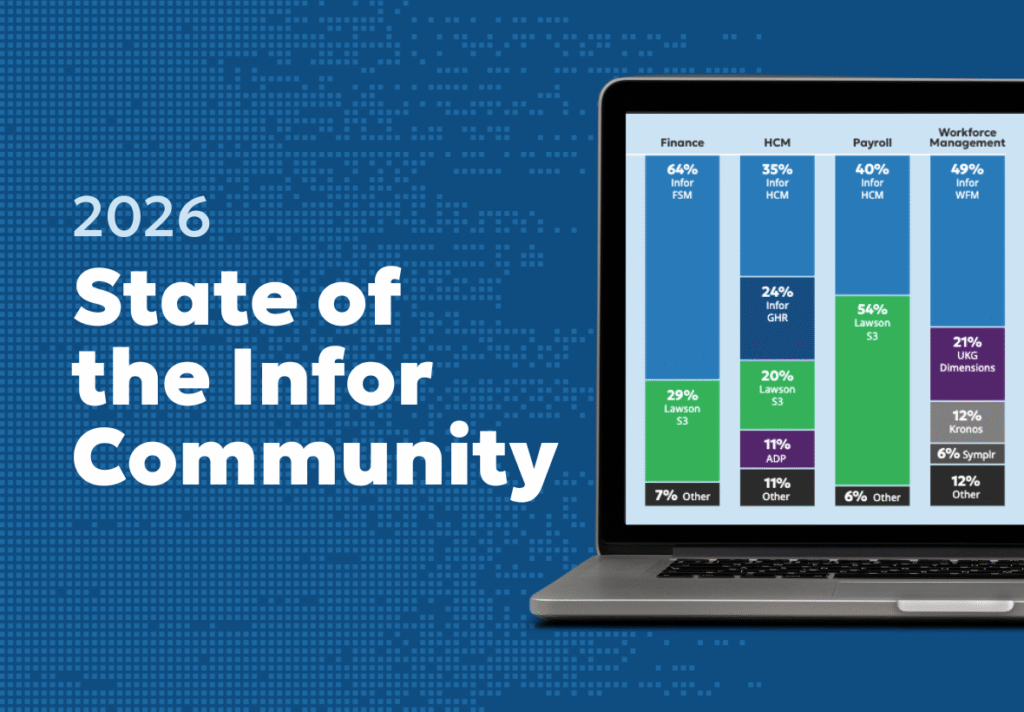
In December 2025, RPI Consultants conducted its third annual State of the Infor Community Survey to better understand how organizations across the Infor ecosystem are evolving their ERP systems.
Each year, this survey is designed to capture a realistic snapshot of the Infor customer experience. Rather than focusing solely on technology, it explores how teams are navigating cloud adoption, system optimization, analytics, and emerging capabilities like AI.
This year’s results point to an ecosystem at an inflection point. Cloud momentum is accelerating, AI is moving beyond experimentation, and long-standing assumptions about reporting and training are being challenged.
Below are five of the most compelling insights from this year’s survey. To explore the full data set, including detailed breakdowns and visual trends, download the State of the Infor Community Infographic.

Takeaway 1: Cloud Migration is Accelerating
Cloud adoption within the Infor community is reaching a critical mass. This year, nearly twice as many respondents reported being in an active migration for their financial and HCM systems compared to last year.
This acceleration is also reflected in the declining number of organizations still running on legacy platforms. Usage of systems like Lawson S3 for finance and HCM continues to drop, signaling that many organizations are actively planning or executing cloud ERP for their next phase.
While the 2030 end-of-life support date for Lawson may still feel distant, the data suggests that many teams are no longer treating cloud migration as a future initiative.
Services organizations, many of which are risk-adverse, recognize that these projects can span upwards of 18 months, and are being strategic in beginning their move to the cloud sooner rather than later.
Takeaway 2: AI Adoption Has More Than Doubled
One of the most notable year-over-year changes is the growth of artificial intelligence usage. Last year, only 20% of respondents reported using AI as part of their job. This year, that number more than doubled, with 46% of respondents indicating they are using AI in jobs.
While adoption is still in its early stages, this increase signals a clear shift from curiosity to consistent execution. AI has carved out a place in day-to-day work throughout the Infor community, and organizations continue to evaluate new use cases to achieve even more value.
The complete survey results take a closer look at how respondents define AI usage today and where they see the greatest potential moving forward.
Takeaway 3: Reporting Satisfaction is Tied to Flexibility
Reporting has been a recurring theme in our survey, and this year revealed one of the most interesting developments yet. A significant majority of users cited using more than one reporting tool to meet business needs.
What stands out is that organizations leveraging multiple reporting approaches also noted higher satisfaction overall.
Rather than relying on a single solution for every business need and use case, flexibility appears to be a key driver of user satisfaction and success when it comes to reporting.
Takeaway 4: Testing is Largely Reactive
This year’s survey results show that many organizations still do not have a consistent, proactive approach to testing during bi-annual Cumulative Updates (CUs). When asked how their team typically handles testing for bi-annual CUs:
- 42% of respondents said they run manual test scripts
- 38% said they fix issues as they appear after implementing new applications
These results point to a common challenge across the Infor community. Testing often happens either through time-consuming manual effort, or after the fact when users begin experiencing issues.
In an environment where releases are frequent and cloud functionality continues to expand, reactive testing can quickly become a bottleneck. It increases the risk of post-update disruption, slows adoption of new features, and puts added pressure on IT teams to troubleshoot in real time.
As cloud adoption accelerates, organizations will need to rethink how they approach testing. A more structured strategy, supported by repeatable test scripts and clear ownership, can help teams validate updates faster and move into new releases with more confidence.
RPI’s test management solution, Dokimi, includes 3,000+ pre-built scripts and allows teams to test new functionality before it hits production. It’s a practical way to reduce manual effort and support smoother change adoption
Takeaway 5: Demand for Training Continues
Training emerged as a top request for members of the Infor community and remains a top priority for organizations, as demonstrated in this year’s survey results. A staggering 77% of respondents indicated they would like to see more training opportunities, up from 63% last year.
As cloud functionality expands and systems evolve through regular updates, this growing demand highlights a gap many organizations are still working to close.
Understanding where users feel least supported provides important context for how training strategies may need to adapt. Fortunately, RPI is acting on this data by hosting more in-person training events this year, including our popular Bootcamps.
To see the current schedule for upcoming training sessions, check out our Spring 2026 Bootcamp schedule.
Explore the Full Survey Results
These five trends offer a glimpse into how the Infor ecosystem is changing, but they only scratch the surface.
Our State of the Infor Community Infographic provides a deeper look at the data behind these insights, including cloud migration patterns, AI adoption trends, reporting approaches, and more.
Download the infographic below to explore the full results and see how your organization compares.