Most nurse scheduling problems aren’t software problems—they’re people problems, and it helps to have consultants who’ve walked in those shoes.
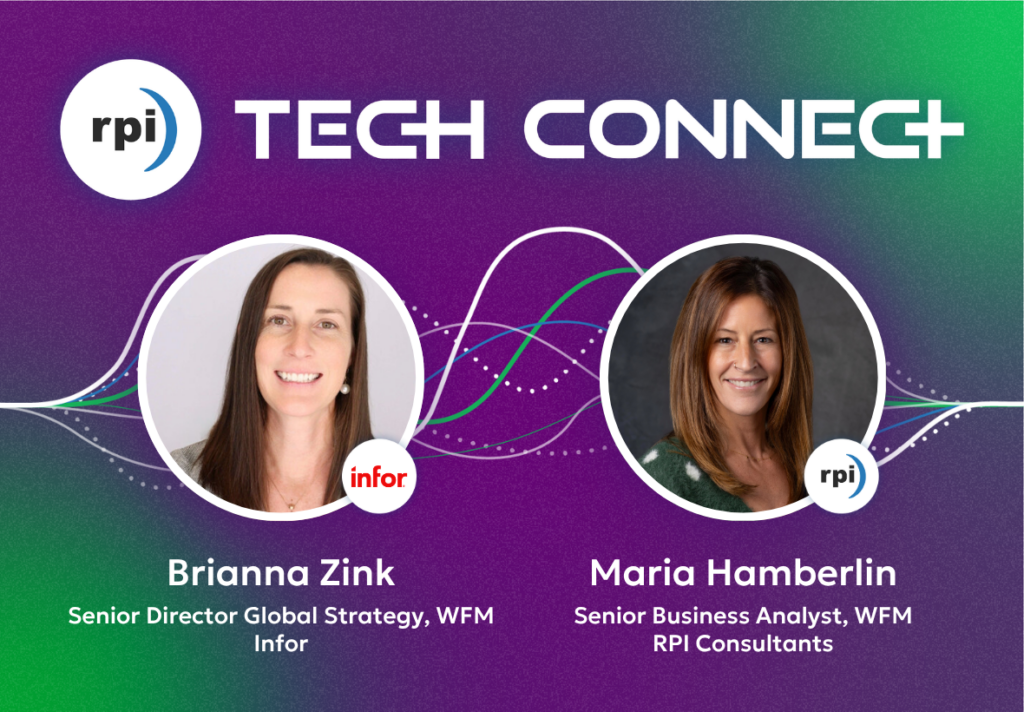
In this episode of RPI Tech Connect, host Chris Arey sits down with Brianna Zink, Senior Director of Global Strategy for WFM at Infor, and Maria Winnick, Senior WFM Business Analyst at RPI Consultants—two former nurses who started their careers together at a long-term acute care hospital and now help healthcare organizations get real value out of workforce management technology.
They talk about the real impact of scheduling challenges on nurses and the patients they care for, how to train teams on WFM so that adoption actually sticks and staff stop reverting to paper and workarounds, and what it takes to build lasting confidence in a system that can genuinely make their lives easier.
They also share fresh takeaways from AONL, including some standout conversations and innovations that are pushing nursing and healthcare forward.
Whether you’re a nurse manager, a WFM admin, or just tired of scheduling headaches, there’s something in here for you. Interested in listening to this episode on another streaming platform? Check out our directories or watch the YouTube video below.
Meet Today’s Guest, Brianna Zink
Brianna Zink is a Senior Director of Global Strategy for WFM at Infor, based out of Charlotte, North Carolina. Her career began in healthcare where she worked in a variety of settings as a Registered Nurse including long term acute care, medical surgical, critical care, and emergency/trauma as well as some time as a Clinical Case Manager.
Brianna completed her master’s degree in nursing in 2018. For the past nine years, she has been focused on Workforce Management technology to support care efforts of organization with complex labor planning needs.
Meet Today’s Guest, Maria Winnick
Maria Winnick is a Senior WFM Business Analyst at RPI Consultants, where she combines 15 years of nursing experience with a master’s in health administration to deliver workforce management solutions tailored to the realities of healthcare. She’s passionate about helping nurses and nurse managers get out from under scheduling burdens so they can focus on what matters most; patient care.
Before moving into consulting, Maria worked across critical care, acute care, and mental health, and served as a super user for Epic and Cerner, leading end-user training and helping hospitals transition from paper charting to electronic health records. That hands-on clinical and technical background gives her a deep understanding of what drives adoption and what gets in the way.
Meet Your Host, Chris Arey
Chris Arey is a B2B marketing professional with nearly a decade of experience working in content creation, copywriting, SEO, website architecture, corporate branding, and social media. Beginning his career as an analyst before making a lateral move into marketing, he combines analytical thinking with creative flair—two fundamental qualities required in marketing.
With a Bachelor’s degree in English and certifications from the Digital Marketing Institute and HubSpot, Chris has spearheaded impactful content marketing initiatives, participated in corporate re-branding efforts, and collaborated with celebrity influencers. He has also worked with award-winning PR professionals to create unique, compelling campaigns that drove brand recognition and revenue growth for his previous employers.
Chris’ versatility is highlighted by his experience working across different industries, including HR, Tech, SaaS, and Consulting.
About RPI Tech Connect
RPI Tech Connect is the go-to podcast for catching up on the dynamic world of Enterprise Resource Planning (ERP). Join us as we discuss the future of ERPs, covering everything from best practices and organizational change to seamless cloud migration and optimizing applications. Plus, we’ll share predictions and insights of what to expect in the future world of ERPs.
RPI Tech Connect delivers relevant, valuable information in a digestible format. Through candid, genuine conversations and stories from the world of consulting, we aim to provide actionable steps to help you elevate your organization’s ERP. Whether you’re a seasoned professional or new to the ERP scene, our podcast ensures you’re well-equipped for success.
Tune in as we explore tips and tricks in the field of ERP consulting each week and subscribe below.

Transcript
Chris Arey
Welcome back to RPI Tech Connect. I’m your host, Chris Arey. Today we’re going to be talking about workforce management in nursing. I have two guests who have a ton of experience working with the product and can speak at length about the value it provides on both sides of the equation.
Please join me in welcoming Brianna Zink, Senior Director of Global Strategy for WFM at Infor, and Maria Winnick, Senior WFM Business Analyst here at RPI Consultants. Brianna, welcome back to the show, and Maria, it’s great to have you for the first time.
Brianna Zink
Thanks, Chris.
Chris Arey
For those of y’all listening in who haven’t had a chance to meet our guests, would you mind sharing a little bit about yourself before we jump in? Brianna Zink, let’s start with you.
Brianna Zink
Perfect, thanks. Hi everyone, I’m Brianna Zink. As Chris said, I’m on the strategy team focused on workforce management here at Infor. I’ve been in this strategy role for four years now and have worked with workforce management systems for the last decade, maybe a little over at this point. Prior to that, I worked as a nurse.
It’s a really cool role to be in, having walked in the shoes of a nurse and felt the pains of an inadequate WFM system firsthand, and then being able to come over to the technology side to help build and drive a system forward that can address those pains. So I’m excited to be here and talk about this today.
Chris Arey
Very cool. And Maria?
Maria Winnick
Hi, my name is Maria. I work for RPI now. I was a nurse for about 15 years and dabbled in quite a bit. Case management, critical care, ICU, PACU, and more, but my heart was always with critical care. I saw a lot of different scheduling systems and a lot of pain points through those years.
It was a great opportunity to come to RPI to work with workforce management and scheduling, because my passion for helping patients has now turned into a passion for helping nurses and healthcare as a whole. It’s great to be here and talk about this.
Chris Arey
So awesome that you’ve both had those experiences, and that’s where I want to start today’s discussion. Before we get into the technology, I want to hear about the early days. As I understand it, you both worked together at Northern Colorado Long-Term Acute Care Hospital. Is that right? What was scheduling like from the floor back then? Brianna?
Brianna Zink
It’s funny because I’m trying to remember what the scheduling looked like, I think we were actually on paper. I remember we had a clock and I’d use my finger to clock in, but that felt like about as advanced as we got. I think we had a binder at the front desk with a chart where we scheduled, and by the end of the scheduling period it would be a mess — things crossed out, people writing over it.
What I think a lot of people don’t realize is just how complex an LTACH is. You really have to pay attention to the ratios. It’s almost like a step-down ICU when you have patients weaning off a ventilator, you need to make sure respiratory therapists are incorporated into how the schedule looks.
You also need to think about the level of experience of your nurses. Maria and I got to see each other for the first time in a decade at AONL a couple of weeks ago, and we were talking about running a code on a night shift when you’re literally on the phone with a physician who isn’t in the room. You need experienced nurses in those moments. On paper, it’s really difficult to ensure you have the right mix — someone senior who knows what they’re doing alongside a newer nurse, like I was at the time.
So I think it was very complex to manage on paper and relied heavily on the knowledge of the nurse manager or charge nurses to make sure the schedule was set up correctly. It was also very error-prone because they’re so busy with everything else that scheduling can end up on the back burner — it gets done, but often on the fly. It’s kind of crazy to think about all the complexities that come into play when you’re doing that on paper.
Chris Arey
It sounds like it’s on the back burner until it’s suddenly, we need somebody here right now. Maria, same question. What was your experience like?
Maria Winnick
Bri summed it up pretty well. We were on paper. I had a little more experience than Bri at the time, and somehow they trusted me to be the house supervisor, so I ended up jumping into that role. I remember the scheduling very well. The binder was at the front desk, and supposedly only the house supervisors were supposed to touch it, but that was not always the case.
I was thinking back to getting calls at 6:30 in the morning: ‘Where are you? Where am I?’ That’s meant that somebody had gotten into that binder and made some changes. And I’m not even sure we had email at the time. If we did, I don’t think anyone had shown us how to use it. There was a lot of text messaging and phone calls, and if somebody forgot or got busy and didn’t reach out, you’d either show up when you weren’t supposed to be there, or not show up when you were.
And Bri is right, the patients were very complex. We had a six-bed ICU in the back, and our front was wound care patients with very severe wounds. These were wounds where patients could lose a limb if care wasn’t delivered properly, and nursing was entrusted to handle all of it. A lot of newer nurses were on staff, a lot of acuity, a lot of people just starting their careers.
So you’d have someone show up on the schedule and not really know if they were brand new to nursing, brand new to the facility, what’s their skill level? You just had them on the schedule and kind of hoped for the best. A lot of paper, a lot of confusion, and a lot of layers.
Chris Arey
Wow, sounds chaotic. It’s really interesting to hear that you both started in the same place as nurses and have since moved into the WFM technology consulting world. I can’t think of a better background for that transition, knowing exactly what nurses are going through because you’ve lived it yourself. Thanks for sharing that.
I want to shift gears now and talk about what WFM looks like today. Have hospitals and nursing systems made real improvements to how they do scheduling since the days when you were working on the floor? Brianna?
Brianna Zink
With all of that said, I know we painted a pretty chaotic picture of the LTACH, but it was an amazing place. We worked with some incredible people and provided really great care for the patients. The tools we had on hand were just archaic compared to what’s available today. That said, when we talk to a lot of hospitals now, we still see that not much has changed, especially when you get down into specific units .
You’ll still see a lot of units that may have a solution in place but have reverted to paper. I’m partial to Infor WFM, but I think the systems out there are genuinely very powerful. The challenge is that it’s a complex world to configure correctly when you’re accounting for everything that goes into building a schedule and making staffing decisions.
A lot of times, hospitals don’t go all the way to make sure that every unit expected to use the system is configured to actually use it the way they need to. Sometimes there’s a ‘one size fits all’ mindset — ‘we have self-scheduling, so everyone can use it’ — without really accounting for the nuances of each unit, the rules that need to be in place, the guardrails that need to be set up to make it successful.
Maria and I have both lived the chaos of paper and know how many things can slip through the cracks. But even now, nearly 15 to 20 years later, we still see a lot of hospitals and a lot of units truly in that same place, relying entirely on the tribal knowledge of the individuals who build the schedules.
If those people leave, the organization is going to be in serious trouble. The great systems are out there, it’s just that it’s not like you flip a switch and they work for you. There’s a lot that goes into configuring them. Maria is doing a lot of that work on the back end, and that work is really important. A lot of times hospitals underestimate the effort and expertise it takes to make sure they can actually leverage the technology as the strategic solution it’s capable of being.
Chris Arey
Maria, I think that’s a great segue. As somebody who goes into these organizations and helps configure and understand how they’re currently operating, what’s your experience been? You don’t have to throw anyone under the bus.
Maria Winnick
In my experience, the biggest breakdown in using these products (I saw this in my own time at larger hospital systems) is that you get an implementation, but the education only reaches a small circle: maybe a house supervisor, a charge nurse, maybe some management.
And that’s where it stops. You have this solution that could genuinely change life at the hospital. Get you off paper, make scheduling more efficient, give you real granularity around staffing acuity, but after go-live, folks get stuck and don’t know how to use it. Then they pull out the paper.
What I saw RPI do with UMMS was set it up the right way: building out super users who train other users, who train other users. That waterfall continues through releases and updates. Because historically, I’ve seen the pattern repeat in multiple places I’ve worked, you have the product, you have the software, but nobody knows how to use it. The workaround becomes paper, Google Sheets, Excel. That’s where hospital systems get stuck.
What RPI is trying to do is make sure that doesn’t happen, so that organizations can utilize the product to its full potential and see that it works. A lot of times when something ‘doesn’t work,’ it’s just that it’s not being used correctly.
Chris Arey
It’s a common theme I’ve heard from different guests on this show — it’s not limitations of the software itself, it’s adoption. It’s whether people know how to use it, whether they’ve been trained properly and over enough time that when they go live, they feel confident. In healthcare specifically, it’s a unique environment. How do you ensure that people are getting the training they need so that when they do go live, they feel comfortable and are taking full advantage of the solution? Open question to either one of you.
Maria Winnick
I think it really comes down to continuously working with the client and the team to make sure they understand — and are continuously reminded of — how important it is to keep educating their staff. Over the last year with OMS, we saw it play out: new updates would roll out or issues would come up, and there’d be immediate panic. But a lot of that resolved with just going back to the super users, giving them the information again, and repeating it.
The key is repetition. Folks in healthcare might ask the same question a hundred times, and you answer it a hundred times. They’re busy. They may understand it in the moment and forget it two days later. That’s just the nature of the environment.
What I also started doing instead of just giving verbal answers was screenshotting things and saying, ‘Put this in your toolbox, you can go back and reference it.’ Giving them a concrete piece of documentation they can keep. That way, we’re not just providing answers — we’re helping them build the habit of troubleshooting on their own. Sometimes when you always get the answer right away, you stop trying to figure it out yourself. So we were trying to give them a little more independence.
It’s a slow approach, but I think it’s genuinely needed. And there’s also a trust component. As a nurse, I remember when technology came into play, there was a bit of a disconnect — nurses and tech people didn’t always communicate well. Bridging that gap is part of what we’re trying to do.
Chris Arey
I love how you’re building them up over time, not letting them struggle, but letting them learn and then giving them documentation they can reference when they need it. That’s great. Bri?
Brianna Zink
I’m actually at a CNO event right now, and this morning we were talking about how different hospitals successfully adopt technology. One of the hospitals here has what they call influencer units. They’ve keyed in on units that may have high turnover or are experiencing some challenges, and those units, along with their nurse managers and staff, actually apply to be designated as one of these units.
What that does is turn those units into ones that genuinely want to be part of the change and want to adopt it. The successes from those units then generate excitement that carries over into other units; a real train-the-trainer ripple effect. And the reason they’re calling them ‘influencer units’ is intentional: five generations are now in the nursing workforce, and the generations coming up are digital natives who understand influencer culture. It’s a way of targeting that younger generation and meeting them where they are.
I was literally sitting there thinking we need to take that same train-the-trainer and change champion concept and frame it as influencers because it’s accessible language, and it signals excitement rather than obligation.
And it matters because frustration over your schedule is one of the things that can make or break someone’s experience as a nurse. One of the draws to nursing is that you work three days a week. But if you lose control over which three days those are , no say in what they are, or you think you have a day off and get a call at 6:30 saying you’re supposed to be in, that benefit disappears entirely. It’s not always fun to learn a new system. It disrupts your normal flow, and it’s a lot easier to trust paper than to trust a system you’re still figuring out. Having those change champions and influencers helps address that trust component.
Chris Arey
I love that concept. That word is accessible to most people these days. Everyone knows what an influencer is, and a lot of people look up to them. Compared to ‘change management,’ which can sound intimidating or bureaucratic, ‘influencer’ signals something aspirational. Great concept.
Maria Winnick
Going back to the scheduling piece, I’m not going to lie, we used to complain. Three 12-hour shifts in a week could land on Thursday, Friday, Saturday, and then they’d put you on Monday, Tuesday, Wednesday. You’re technically working three days a week, but you have one day in between, and you feel like you’re going to collapse. And especially as a younger nurse, you don’t have the confidence yet to push back. You just kind of go with it.
Brianna Zink
Or you might as well have just worked the whole week straight.
Chris Arey
So workforce management as a solution for nursing has evolved significantly over the last 15 to 20 years. Do you feel there are capabilities within the application that hospital systems aren’t taking full advantage of?
Brianna Zink
I’ll go first since I’m on the Infor side. I think some of the newer functionality that’s come out has a lot of benefits that haven’t been fully adopted yet. The one I’m most excited about is forecasting. Infor has had a forecasting solution for a long time, but it was primarily aimed at other industries. We’ve completely rewritten it, leveraging machine learning and AI to make it much more powerful and applicable across industries.
In healthcare, that means forecasting things like ADT and census, but also unplanned absences. Some of it may be obvious: Friday nights tend to see more call-outs, but there are also less obvious patterns the system can surface. Like staffing up on a particular Thursday because the system is predicting a spike in unplanned absences based on historical trends. The goal is to help organizations be more predictive and proactive around their schedules.
Another feature we’ve had for years is the shift billboard, where employees can claim open shifts or post their own shifts for others to pick up. We’ve significantly expanded that and added automation behind it, so if an employee calls in sick, the system can determine whether the shift still needs to be filled, whether it should be posted to the billboard, and whether to send out a text alert automatically. All of that lifts the burden off the nurse manager or charge nurse.
Just purely because these are newer features, they haven’t been adopted as widely yet. But again, it comes back to making sure all the units and team members are actually bought in and using the solution, because you need that foundation in order to leverage the automation capabilities on top of it.
Chris Arey
Are any of these updates part of the April CU that folks might be reading through right now?
Brianna Zink
Yes. Forecasting is in early adopter status — so if a customer is listening and interested, they can reach out and we’ll get them set up in the program. Because it’s a new concept for healthcare specifically, we want to provide a lot of hands-on support and gather feedback so we can continue building on the solution. And OpenShift automation is part of our AI offering, Velocity Suite, which is also new in the April release.
Chris Arey
I’m familiar with the Velocity Suite and it’s great to hear that’s part of it. Maria, anything from your side that you’d like to see nurse teams and healthcare organizations take more advantage of?
Maria Winnick
I got really excited at AONL about some demo content I saw from colleagues there. A lot of them were still talking about tracking absences on paper, last to float, low census on-call, all on paper in their pockets. And then I saw something that I thought could be impactful: using the contact card to capture the date of the last float and the last low census on-call. That kind of granularity in the schedule can make a real difference.
I also thought the Areas feature was really cool, especially for something like an ED, which is a pretty complex schedule. Different hours, different sections of the department, different rooms and triage areas. Being able to section that out and get more granular with how staff are assigned is exactly the kind of thing that can get people off paper and into the system, because with paper, you either lose it or it doesn’t get updated. That efficiency alone makes it worth exploring.
Chris Arey
That’s the second time I’ve heard both of you mention AONL. Sounds like a great event with a lot of good conversations. Any takeaways you’d want to share, or reasons why folks should attend?
Brianna Zink
My biggest takeaway is always the networking and learning opportunities. I love doing a lap around the exhibit hall to see what different vendors are thinking about and working on. Maria actually pulled me over to a really interesting demo about IV catheters and how they can be used for different draws. For me, being on the technology side for the last decade, it’s a great reminder of what’s happening at the bedside.
It’s a really great way to stay in tune with what’s happening in the nursing and healthcare space, and getting to reconnect with an old friend was a bonus.
Maria Winnick
Super energizing. It was great to see that nursing is still moving forward. Things I used to complain about as a nurse; outdated equipment, IV lines that were hard to work with, the list goes on. You can see the innovation coming. There were some great beds on display. It just energized me to want to help nurses even more and use our product to make things better for them. And it was wonderful to reconnect with an old colleague.
Chris Arey
It must be really something for the two of you to attend an event like that. Being in that world and then seeing all the advancements being made. I imagine it’s inspiring in terms of wanting to help these organizations get there.
All right, it wouldn’t be a technology podcast if we didn’t talk about AI. You both mentioned some things earlier about changes coming to the WFM application and the role AI is playing. There are sometimes fears around AI in healthcare, whether it’s supplementing or replacing the way doctors and nurses provide care. What do you say to that? What does the human element look like in the way AI is being applied here?
Brianna Zink
I’ll go first. One concept I keep coming back to, and I know it can feel a little buzzwordy because you hear it so often is ‘human in the loop.’ Bear with me on that one.
Chris Arey
That’s new to me. I’ve never heard that. I like it though.
Maria Winnick
I was like, I must be out of the loop.
Brianna Zink
Maybe we’ve all been to one too many AI conferences. This is very much the approach Infor takes: AI isn’t here to replace humans. It’s here to augment what we do. When we’re building new solutions and thinking through a process, we ask: where can AI handle the repetitive, rule-based tasks? The clicks, the criteria checks, the straightforward ‘if this, then that’ decisions. We offload those.
When we pull the human back into the loop when human judgment is actually needed, when a situation is complex, when two different scenarios are possible and you need critical thinking to figure out the best one. That’s where the AI pauses and hands it back to the person for their sign-off and expertise.
In healthcare and nursing specifically, that means still leveraging clinical expertise when clinical expertise is truly needed. AI handles repetitive work; humans handle the judgment calls.
Maria Winnick
Yeah, absolutely. There’s definitely a time and place for it. The way I think about it is: even if AI does something for you quickly, you still want to review it. Make sure it’s appropriate and captures what you intended. That’s the human side of it. But for those mundane, repetitive tasks, the click, click, click, having AI handle those can be huge.
In nursing and healthcare, an extra 30 seconds is sometimes the difference. That’s what AI can give back to caregivers: minutes, and sometimes more than that. Sometimes those mundane tasks feel like the last thing in the world you want to deal with. They’re small and minor, but in the moment they feel like a lot. That’s exactly where AI can help.
Chris Arey
That’s a really good point. Thank you.
Brianna Zink
And I think it really ties back to our earlier conversation about scheduling on paper, trying to understand experience levels, pulling information from multiple screens, relying on your own memory or biases just to make a decision. That’s where AI is so useful. It knows where the information lives and can surface exactly what you need in the moment. So much time gets wasted, especially in nursing, just searching for the information needed to make an informed decision.
Maria Winnick
Exactly. The minutes you lose just trying to pull everything together add up. Agree completely.
Chris Arey
I appreciate the way both of you are framing the use of AI, augmenting and supporting care delivery rather than replacing it. And Maria, like you said, 30 seconds can genuinely be the difference between life and death. No exaggeration. We’re getting into some really good territory today.
Chris Arey
Here’s a question for both of you. Given your background and what you do now in the world of consulting and WFM, if you woke up tomorrow back as a working nurse — knowing what you know now — what would you do differently? Brianna Zink?
Brianna Zink
If I woke up working as a nurse again, especially after the last 10 years on the technology side, I would lean into the technology so much more. I remember small changes coming in the EMR, like moving where you click something or adding a new form, and I would be furious about it for three weeks.
Then I’d get over it and it would just become part of my routine. I wasn’t exactly kicking and screaming, but I was not someone who got excited about adopting anything new. I’d change that mentality. I’d be the one raising my hand to help with something. That interaction with technology is what I’d go back and do differently.
Chris Arey
You’d lean in.
Maria Winnick
It makes me laugh thinking about how frustrated I used to get, because that’s exactly how I felt. Any memo about an upgrade or a change and I’d be like; I do not want to learn this. It was a barrier.
What I would do differently now — especially having been in management for a while — is take the technology, learn it myself, and then find my super users on the team. Get them trained, get them training others, keep that waterfall going. I did a lot of workarounds with paper. If I didn’t know the technology, I’d pull out a piece of paper and that’s where it stayed. I was busy, frustrated, and didn’t want to learn anything new. But I would absolutely do things differently today.
Chris Arey
Last question for both of you: one piece of actionable advice for the nurse managers and WFM administrators listening today. What’s your 30-second takeaway? Don’t tune out without this. Bri?
Brianna Zink
This actually isn’t what I had prepared, but it just came to mind. For clients who are listening, Infor hosts a monthly call called Coffee with Nurses. The topics rotate every quarter, and there are a couple of opportunities each month to join. We have members from our product team, a really great customer success executive who is a nurse and runs it, and our solution consultants all participate.
It’s a great way to hear about new features from a nursing perspective, because a lot of times when those updates come through, they’re framed in IT or business language. This is the space where you can hear it from a nurse, network with other customers, and ask questions directly of the product team. My recommendation is to reach out to Infor and ask to be included on those invitations.
Maria Winnick
And I’d add that both Infor and RPI are working to bring healthcare experts onto their teams. When you’re going through discovery and figuring out your needs, there are clinical people in the room who can bridge that gap between the technology side and the floor. Someone who speaks the language. I think that makes a huge difference.
And just be patient. It is a learning process. It takes time. The back-end configuration work does take effort, but what you get out of it on the front end is so beneficial and efficient. It’s going to help healthcare. I genuinely believe that.
Chris Arey
Thank you both so much. I love hearing how involved nurses and frontline healthcare workers are in product development that they’re helping shape a solution that’s going to make delivering care that much better. That’s what this is all about.
Maria Winnick
The only thing I’d add is that the stress of scheduling can be alleviated so much with this product. I genuinely believe that. And when you’re not spending hours working on a schedule, you can focus more on patient care and on taking care of your employees.
Chris Arey
When in doubt, don’t pull out the pen and pad. Right? Don’t do it.
Chris Arey
Awesome. Folks, if you want to learn more about Infor WFM and how Infor and RPI can help with your workforce management and scheduling needs, we’d love to have that conversation. You can reach us at podcast@rpic.com, again, that’s podcast@rpic.com.
This has been RPI Tech Connect. Thank you both so much for spending this afternoon with me. It’s been a great conversation, and I look forward to doing it again soon. Thanks, guys.