ERP projects succeed or fail based on how they are managed, not the software itself.
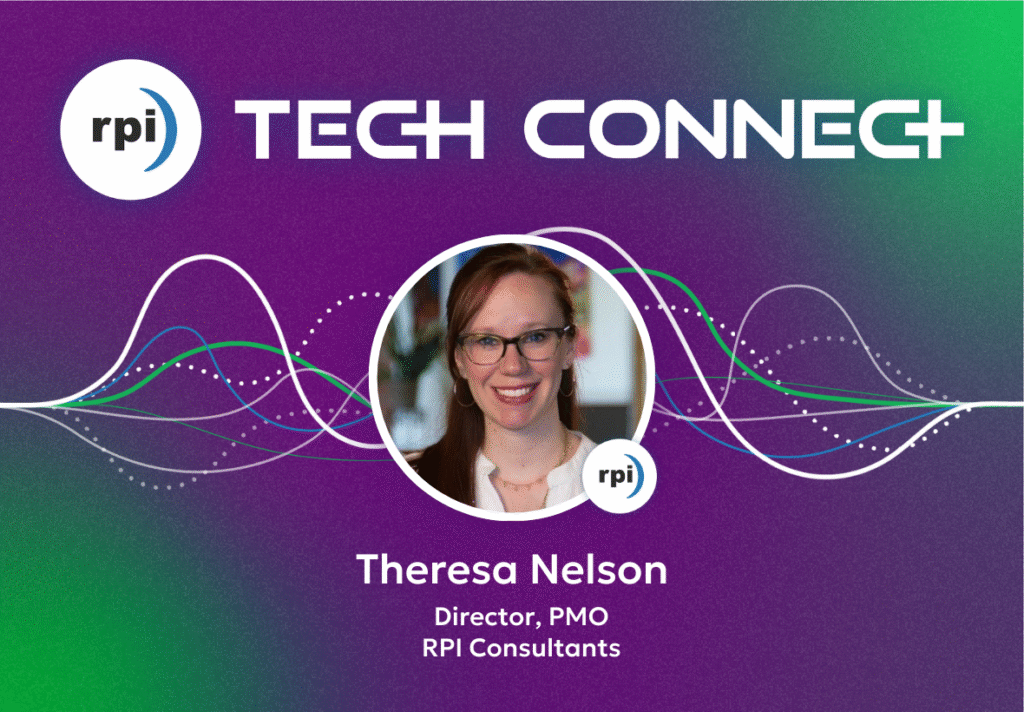
In this episode of RPI Tech Connect, RPI PMO Director Theresa Nelson explains what most organizations are not told before starting an ERP implementation. She discusses the project management decisions that determine ERP success, including leadership alignment, communication planning, risk tolerance, and methodology selection.
Theresa breaks down why waterfall remains the dominant ERP project management approach, how agile methods fit into ERP work, and why highly integrated systems require structured planning and phased testing. The episode also explains the role of unit testing, system integrated testing, and user acceptance testing in reducing risk before go-live.
To make those concepts relatable, Theresa draws a parallel between ERP project management and parenthood, explaining how prioritization, critical path, and knowing which things you cannot drop are essential in both.
Listeners will learn what causes ERP projects to go off track, how strong project managers identify issues early, and what organizations should look for when selecting an ERP implementation partner.
Interested in listening to this episode on another streaming platform? Check out our directories or watch the YouTube video below.
Meet Today’s Guest, Theresa Nelson
Theresa Nelson possesses over a decade of IT project management experience, which she leverages as RPI’s PMO Director. She consistently manages RPI’s most complicated projects, in addition to providing oversight to RPI’s Project Management Organization as a whole.
Prior to joining RPI, Theresa was a project manager with Tritech Software Systems, a public safety software company, where she successfully oversaw the implementation of several hundred projects that later enabled her to thrive in the world of ERP.
Theresa has earned both the Certified Associate of Project Management (CAPM) and the Project Management Professional (PMP) designations from the Project Management Institute and is well-versed in project lifecycles.
Theresa also delivered the commencement address at both her Undergraduate and Graduate ceremonies, a testament to her excellent communication.
Meet Your Host, Chris Arey
Chris Arey is a B2B marketing professional with nearly a decade of experience working in content creation, copywriting, SEO, website architecture, corporate branding, and social media. Beginning his career as an analyst before making a lateral move into marketing, he combines analytical thinking with creative flair—two fundamental qualities required in marketing.
With a Bachelor’s degree in English and certifications from the Digital Marketing Institute and HubSpot, Chris has spearheaded impactful content marketing initiatives, participated in corporate re-branding efforts, and collaborated with celebrity influencers. He has also worked with award-winning PR professionals to create unique, compelling campaigns that drove brand recognition and revenue growth for his previous employers.
Chris’ versatility is highlighted by his experience working across different industries, including HR, Tech, SaaS, and Consulting.
About RPI Tech Connect
RPI Tech Connect is the go-to podcast for catching up on the dynamic world of Enterprise Resource Planning (ERP). Join us as we discuss the future of ERPs, covering everything from best practices and organizational change to seamless cloud migration and optimizing applications. Plus, we’ll share predictions and insights of what to expect in the future world of ERPs.
RPI Tech Connect delivers relevant, valuable information in a digestible format. Through candid, genuine conversations and stories from the world of consulting, we aim to provide actionable steps to help you elevate your organization’s ERP. Whether you’re a seasoned professional or new to the ERP scene, our podcast ensures you’re well-equipped for success.
Tune in as we explore tips and tricks in the field of ERP consulting each week and subscribe below:

Transcript
Chris Arey
We’re back for another exciting episode of RPI Tech Connect. I’m your host, Chris Arey, and today we’ll be talking about what really drives ERP success, which is how the projects get managed.
There’s a lot of debate around Agile versus waterfall methods, and today we’re going to break down what those actually look like in an ERP context. I’m joined by Theresa Nelson, RPI’s PMO director.
Theresa oversees how we manage ERP projects across teams, industries, and platforms. Theresa, it is great to have you on the program. Thanks so much for joining me today. For listeners meeting you for the very first time, could you share a little bit about yourself?
Theresa Nelson
Yeah, thanks for having me, Chris. I’m Theresa Nelson. I actually just celebrated 10 years with RPI. It was a really exciting milestone for me earlier this month.
Before RPI, I came from a background of public safety project management. And you think, like, how does that transition into ERP? But it actually is a really clean transition because it’s all about helping people in their jobs and making lives easier.
That’s one of the things I love about good project management is it kind of fades into the background. You don’t know it’s there, but it’s making everything run smoothly. And yeah, I’m just excited to be here talking to you about things that I love so much.
Chris Arey
Awesome, and you you mentioned something there that I heard from a previous guest on another episode, which is that when ERP is working so well and being managed well, you kind of don’t notice it right?
Theresa Nelson
That’s how it should be. Yeah.
Chris Arey
That’s the goal. Yes, okay So I love that you say that because my first question here is, when you go into one of these ERP implementation projects, what’s the common denominator that you see in the ones that go well?
Theresa Nelson
I would say leadership is extremely important across the project, as well as having a strong vision, because an ERP system is sort of like putty. You can make it into all kinds of different things, and you can take the same system from one place to the next and have it function pretty differently and work in multiple ways.
So it’s really about having that clear vision for the future and then having the right people in place to get you there. Consistent leadership, strong organization, and just a really clear methodology so that you know how to get step by step from A to B.
Chris Arey
So that leadership call out there, is that from within the organization or from the ERP partner or vendor? Who does that apply to?
Theresa Nelson
Yeah, it’s kind of all of the above. I’ve certainly come in as a partner on projects where there isn’t strong internal leadership, and that is a very hard mountain to climb. I think you can get there, but a partner coming in, it doesn’t matter how strong they are, what their methods are. If you don’t have that clear internal presence that is guiding and directing, there’s only so far an external entity can really take you.
But on the same side, an internal group probably doesn’t have all of the intricate knowledge of how to make a project like this successful. These are big and complicated. They have a lot of components to them. There’s a lot of detail and nuance in the various phases you need to go through. having an outside partner as well who does have that knowledge and experience.
Some strength and leadership there certainly gets you there too. Yeah, sorry it’s not a cleaner answer, one or the other. It really is both, you need it on both sides.
Chris Arey
Awesome. That makes sense too. I’ve had a lot of different guests on the show now, and one of the things that I remembered from a previous discussion was that ERP projects are not a you or a me project, but they’re a we project, right? Both parties have to come together.
Like you said, an external person coming in to an organization who’s getting ready to make this disruptive change, you’re going to have somebody internally representing that as well.
Theresa Nelson
Yep. Absolutely.
Chris Arey
So with that said, I want to hear a little bit more about how you and the RPI team go into these projects. Like what are some of the non-negotiables that you set in place from day one?
Theresa Nelson
Yeah, I would say a clear path to success is really important. One of the very earliest conversations that we have with clients is trying to understand what their path to success looks like. And I say that because ERP is different everywhere, and a successful project is never going to be a project without bumps or issues or hurdles. That’s just not reality.
But, understanding what that ideal end result needs to be is crucial to getting them there successfully. ⁓Some other strong non-negotiables are on the logistical side of project management. We need a clear structure that’s documented in a very detailed project work plan. There’s lots of moving pieces and parts at every point of the project. Oftentimes, you’re talking about a team of 30, 40, even 50 people that are involved.
Coordinating all that work at the same time is massive. And you need to have a well-documented plan with how all the pieces need to fit together that traces that critical path of events and shows which chains can’t be broken for us to meet our deadlines. That’s non-negotiable. Every project needs to have it.
Theresa Nelson
Another thing is a strong communication plan. A lot of times early in the project, we want to just throw something out there and get to the real work, but it is the real work.
If we don’t have this plan, you can’t proceed, because if we can’t tell people what’s going on, then we’re going to go off the rails quickly.
Chris Arey
You can’t skip that step.
Theresa Nelson
So that to me is something that every project, even our smallest projects need to have a well thought out communication plan that documents that. That’s crucial. One of my other favorite discussions to have is also an understanding of risk tolerance. So, you know, different levers operate over the course of a project, right?
One group of people might see it as non-negotiable. Another group of people has a little room there. In project management, we talk a lot about the triple constraint, and that is your scope, your timeline, and your budget. And then kind of the middle of those things is the quality of what you’re delivering.
And those all work together, but in any given context or project, one of those areas maybe has a little more room for compromise than others. And that’s an important thing to understand. know, some clients budget is the be all and end all. They know that they’ve worked hard to get the budget that they have for this and there’s not one more dollar that can go towards this project. That’s a good understanding to have early because it might mean that down the line we hit some bumps.
We need to make decisions around scope or possibly our timeline. Other clients have a really hard and fast date. Maybe there’s contracts in place that they can’t compromise on. There’s an end date to their current system and we can’t surpass that. So that’s good to know up front too. And that helps us with managing project risk because when we understand what’s really driving a group’s change to an ERP system and where they have room to maybe have a little more risk or have a little less risk.
It helps us identify early on the potential issues that could come our way that are going to be impactful. And we give them a little extra attention. That’s where we go back to that communication plan. And we’re talking early and often about those things that we see impacting an area where there’s a little less risk tolerance in a group.
Chris Arey
Yeah, this all sounds like important groundwork. Question for you. You mentioned that there are different groups with different risk tolerances and like you’ve got sometimes up to 50 people that are a part of this project. Is it difficult? What kind of process do you have for hearing all those different voices and needs and like, is that something that spans months?
Theresa Nelson
Yeah. Yeah, that is our planning phase. We call it initiate and plan here. A big part of those early weeks in a project are interviews. We do them with teams. We do them with individuals. Yeah, because the only way to collect this kind of information is to really sit down and talk to people.
If there’s documentation, we love documentation too. But you can only get so much from a document. And people don’t tend to record things like, hey, I’m uncomfortable with the timeline extending. You can’t always get that by reading somebody’s old design document. So those interviews and conversations, those span the first few weeks.
Chris Arey
Haha. Yeah.
Theresa Nelson
It usually involves all of the key stakeholders. We want to talk to project sponsors. We want to talk to your business leaders. If you have some end users who are going to become what we refer to as your super users, those are people that are in the system and leveraging it to do the core work of their job. Those are conversations we want to have either one on one or in a group right from the beginning to collect all that information.
Chris Arey
Wow, you’ve got an answer for everything. I can’t stump you. Not that I’m trying to, but I’m just very impressed. Thank you. That’s a great foundation. I want to hear now a little bit about some of the methodologies. I’ve heard there’s some debate about what the right methodology is. What is RPI’s methodology?
Theresa Nelson
Thank you. Yeah.
Well, in the project management world, there’s debate. But in general, when installing an ERP system, you’re going to follow what we call waterfall methodology. And that just means that you have your project structured so that you move in a linear fashion from one phase to the next. And then you have a large go live at the end.
It is sometimes contrasted to Agile methodology, which is a little bit more cyclical and works well for development work. We incorporate a little bit of Agile methodology into our overall structure because we find that there are some core tenets of it that serve us well as we develop things like customizations, interfaces, and even some of our ancillary applications like XM implementations.
Those are following a little bit more of a hybrid waterfall Agile approach where we’re not as linear, where we build and we test and then we move on to the next phase. So, we do incorporate a little bit of it, but overall, you’re going to notice that we go into a requirements gathering at the beginning and then we do a system design.
Part of that is a conference room pilot, which gets our teams a little bit more hands-on in the system, seeing what they’re designing. From conference room pilot, we really work to firm up that design plan, and we use that to do our first complete system build, which is done.
Usually, if it’s a full CloudSuite ERP implementation, we’re looking to do that within the first three to four months of the project. So, within those first three to four months, that’s where we’re looking to really nail down design and then move into our test cycles.
There are three test cycles in our standard methodology. That first one, as I said, is called unit test. This is really about the prototype. It’s about taking design and putting it into a system and letting you kick the tires, so to speak. Yeah, you know, there aren’t necessarily all the pieces yet that connect the different parts together. That comes a little bit later.
And the reason why is we want to make sure that that design is solid before we start building off it and connecting pieces. Because trust me, I have lived that pain of spending hours and hours. Yeah, and then you have to go undo it and start over. It’s just not ideal. So unit tests are crucial for that. Yeah. From there, we move into building out all those integrations.
My favorite, if I’m allowed to have a favorite test cycle, SIT or system integrated testing. And this is where you do get that day in the life end-to-end test experience. A key piece of that system integrated test is getting all of that development done, because this is our one chance to really see how the system’s going to work. We want to see data go from entering in all the way through until it leaves either in an interface or a report. We want to trace it all the way through.
At that point, we get to the end of and we’re able to move into user acceptance testing, which is a pretty fun round because this is where we open the doors up and let some other people come in and have a peek at what we’ve been building. User acceptance test, if we’ve done our job in unit testing and in SIT, becomes a lot more about that user acceptance piece than the testing.
So hopefully we’ve kicked the tires and we’ve really got ourselves to the point of a pretty polished system. It’s still testing, it’s not ready for prime time, but we’re able to bring people in and let them experience it. We get some great feedback in those sessions and it also gives us a chance to test drive our training, which I think is really key. A lot of times you wait until the very end of the project and then you roll out this massive training.
Sometimes you find out that it’s not as clear as you think, because you’ve been in the system for 12 to 18 months at that point, and you know things that maybe you’re not able to communicate clearly just because you’re so familiar with it. So, taking that opportunity at user acceptance testing to give yourself a little bit of a test drive is always a nice feature and get that feedback early on.
As we come to the end of that, this is where our focus shifts to really full steam ahead into rollout. We do our broader user training. Oftentimes we do a mock go live. So that’s just a test of the go live process itself. These are complicated systems and complicated projects. And that go-live is a highly coordinated, (I mean down to the minute oftentimes) event to try and make everything happen within a very short window of down time.
Chris Arey
Wow.
Theresa Nelson
We do that mock go-live to get us to the point of feeling like, you know, we’re a well-oiled machine. And in the moment that we decide cutover is started, we can just go and work together as a team to quickly get things live.
Chris Arey
You’ve got it all planned out here. Question for you. So, it sounds like each one of these different, especially the testing phases, the system integrated testing, unit testing, system integrated testing, and user acceptance. Each one of those is an opportunity to iterate and fine tune system development and configuration and the way that things are flowing between applications. Is that right?
Theresa Nelson
Yes. That’s absolutely right. Yeah. And each test phase has its own unique purpose and focus, you know, to get us to the point where we’re ready to take things live.
Chris Arey
Okay, and so you feel that the waterfall methodology is one that supports these different phases you’ve talked about and iterates along the way. Does that mean that Agile is rigid or why does it not fit?
Theresa Nelson
Well, Agile, you tend to build a piece at a time. The analogy that I learned when I was first learning Agile is to pretend you’re building a skateboard. You might have a sprint, because the work is divided into sprints. And say you have a sprint, and all you’re doing is building the wheels. You go through your two weeks, and you build out four wheels, and then you move on to the next sprint.
In the next sprint, it might be all about connecting those together. So, you go through that sprint and you connect them. Sometimes Agile can work really well. It is a little bit more iterative in the sense that you might build a part of that interface, come back, test it, and then go there are these other components that we also need it to do and you add those back into your development cycle, you come back, and you circle again.
One of the reasons why Agile isn’t exactly a great fit for ERP is it’s hard to roll an ERP system out in small pieces. Everything is so deeply integrated that you’re sort of forced into the waterfall method because it’s large when we try to break it out and we try to do maybe just one module at a time, you’re talking about months of work, at least, in between each module.
And then the connecting of all the pieces is so involved and intricate that it really does work better to look at it as a whole and to do your design holistically and then take yourselves through the process to get everything live together.
Chris Arey
Okay. It sounds like the Agile methodology kind of works in silo as opposed to like a big picture, kind of.
Theresa Nelson
Yeah, I mean, that’s maybe a way to look at it. It’s just a little bit narrower in focus, and it’s more iterative in its approach. So yeah.
Chris Arey
Thank you for making that distinction clear. I’m not a project manager, guys. So I’ve learned something here today, too. I appreciate that. And that was great to hear, just the way that your team and RPIs approach to project management for these large-scale ERP implementations. The way that you do them is very detailed. So, thank you.
Now, I want to pivot to something that seems maybe a little out of left field here, but something that I’ve heard from folks in my time here at RPI is that there have been whispers of a parallel between project management and being a parent.
Now I say that, and folks listening in, if that sounds crazy to you, maybe it’s not as crazy as you think. Theresa, what can you share?
Theresa Nelson
Yeah. There are definitely parallels. The one that really comes to mind for me right off the bat is just the reality of prioritization. Being a mom myself, I have three kids, and they range in ages from three to 12. And I can tell you, we are a busy house.
There’s a lot going on, and I spend a lot of my evenings and weekends just figuring out what do I get done and what I let go of. Project management can be a lot like that too. It’s knowing what to focus on and what you can maybe let go of because you’re never going to get absolutely everything completed.
There’s an analogy I heard about parenthood that I think is applicable to project management too, and it has to do with juggling. You’re juggling a bunch of balls, some are glass balls and some are rubber. It’s just important that you don’t drop the glass balls. The rubber balls are going to drop, bounce, and roll away, but it’s okay, you can go pick them up in a little bit.
The glass balls are the ones you want to keep up in the air, and that’s definitely true of being a parent and as far as project management goes, those are the tasks that we call the critical path. Those are the ones that if they go off the rails, they’re going to take your whole project with it. So, you focus on the glass balls. And then there are inevitably some rubber ones that you’re going to have to let roll away.
Chris Arey
Wow, that was a great way to frame all that there. And the juggling analogy is you can’t drop the glass ones. Must make sure you keep those. And that same mindset applies to an ERP implementation. There are things that must get done and can’t be pushed down the road, right?
Theresa Nelson
Yep, absolutely.
Chris Arey
Very cool. Well, Theresa, we’re getting close to time. I don’t know if you know this, but before we wrap up, I always like to ask my guests if there’s one actionable takeaway they would like to impart on today’s audience. What would yours be?
So, I’d love to hear. This is your 30 to 60-second most important statement for today’s topic of ERP project management.
Theresa Nelson
Wow, yeah, no pressure, no pressure.
Chris Arey
No pressure.
Theresa Nelson
No, I think one of the key things that sort of wraps up everything I’ve talked about is making sure that you have the right person in that project management role. And it’s something that I have seen go well and go badly.
There is so much to it on a project of this size that you must have somebody who is organized and knows how to drive a team. It’s also important to have somebody who is going to be able to strategically see the direction that you’re going to capture the vision of whoever is driving the project, and also see risks early enough to do something about it. So you need that sort of combination of being tactical, being able to be in the weeds, in the details, and drive the work forward, and also strategic vision to see where you’re going and how your future state needs to look.
Chris Arey
That is, that’s a really important comment you have there because this whole episode has talked about the importance of methodology and process and all these things that you do upfront.
But at the end of the day, if you don’t have the right person in that position to do all of those things and manage and have the foresight to plan and interview all these folks, like you mentioned, like is that, is that project going to go well?
Theresa Nelson
Probably not. No, it’s very difficult. Yeah, leadership is key.
Chris Arey
So my follow up question for you on that is how do these organizations vet and find out if the person is going to be the right fit?
Theresa Nelson
Yeah, that is the question, isn’t it?
I would say don’t be afraid to ask a lot of questions, and get really specific in what you’re looking for. There are so many project managers in the world. Only some of them are good, and even fewer of them are able to be strategic.
So I think that asking the questions in an interview process, making sure that they have some foresight and have demonstrated success in the past, especially success on an ERP implementation, I think that’s the key to getting the right person in the door.
Chris Arey
Don’t be afraid to ask more questions. Yeah, that’s what we want. Folks listening in, ask as many questions as you can when you’re thinking about who your ERP partner or implementer is going to be, because that’s going to make a difference with who’s going to be managing your project.
Well, Theresa, this has been an absolute joy having you on the show today. Thank you so much for sharing these great insights.
Folks listening in, you want to learn more about RPI’s methodology for ERP project management, or if you want to find out how we can help you, we’d love to hear from you.
You can contact us at podcast@rpic.com. Again, that’s podcast@rpic.com. This is RPI Tech Connect, and we’ll see you next time. Thanks, Theresa.