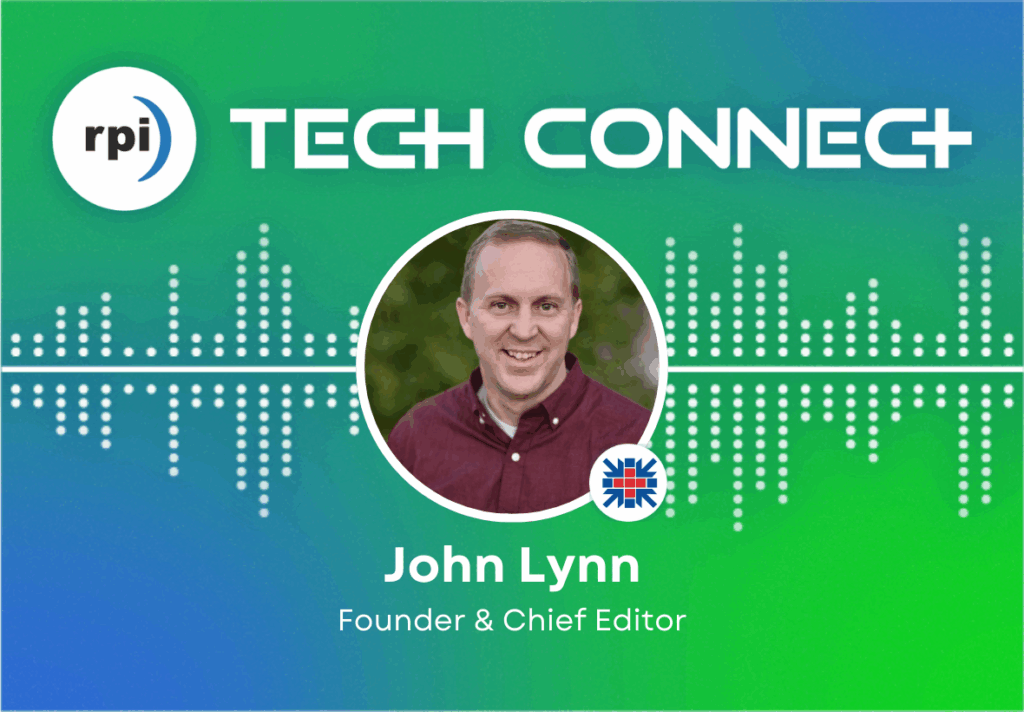
Healthcare has no shortage of data—but using it to actually improve patient outcomes is another story. In this episode of RPI Tech Connect, John Lynn, founder of Healthcare IT Today, explains why better data governance is the missing link.
From staffing and supply chain to finance and HR, John shares how back-office data directly shapes the patient experience. He and host Chris Arey also explore the rise of AI medical scribes, the challenges of interoperability, and what separates organizations that just put out fires from those that build lasting change.
Interested in listening to this episode on another streaming platform? Check out our directories or watch the YouTube video below.
Meet Today’s Guest, John Lynn
John Lynn is the Founder and Chief Editor at Healthcare Scene which includes the Healthcare IT Today and Swaay.Health communities, publications, podcasts, and conferences. Healthcare IT Today is the leading healthcare IT community with over 19,000 published articles, 1000+ video and audio podcasts, and a community of 200,000 followers.
Swaay.Health is the only place healthcare B2B marketers and hospital and health system marketers come together to improve patients’ lives. Healthcare Scene has carved a strong place in health IT media.
Meet Your Host, Chris Arey
Chris Arey is a B2B marketing professional with nearly a decade of experience working in content creation, copywriting, SEO, website architecture, corporate branding, and social media. Beginning his career as an analyst before making a lateral move into marketing, he combines analytical thinking with creative flair—two fundamental qualities required in marketing.
With a Bachelor’s degree in English and certifications from the Digital Marketing Institute and HubSpot, Chris has spearheaded impactful content marketing initiatives, participated in corporate re-branding efforts, and collaborated with celebrity influencers. He has also worked with award-winning PR professionals to create unique, compelling campaigns that drove brand recognition and revenue growth for his previous employers.
Chris’ versatility is highlighted by his experience working across different industries, including HR, Tech, SaaS, and Consulting.
About RPI Tech Connect
RPI Tech Connect is the go-to podcast for catching up on the dynamic world of Enterprise Resource Planning (ERP). Join us as we discuss the future of ERPs, covering everything from best practices and organizational change to seamless cloud migration and optimizing applications. Plus, we’ll share predictions and insights of what to expect in the future world of ERPs.
RPI Tech Connect delivers relevant, valuable information in a digestible format. Through candid, genuine conversations and stories from the world of consulting, we aim to provide actionable steps to help you elevate your organization’s ERP. Whether you’re a seasoned professional or new to the ERP scene, our podcast ensures you’re well-equipped for success.
Tune in as we explore tips and tricks in the field of ERP consulting each week and subscribe below.

Transcript:
Chris Arey
Welcome to RPI Tech Connect. I’m your host, Chris Arey. Today, we’re taking a closer look at the mountains of data healthcare systems have access to, and specifically, how they don’t fully use it. Not doing so has real consequences. For one, it makes it harder for staff to work efficiently. Two, it limits how well patients can be served.
Joining me today to talk about the governance of data in healthcare and how making use of it can have a significant impact on how patients receive care is John Lynn, founder of Healthcare IT Today. John, it’s an absolute pleasure to have you on the program this morning, sir. How are you?
John Lynn
Doing great. Thanks for having me. Excited for today’s discussion.
Chris Arey
Yeah, man, where are you calling in from today? I always like to ask my guests where they’re at.
John Lynn
Well, it’s funny. I split time between Vegas and Salt Lake, but I happen to be on the road in Springfield, Massachusetts. It’s an amazing place and I love it. It has the NBA Hall of Fame here and stuff. So here at a conference on the road, like usual.
Chris Arey
So you’re on the East Coast.
John Lynn
Yep, I am.
Chris Arey
Okay, great. That’s awesome. It’s not too early for you, then.
John Lynn
Yeah, you know, I wouldn’t have accepted it, I think, if I were back in Vegas.
Chris Arey
Before we get in, I’d love to hear a little bit more about you. I know you’re the founder of Healthcare IT today, which is an awesome blog. What else can you share?
John Lynn
Yeah, you know, I was at a conference recently, and someone pulled up LinkedIn, and they’re like, Oh, you’re almost at 20 years. And I’m like, geez, that makes me feel old.
But yeah, the first blog post on Healthcare IT Today was 20 years ago. And, you know, we have about 19,000 articles that we’ve published over that time, just a ton of content. We have an amazing community of about 200,000 people, and 46,000 email subscribers to our daily email newsletter.
We pump out somewhere around 17 to 20 plus articles a week, just sharing practical healthcare IT content. So how can we make the lives of the CIO and everyone that reports to the CIO at a hospital health system medical practice easier?
We also have a healthcare marketing community at Swaay.Health. So that’s a lot of fun as well. How do you market healthcare IT solutions to hospitals, health systems, and medical practices?
And also, if you’re a marketer at a health system that wants to do it, you’re welcome in the community as well. So yeah, we see them as two communities, the health IT community at Healthcare IT Today, and then our healthcare marketing community at Swaay.Health.
Chris Arey
Very cool. And you’re doing a great thing there. To maintain a blog, to be pumping out content of that volume for over 20 years, that is a testament to your work ethic, because that’s no easy feat.
John Lynn
It’s funny, I was at a marketing conference here in Springfield and asked one of the ladies in charge of the blog, and I was like, yeah, what’s your rhythm? She’s like, you know, we shoot for one a day.
You know, it turns out the number one winner in content creation is time. Time is incessant. And you know that if you’re hosting this podcast, you understand time is the enemy, and I don’t care how far ahead you get, you’re always behind because time never stops. It’s relentless.
Chris Arey
Yeah, yeah, I can definitely relate to that. And the other part of it is that your job is never done. There’s always more, right? There’s always more.
John Lynn
Well, that’s probably the most common question we get. Like, well, do you ever run out of things to write about, to, you know, do a podcast about? I’m like, you don’t understand the industry.
There is so much that you could cover. You know, sometimes it feels a little bit like Groundhog Day because you’re like, geez, I feel like we’ve been through this kind of regulatory cycle before. But you know, there’s so much, especially now with AI, the innovation that’s happening is incredible.
Chris Arey
Yeah, yeah, I agree with that. It’s helped me scale more. I can create more content with less effort. I don’t know if you use it that way, but that’s a discussion for a different time.
John Lynn
Yeah, we’ll have a marketing one another time.
Chris Arey
Let’s go ahead and shift gears here. My first question for you is, why are healthcare organizations still struggling to make use of the data that they have?
John Lynn
Yeah, know, the number one thought I’d have with that question is around a lack of standards. And the reality is that we have a lot of standards in healthcare, and we keep getting more, which is interesting. But, you know, they were largely focused on the clinical side of things.
So, whether it’s the clinical information or whether it’s something for the patient to get them the clinical information, the standards have largely been focused there. Labs have done well, pharmacies have done well with standards, even billing, you know, has done well. You know, we’ve had standards in billing probably longer than anything.
But when you look at the back-office data, we don’t really have those standards available to us. And so, you know, there’s been kind of a lack of standards in that regard because we’ve been too distracted, quite frankly, on all the clinical side of things. So, I think that’s the big challenge. And kind of related to that is that the EHR has been a distraction.
Just look at ERP systems. We went 20 or 30 years, and no one was really changing ERPs because we were too busy implementing the EHR and chasing after government stimulus money for EHR.
Granted, those are massive projects that require a focus. I think we’re now in a place where the EHR is more stable. And so, people are saying, “Wait, we should do more with our ERP and more with the data.”
And to be frank, many healthcare organizations had old ERPs that didn’t support the kind of sharing of that data and access to the data that would be meaningful to them. I think that’s the interesting challenge we have is that we were distracted on the clinical side, focused on the EHR, and there weren’t the standards to be able to access that data and kind of leverage that data the way that we should.
You know, it’s interesting, we’re interoperable to a degree, but we’re not nearly as interoperable as we think. And if you’re on a legacy ERP, that’s even worse.
Chris Arey
Do you think that introducing new standards for data maintenance or data quality on the backend is coming? Like in the future?
John Lynn
Yeah, you know, I’m not sure it is. That’s the other problem. I think that the solution will probably not be standards from, say, government organizations, but I think they’re creating their own APIs on the back-office side.
And we know there are half a dozen, a dozen main vendors that are storing a lot of that system and record data for a healthcare organization. Most of them are creating APIs to be able to access that data.
So I think that’s how the standards will be created. I’ve said it on the clinical side. If Epic just says, here’s our standard, if you want to get access to the data, then guess what? We now have a standard, right?
I think that’s what’s going to happen on the ERP side. Those vendors are going to make API access available to integrate with the EHR, to integrate with outside sources, et cetera. So, I think that’s how we’re going to get standards. It’s going to be more of an industry-led one, as opposed to a kind of government-led, you know, standard like we have on the clinical side.
Chris Arey
Got it, that makes sense. So, I want to talk now about how healthcare systems have access to this data, and they’re struggling to make use of it. But what is the relationship between, say, supply chain data and the patient experience? How do those things translate into patient care?
John Lynn
Yeah. So, think about this. I’m not even sure you could do a study on this, but what do you think is the number one impact on the experience a patient has? And as I thought about that, I was like, I think that the number one impact on the experience patients will have in the organization is, are you staffed properly or not?
If you have poor staffing, you’re almost guaranteed to have a bad experience because you just don’t have enough people to provide the care and the attention that’s needed to be able to care for a patient properly.
A direct line perspective on it is if you have poor staffing efforts, your data is not good, and it takes six months to onboard a new staff member as opposed to one month or whatever the timeframes are, right? That is problematic because every healthcare organization I know could use more staff, right?
Chris Arey
That’s so true.
John Lynn
Like, yeah, I just heard a story about a hospital that ended up burning down here in the New England area. And when they burned down, guess what one of their main concerns was? They were worried about how they were going to retain the staff they had. Before the fire, they had staffing challenges, and they’re competing in the New England area, which is competitive.
John Lynn
They’re like, how do we ensure that when we’re ready to reopen, we are going to have staff? Because we had staffing challenges before. If they all leave, then what do we do? So, my point is that having systems that ensure your staff are there and ready for it is a really big deal.
We know this is a big deal. Someone told me that you look at what people regulate to understand what we’re afraid of, and they were trying to regulate nurse ratios.
That’s a whole topic for another day, if that’s good, bad, or otherwise, and the impacts it has. But that’s the reality, we know that if you have the wrong nurse-staff ratio, nurse-to-patient ratio, then you’re going to have worse care. And so that’s why they’re considering that type of legislation because we want to make sure that the right number of staff are there.
So, to me, that’s one of the biggest ones. The other thing to think about on this, Chris, this question of supply chain; there’s this trickle down that happens with staffing and with supply chain.
Let’s talk about the supply chain side. Okay, let’s say the supply chain is poor and you’re missing supplies. Well, if you’re missing supplies, what happens? The staff gets super angry. They are frustrated at a minimum, right? Now the staff are frustrated and angry, and then it trickles down.
They’re going to provide a bad experience to the patients, and then you have this kind of trickle-down effect, leaving the staff frustrated and angry. Now the patient doesn’t get taken care of the way that they should, and to credit a lot of these staff, they know how to navigate frustration and missing things, but that is part of what makes the experience bad for a patient.
I think it was Richard Branson, if I remember right. He said something like, if you take care of your people, they’ll take care of your customers. And that’s what it is when it comes to the back office, right? Are you taking care of your people in a way that is respectful and that doesn’t frustrate them? If you take good care of them, they will take good care of your patients.
Chris Arey
I think that’s so true. And you mentioned something there about the patient experience, right? What determines whether that’s going to be good or bad? And I agree with you that staffing is a big part of that.
Something that we actually covered in a previous episode was what it felt like to be a patient in a room with a doctor who is spending more time looking at the computer, hard coding the data into the system.
They don’t feel prioritized and feel like they’re kind of like a number. But the way that that data is entered into the system, I think, is also a part of that experience. And I think one of the avenues that was proposed for making that experience better and getting that data in there and allowing healthcare practitioners to focus on the patient was to deploy new types of technology.
The one that comes to mind was like there was an assistant voice thing where the doctor could speak aloud and it would record the notes right into the system, so they weren’t typing or navigating to a different application to enter X, Y, and Z fields. Anything you can share there? Is that something you’ve just, you know, explored?
John Lynn
It’s my favorite technology that’s happening right now. But clearly, most people are calling it AI medical scribes now. There is some sort of ambient clinical voice overlay on that as well. So, it listens to the visit and documents it for the doctor.
When we implemented an EMR, people loved it because it took off the documentation. They could read it, and they can access it. They didn’t have to go to the chart room and find the chart. And the doctor took it home, and now I don’t have it.
When you pulled it up, it was easily legible. You didn’t have to read their handwriting. And then what we did layered on all this complexity because we now have all the data electronically.
We could run reports on this. We could report to the government on this. And the government said, hey, now we have it. We could have them send us this data. And so, we layered on all these levels of bureaucracy and documentation on top of it that, in a paper chart world, we didn’t really care because we weren’t going to do that in aggregate anyway. After all, you can’t aggregate a report across charts.
Although ironically, some people did. They’d pull 1,000 charts and then do it manually, like ridiculous, right?
Now it’s like one query, 10 seconds, you get your result. Anyway, so it’s like we layered on the bureaucracy. And so now we’re saying, okay, you took an EHR, which was pretty helpful in the beginning. There were some good benefits. Well, we take those benefits for granted now. So, you know, you can’t count those anymore because now we’ve had it for so long.
But then we layered on all this bureaucracy that said, hey, I want a bunch of documentation from you that I didn’t ask for you previously, but hey, now I can, so I’m going to. And so that’s what you’re talking about, Chris.
That’s why ambient clinical voice is so powerful and why it’s loved by doctors. It’s the most exciting thing we’ve seen since they gave $36 billion of stimulus to EHR, because I think 80 to 90 % of doctors are going to adopt it, like how 80 to 90 % of organizations have adopted an EHR.
It’s because they’re living the dream that they want, which is that I walk into the room, I see the patient, I care for the patient, and when I walk out, the documentation is nearly done for me. And I have to review it, right? And they’ll probably keep doing that for quite a while, but they’ll review it and say, yeah, that’s good. Make a few tweaks and then move on to the next patient.
They don’t have to do the documentation later. They don’t have to remember. They call it pajama time, right? There’s no pajama time at home doing the documentation. They’re doing it all in the visit.
There are pros and cons to all this. We could talk for hours about it. I’ve interviewed almost all of the main vendors in the space, and it’s incredible what they’re doing. There are a lot of things to work out. It started with ambulatory, and started with specialties.
It’s going to grow into the acute care side. We still have to figure out what the workflow is for a nurse in the acute care setting. That’s going to be something they work on, right? But it’s happening so quickly.
It really does do exactly what you described, which is that it makes the doctor enjoy the experience because it’s taking off all those layers of bureaucratic minutia that we added to them. And now it’s going to happen automatically.
Chris Arey
In your role and all the conversations you’ve had with folks, do you have any visibility into what percentage of healthcare systems are using some sort of tech like that right now?
John Lynn
It’s hard to say because it’s moving so quickly, but I would say every single health system is doing some sort of pilot or has implemented this across their organization. If you’re not, you probably should fire your CIO, to be frank, like, you know, like that you’re not exploring it.
There may be a few specialties where that’s not true because it hasn’t quite developed there, but I would say almost everyone is looking at it and saying that it’s interesting. When I started writing about EMR, the feeling was, should we do EMR? And then it kind of like right before the stimulus happened, everyone was like, okay, we know we need to do an EMR, but which one and how do we do it?
What’s the right way to approach it? Right. And then the stimulus package hit, and they’re like, okay, we’re doing it. We’re going after government money. Right. Well, we’re kind of in that same, but it’s gone much quicker with ambient clinical voice and medical scribes, where at first they were like, does this technology really work? Should we be doing this?
So then they’re like, okay. We need to be doing this. And I think we’re in that kind of stage where it’s like, we’re going to do it, but which vendors, how do we approach it? Who’s right? What’s the onboarding? So we’re kind of in that middle stage where everyone’s trying it, so I don’t think we know the number, and it’s changing so quickly, but we’re having millions and millions of encounters documented by an AI medical scribe every day across, you know, every healthcare organization.
Chris Arey
Yeah. That’s good to hear that they’re leaning in then and realizing that it’s going to help them do their jobs and deliver better care. Which is always nice to hear. Sometimes I feel like there’s reluctance, you know, for new tech and changing things up. But this industry, I think I feel in particular, you know, from the supply chain challenges to ongoing workforce shortages, like they’re in, they’re in a place where they really need change and a way to do things more efficiently. So it’s great to hear that.
We’ve discussed briefly how this backend data can directly impact patients. What can healthcare systems do to improve data quality and governance? What kind of processes would you recommend or do you think will move the needle into delivering better care?
John Lynn
Yeah, when it comes to it, I think the first part is actually caring. It’s such a simple idea, right? But it turns out it’s one of the simplest leadership principles, if you care about it, if you put some focus on it, then it will improve. So, that’s a simple thing to say, right? What we focus on, we improve on. And so the question is, is this something worth focusing on? In this episode of your podcast, we’ve kind of seen that there’s a lot of value in focusing on the right data.
And when you talk about any AI solution, it’s all built on the back of your data. If you have quality data, then you can create some quality results. If you have bad data that’s inaccessible, then the AI can’t use it. So, you know, it’s like, that’s the first key, is knowing that there’s value in doing that.
Then the next question is, okay, what’s the governance structure for us to do this? What I suggest to people is I say, hey, look at a smaller project that you can do a quick win on, right? So don’t try to eat the entire data governance quality approach, right? Instead, say, hey, we have a very specific project. I talked to an organization last week. They had some reporting they had to do to the state for perinatal care.
They looked at it, and there were 350 fields that they had to fill out for it, right? They wanted to pull it all from the EHR using automation. It’s amazing stuff, you know, from AMETEK and using UiPath and some great technologies behind it. But what they realized is they needed to spend a few months cleaning up the data in the EHR because one clinician was storing that data point here, and the other one was storing it here.
And so it was stored properly. They were documenting the data, but it was in different places, or it was in different formats, was whatever it might be. And so they had to spend a few months on what you just described, which is we need to make sure that the data being stored there is in the right place and is consistent, so that then we can apply the automation and apply the AI to actually do the project that they had.
In this case, it was government reporting that was required and needed to be done. And humans were spending days and days doing it. And now they replaced that with AI. But the first step to that whole project was, is the data in the EHR? If not, we need to train them on why they need to do this.
And, hey, this is going to save you a call. A little anecdote from that story was like, they would call the doctor while they’re in the room with the patient to try to update documentation from two weeks ago, which the doctor probably barely remembers, you know, and so that wasn’t good for the doctor.
So being able to train them on, if you put the data here, we won’t bother you. That’s a big win for everyone as well. So, you know, that’s core to everything is the quality of data and ensuring that is what’s going to power any successful AI solution.
Chris Arey
You talked there about it not being good for the doctor when they’re calling him up to verify data, but the patient’s sitting there too, and you think that’s gotta have an effect on their experience, right? It’s like, why are you doing this now?
John Lynn
Of course. We’ve all been through that, right? Like, it’s annoying when you’re like, wait, do you not care about me? Do you care about them more? And to be frank, sometimes they do, right?
Chris Arey
Yeah. It’s such an important part of that. It sounds like what I’m hearing from you is that making it a priority is step number one, and not trying to do it all at once is another part of that.
But you have to think too, like, how do you prevent it from getting to a point where you have to go back, correct data, and put it in the right format? What can they do now so that when it’s getting entered correctly from like day one? Is there a way to do that?
John Lynn
Yeah, I mean, we see some stuff, right? Templates, reminders, prompts, and we’re seeing even more of it, right? Epic announced 100 new AI initiatives, and some of it’s around data quality and ensuring that they’re doing quality documentation or things like that, right?
There are things you can do, but it’s interesting. We talked about AI medical scribes here. One of the amazing things about technology is its extreme consistency. Even if it’s wrong, it’s going to be consistently wrong.
Whereas humans are not. Humans are amazingly inconsistent. So if you audit a human’s charts, right, and the way that they’re capturing data or someone that’s doing credentialing of your providers, they can be amazingly inconsistent, where one time they forget to do the state, and one time they forget to do this format for the birthday and one time they forget whatever, right?
Chris Arey
It’s true. It’s unpredictable.
John Lynn
One of the beauties of the AI medical scribe is that it could hallucinate. That’s a bad side, right? It could have the wrong information, but generally, it does it consistently wrong. So when you find something that’s wrong, you can correct it, and then that doesn’t happen again. Whereas the same is not true with humans. So in some ways, the answer to your question is AI should do it because then it’s more consistent.
Chris Arey
Yeah.
John Lynn
And then, you know, even if it’s consistently wrong, then we can go back and correct that, or we can address that in the future going forward. Whereas humans will always be inconsistently wrong because we’re human. That’s the nature of what we do.
Certainly, there are processes you can do to help humans be more consistent and to ensure they have the right data, and you can proactively reach out to them. You can do templates, you can do all sorts of training to understand them. And that helps.
But interestingly, the long-term answer is probably AI, which is very consistent.
Chris Arey
I love that you said that too, because it’s something I can personally relate to with AI is that when you’ve used it enough times, you know what errors to look for. And then when you know that it’s very easy to correct and probably automate to fix without requiring human intervention, going forward. So I love the distinction there between like, we’re not totally reliant on AI yet because humans have to review it.
It’s really just a tool in the toolkit, but I love how you mentioned that it’s going to be consistently wrong, and you can take notes about what areas it’s making those mistakes. So they’re going forward, you know exactly where to scan to and see, did it do that thing that it did the last 20 times? Let me check that real quick.
John Lynn
Yeah, and some people may say that with gen.ai, we’re starting to see more intelligence, which makes the AI less consistent. But what we found is that, though this is true, we still have versions of models. If it’s consistently bad in this version of that model, then it’s consistently bad in this next version of the model.
So there is still some more consistency. Although the way it’s evolving, we’ll see how that changes as well, because if you pump more data into it, you change the generative AI model and it may put out a different result, but at least it will be consistent across different models and versions that you implement.
So, it’ll be interesting to see how quickly that evolves, and especially the artificial side of the AI, which I think we’ve corrupted the term AI to include any process animation, even analytics. I like to say marketers ruin everything, and that’s true with the term AI. It applies to pretty much any automation these days.
Chris Arey
Yeah. I want to dispute you on that, but I think you’re probably right. It’s a term that’s made its way into a lot of places it probably doesn’t belong. A few more questions for you here. This next one, I think I know the answer, but I’d love to hear it if you break it down nice and easy here. What do you think is going to separate forward-thinking data-driven organizations from those that are kind of lagging on this data usage?
John Lynn
Yeah. Here’s what I would say. To me, it’s all about the leadership and the focus that your leadership has. And here’s how I like to differentiate it. Is your leadership focused on firefighting or are they focused on strategic building of solutions for your organization?
Because there are a lot of leaders out there who are just fighting fires. And guess what? In healthcare, there’s always a fire to fight. And you can feel like you’re being extremely productive because you’re closing a lot of tickets and you’re helping a lot of people with fires that are distracting you from the day.
And you can do that, right? As a leader, there are plenty of fires to go out there and fight. There are plenty of problems to solve, and you get them in your ticket system every single day. But those that take a step back and say, hey, I need to do some firefighting.
There are certain things that you have to just put out right away, but you have to do more strategic building so that you stop the fire from happening at all. Like, I think of it as an analogy, right? Imagine you’re a firefighter and you go and you’re putting water on the fire and you’re like, why isn’t the fire going out? And then you realize, the gas is still on, and it’s just, you know, the fire is just burning up the gas.
So you can put as much water as you want on the fire, but if you just go turn off the gas and then put water on the fire, then it’s gone and it’s out. Right. And that’s what we do in healthcare a lot.
We just keep pouring water on the fire. Solving the problem, the complaint from the doctor, we deal with that, rather than saying, wait, can we just turn the gas off so that we stop getting these fires completely?
So I think that’s the difference is a leader who says, Hey, I’m not just here to keep the IT lights on. Sure, I need to do that too, but I’m here to be a strategic part of the business, and I want to solve strategic problems that really change the way we approach it.
And I think that is going to be the biggest differentiator and separator is those that focus on where you can create change at your organization so that you don’t have any fires to fight later, or at least fewer. So I think that’s the biggest one.
Chris Arey
Okay. Yeah. And you mentioned the, I love the fire analogy you gave there. It’s, it’s similar to one that Brian Rosenberg made on a different episode, talking about somebody who’s sawing down a tree in a forest with a dull blade.
You’re going to be doing that for a long time. Let me show you that if you just sharpen this blade or use a different one, it’s going to have a much bigger impact. And I know that takes away from, like, having to address this thing right now.
It’s gonna be worth it. It’s gonna save you time and help you be more successful down the road.
John Lynn
The challenge is that it’s actually harder than you think because the people requesting it have a lot of power, and they’re your customers, and you want to satisfy them quickly.
You know, don’t underestimate that it takes some clout, takes some gumption, and some leadership to do that. You know, it doesn’t just happen automatically because they are compelling, and they make the case that they want it now. And it takes work to tell them, hey, that’s not the best way to approach this.
Chris Arey
I asked him that, asked him as a, the discussion I had was, said, you know, we’re talking right now about best practices for how you’re supposed to be running your healthcare system. Like do X, Y, and Z.
And I said, that sounds good and dandy, but how do you get people to actually do that when they’re so busy handling the day to day, keeping the lights on, and trying to keep things, you know, moving in the right direction with limited resources, workforce shortages, right?
We know that this industry is suffering from a lack of resources to do the work. His response was like, if you see somebody in the forest chopping down something with a dull blade, like, you’re only gonna get so far. But I hear you, I totally hear you.
When I actually asked him that question, that was my thought was like, How do you get somebody to stop from doing their job, right? Because that’s what they’re there to do. It’s hard.
I think that’s actually, that’s one of the benefits you have from having an ERP partner, like RPI Consultants, come in. You have a third party who is neutral to the situation and is outside of your world who can provide an objective, give an objective perspective on how things are and how things could be improved.
And to help you kind of make that transition to a better process where you’re making better use of data and using systems and technology that can reduce the burden on your staff. And we know that they’re already looking for ways to do that.
John Lynn
Yeah, well, the reality is that we’re all overwhelmed. And, you know, I heard someone say that maybe the worst phrase in the English language, I think this might be in a business context, is “that’s the way we’ve always done it”.
And that’s where I think it’s valuable to have someone like RPI Consultants come in and say, Hey, you’ve always done it this way, but why? And they can do that from this objective place of “I’ve talked to 30 others and no one else does that”.
So that’s why we’re doing it. We’re not against changing if there’s a better way, but they need someone who can bring it in and say, There is a better way. And so that’s where I think having a third party come in and say that is so powerful.
Chris Arey
Yeah. Change management, you know, a lot of these projects are technical in nature, but that’s only half the equation. Like getting people on board and showing them the way, and showing the value early, and building like excitement for the change is a big part of that too. Okay, we’re getting close to time here, John.
John Lynn
Yeah, absolutely.
Chris Arey
You may or may not know this, but before I wrap up, I always like to ask my guests if they could share one actionable takeaway for today’s audience. It’s usually related to the topic. Today, we’ve talked about back office data quality and governance. What is your one piece of advice for today’s listeners?
John Lynn
Yeah, I would actually reiterate some things we talked about already on the episode, which is that data quality and governance take real effort. It doesn’t just happen magically. It’s not just going to happen on its own. So if you care about that, and you should, because the future of your organization depends on the quality of that data, well, then you need to put in the effort to look at that data and ensure that its quality and that it can be used.
And I love the word trusted, right? Like you have to put in the work for it to be trusted. And we’ve seen this, it turns out that’s true in life. If you want to be trusted, you have to do the work to be worthy of trust. And the same is true when it comes to data quality and governance. So, like we talked about, find some quick wins that you can do the effort and then they can see the benefit of making sure that the data is quality.
You saved them time on this government reporting. You made something more efficient, so they were able to get paid quicker, or they hired someone quicker, or whatever it might be that you’re focused on.
Find some quick wins there and put in the effort for this small slice. Give them a win, and then they say, you know what? There are some other ways we could do it as well. And so that would be my advice is put in the work and find quick wins.
Chris Arey
That’s awesome. I love that. That philosophy, we believe in that here at RPI, too. There are many times you want to do all these big activities all at once. It’s like, no, do it methodically, do it slow, do it over time. And like you’re saying here, like a little project at a time. And that makes a difference over a long period of time, right?
John Lynn
Yeah. Think about how many enterprise data warehouses, you know, where they spent millions of dollars building these enterprise data warehouses, and then no one used them. You look at it now and you’re like, man, we were so backwards to waste all that time and money doing that.
And then we ended up with what, right? The project was to create the enterprise data warehouse, as opposed to the project was to impact XYZ patient care or whatever it might be.
Chris Arey
Absolutely. Well, thank you so much for hanging out with me today, John. It’s been a pleasure to have you on the show. I love the topics we covered, and maybe we’ll do something again here in the future.
For those of you listening in, if you have any questions about today’s topic or you want to learn more about how RPI can help you with data quality and governance, we’d love to hear from you. You can contact us by emailing us at podcast@rpic.com. Again, that’s podcast@rpic.com.
John Lynn
Yeah, thanks so much.
Chris Arey
This is RPI Tech Connect, and until next time, take care. See you, John.
John Lynn
Thanks.