With so many technology events competing for attention and tighter budgets shaping attendance decisions, choosing the right events in 2026 matters more than ever.
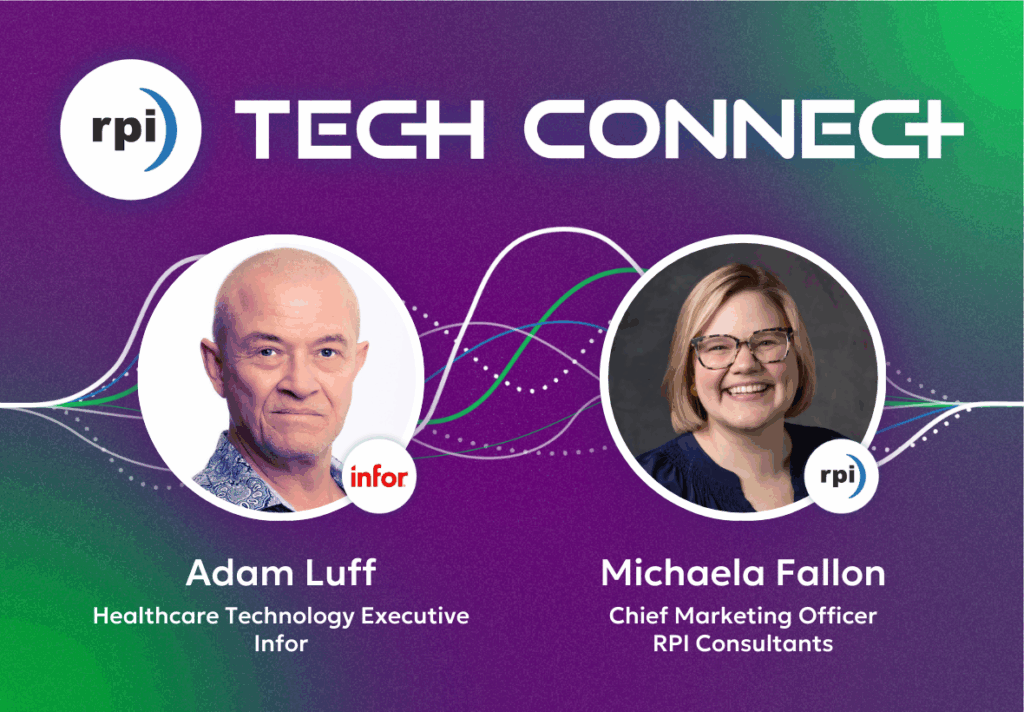
In this episode of RPI Tech Connect, Michaela Fallon, CMO at RPI, and Adam Luff, VP of Product Solutions at Infor, return to break down how customers should think about the evolving event landscape. The conversation spans local user groups, large scale conferences like Infor Connect, industry focused community events, and RPI led Bootcamps and training sessions.
Together, they discuss why in-person events are regaining momentum, what makes smaller and more intimate gatherings so valuable, and how different event formats serve different audiences, from daily system users to executive leaders. The episode also explores the growing importance of peer-to-peer learning, hands-on training, and authentic connection in a market crowded with virtual noise.
If you are planning your 2026 event calendar, this episode offers a practical framework for deciding where to invest your time and why showing up in-person still delivers meaningful value.
Interested in listening to this episode on another streaming platform? Check out our directories or watch the YouTube video below.
View our upcoming events, including Infor Connect 2026 and RPI’s CloudSuite 101 Bootcamp.
Meet Today’s Guest, Michaela Fallon
Michaela Fallon is a marketing leader with nearly a decade of experience in marketing strategy and operations. In her role as the Chief Marketing Officer at RPI Consultants, she leads the marketing team, overseeing events, content, operations, and design.
Before joining RPI, Michaela held several marketing leadership roles in B2B startups across many industries, showcasing her versatility and allowing her to evolve into a full-stack marketer.
Michaela’s expertise spans branding, team leadership, and growth marketing. She has consistently led impactful marketing initiatives, steering efforts in brand identity, content strategy, CRM management, and demand generation.
Meet Today’s Guest, Adam Luff
Adam Luff is a healthcare technology executive and VP of Solution Consulting at Infor. A 25 year veteran of Healthcare Technology, Adam focuses on operational efficiency that leads to providers getting paid faster and simpler.
Meet Your Host, Chris Arey
Chris Arey is a B2B marketing professional with nearly a decade of experience working in content creation, copywriting, SEO, website architecture, corporate branding, and social media. Beginning his career as an analyst before making a lateral move into marketing, he combines analytical thinking with creative flair—two fundamental qualities required in marketing.
With a Bachelor’s degree in English and certifications from the Digital Marketing Institute and HubSpot, Chris has spearheaded impactful content marketing initiatives, participated in corporate re-branding efforts, and collaborated with celebrity influencers. He has also worked with award-winning PR professionals to create unique, compelling campaigns that drove brand recognition and revenue growth for his previous employers.
Chris’ versatility is highlighted by his experience working across different industries, including HR, Tech, SaaS, and Consulting.
About RPI Tech Connect
RPI Tech Connect is the go-to podcast for catching up on the dynamic world of Enterprise Resource Planning (ERP). Join us as we discuss the future of ERPs, covering everything from best practices and organizational change to seamless cloud migration and optimizing applications. Plus, we’ll share predictions and insights of what to expect in the future world of ERPs.
RPI Tech Connect delivers relevant, valuable information in a digestible format. Through candid, genuine conversations and stories from the world of consulting, we aim to provide actionable steps to help you elevate your organization’s ERP. Whether you’re a seasoned professional or new to the ERP scene, our podcast ensures you’re well-equipped for success.
Tune in as we explore tips and tricks in the field of ERP consulting each week and subscribe below:

Transcript
Chris Arey
Welcome back to RPI Tech Connect, the trusted source for enterprise technology insights. Today we’ll be talking about the Infor event landscape and how listeners should think about prioritizing events in 2026.
Over the last few years, we’ve witnessed a growing appetite for human connection, and the demand for in-person experiences across the Infor community is strong. With so many different events to choose from though, it can be difficult to decide what to attend.
To discuss how to find value in the variety of events today, I’m pleased to welcome back Michaela Fallon, CMO here at RPI and Adam Luff, VP of Product Solutions at Infor. Adam, Michaela, it’s great to have you both back on the program.
Adam Luff
Yeah, yeah, great way to start the year.
Michaela Fallon
Yeah, thanks for having us.
Chris Arey
Very fun.
You know, we were recently talking about how long you have to do something before it becomes a tradition. I think this is our third time doing an event.
Michaela Fallon
Yep, yep.
And you’ve asked me back every time. So we’ll see if there’s a fourth invite after today, but it’s been fun.
Chris Arey
Awesome. Well, it’s great to have you both here. I think a good way to start today’s discussion would be to examine the events scene in years past.
So Adam, first question here is for you. You’ve been attending Infor events for a long time. Take us back a bit. What were those early events like and how do they compare to what you’re seeing now?
Adam Luff
That COVID thing came along and kind of nixed everything, didn’t it? The first time that we started reinvesting in user groups as a company was mid-2024.
It was in St. Olaf’s College, Minnesota, and it was not very well attended. There were more people from RPI and the other partners than there were attendees. I was doing the keynote speech and there were 12 people in this giant auditorium at St. Olaf’s, which is a teaching college, right?
You had this giant auditorium, and all these people were dotted around. Though it wasn’t very well attended, we persevered.
We started getting the word out internally here. We started talking. I started talking to the account executives, the RVPs, and the partners and everybody said, “You’ve got to drive attendance. We’ve got to drive attendance”.
The next one we did was in Denver, and I remember it because it was in probably one of the oldest Marriotts I’ve ever been in. This place was old. Tell you how old it was. It had telephones in the bathroom.
Chris Arey
Like the rotary phones with the dial?
Adam Luff
Not a rotary phone, but as you were sat there on the throne, there was a phone right there.
Michaela Fallon
That reminds me of my grandparents’ house, yep.
Adam Luff
I mean, there was a time when that was cool, right? When that was cool. I’m like, wow, that’s how old this place was.
That was better attended. I would say we doubled the numbers. We probably got about 30 or 40 people. You know, I’ve been doing these now for like 18 months, and we’re up to three or four in the spring and three or four in the fall.
All of that led up to the last one I did, which was funnily enough at the RPI office in Baltimore, which is a must-visit.
It’s a sweet place. really is lovely. It really is lovely. How many people did we have? Over 120 attendees. Attendees, not just representatives from RPI, Infor, and the other partners.
Chris Arey
Yeah, I want to want to sit on that one for a second there. We did end 2025 on a particularly high note. MRLUG at Baltimore at our office, over 100 attendees.
Why did that resonate so strongly? What? Michaela, we can start with you. Why do you think that was?
Michaela Fallon
Sure. Well, I would love to say it was just our beautiful office and the opportunity to come to hang out with us, but I think it’s really due to overall growth in the events space.
Kudos to Adam for this, because I think there’s really been momentum with user groups. Part of it is the quality of the content that’s coming out, I think people are hearing good word of mouth that these events are worth their time.
Speaking to the events landscape post-pandemic, there’s a higher bar for people to attend events. They have to be really worth it. You have to really show value. There has to be great content and good networking. And I just think the bar is being raised all the time, people are hearing that, and there’s appetite for it.
Adam Luff
Yeah, if I can paraphrase, Chris and I did a couple of interviews at the end of the event, and we interviewed the ladies that run MRLUG. They said some interesting things, but mainly spoke about the importance of getting people back together again, which is a big deal, right?
Because, you know, we, as humans, socially, that’s how we interact. That’s how we interact. We’ve gotten used to doing things on Teams, and here we are doing this on a recording platform, right? But we got used to doing it because we had to.
The day those shackles came off, I remember I was on a plane flying when the pilot came across the loudspeakers and said ladies and gentlemen, you’re not going to believe this, but the mask mandate has just been lifted federally.
Remember, we’re all sitting on the plane with our masks on. The cheer that went up on that plane. It was amazing! I remember that vividly, right. But going back to this, and I think what you said, Michaela, it’s the quality of the content and word of mouth.
I think word of mouth is probably driving most of the attendance here because you want to come to this because not only are the partners invested in this, but Infor is also investing in this right?
Making the push for Infor to resume sending people rather than dial in was important to me, because that was always something I enjoyed. I’ll get on a plane and go somewhere, even if I only have a one-hour presentation commitment. I’ll go there.
Eventually, we got people to show up, and that helped a lot.
Michaela Fallon
Yeah, that’s huge.
Chris Arey
You mentioned something there, Adam, about the interviewing we did at the tail end of the event. I remember we spoke to some Infor users as well, and we were asking them what kind of experience they were having at MRLUG.
I remember that they talked about how the Infor knowledge base was helpful and that they appreciated the documentation, but nothing replicated that experience you would have in person with peers.
Adam Luff
Mm. Yeah.
Chris Arey
Exchanging problems, solutions, all that stuff.
Adam Luff
Yeah, it really was. The keynote speaker was fabulous. That was me, by the way.
During lunch, I walked around and I sat and chatted with people that I had never met before. They would chat, they’d introduce themselves and you had representatives from the Archdiocese of New York talking with a manufacturing company and a hospital. That was cool. That was really cool.
Yeah. Anyways, that was great way to finish the year.
Chris Arey
Yeah, I like that you talked here about this increase in attendance from 2024 to 2025, ending the year on a high note.
I want to talk now about the value of the user group. We know in-person is important, but what do those users take away from an event like that when they leave and go back to their jobs? Michaela, something you can share on that question?
Michaela Fallon
Totally. Like we talked about, it’s the combo of great content and networking. And I think that has evolved over time too, as there’s a critical mass of people who have moved to the cloud who are attending these user groups.
So, I think it’s valuable for folks who are all on the cloud, who can talk to each other and relate. I think it’s also useful for people who have not yet moved to the cloud because they get to see their future and talk to all those people.
Chris Arey
Yeah.
Michaela Fallon
So, you I’d make the pitch that one of the unique things about the user group is you get to talk to people who are in all different project phases, all different states with their system, maybe using different products that you’re not. I think there’s a lot of value in bringing that mix of people together.
Chris Arey
Yeah, I really like that. Go ahead, Adam.
Adam Luff
Yeah, yeah, I what I tell you all, I have a little story from a previous event. While I was sitting down, a man approached me and introduced himself, saying that he worked for a manufacturing company up in New Jersey. He’s talking about one of the main problems he faces, and it was around procurement.
I’m a supply chain guy, so we’re chatting away. I said, yeah, I see that a lot in my industry. He’s like, what? Said hospitals, you know, and he’s like, oh yeah, hospitals have to buy stuff, don’t they?
And it was just this realization; we all get so focused on what we do for a living within our industry that we forget that a lot of our problems are the same. They really are. So, I think you’re right, Michaela.
Those ladies we interviewed, Chris, they said that they had made friends for life over the years in these user groups, right? In different entities. They don’t see each other often, but when they do their regional user group teams meetings, they know each other. How are the kids, how is the family, that sort of stuff. That’s powerful. Yeah.
Chris Arey
Yeah.
Michaela Fallon
I agree with that. I’m newer to the Infor world. I’ve been at RPI for about three years and it’s amazing seeing people at these user groups who have been going for decades, and it feels like a little reunion. Everybody knows each other. It’s a very lovely thing to see.
Adam Luff
Yeah, it is, yeah. It’s a closely knit community.
Michaela Fallon
Yeah.
Chris Arey
You’re part of the in-crowd when you come to these things.
Adam Luff
Yeah, the Infor in-crowd, right? But it really is heartwarming. We’ve seen people doing this. They have to pay to get on a plane, to stay in a hotel. We don’t pay for any of that. And as you said earlier, it’s about finding their “why”?
When COVID came along, many companies revisited what they were spending money on. I always said, actually, user groups hold tremendous value, right? That’s why I’m so interested in doing this, really.
Michaela Fallon
Yeah. And I would add to that, not only are people paying to attend, being part of the organizing bodies of these, that’s a volunteer position, right? These people have full-time jobs.
You know, I’m down here doing events all the time. That’s what I get paid for. But the people who are organizing these have full-time jobs and they are spending time doing this. And obviously they see value and put a lot of heart into it because it’s a volunteer organization and they do a great job. So, yeah.
Adam Luff
Yeah, very true.
Chris Arey
Yeah, I appreciate both of you. You talk about the value of these user groups and other more intimate, in-person events. The truth is, Michaela, as you mentioned, these people have full-time jobs. They probably can’t attend every event that happens throughout the year.
I want to talk now about an event like Infor Connect. What is the difference between something of that scale versus these local user groups, and how does a customer decide what’s going to bring more value to them?
So, Adam, that question is for you.
Adam Luff
So I’ll tell you what it’s got in common. I will be there.
Michaela Fallon
Sold!
Adam Luff
Yeah, yeah, no, that’s it. I’m there. Now, the user groups are smaller. Well, they got bigger, right? And they’re very defined. But they’re really focused on the users. Infor Connect is really focused on us. We put this on, right? Infor puts it on, and it’s a selling event.
There are user groups, there’s a process advisory group, we have the industry council meetings there, et cetera, et in person. It’s the same but different. I know that sounds wishy washy, but to use an analogy, it’s the difference between me going to watch my local soccer team and going to watch a Premier League team.
It’s that sort of thing. Michaela, we talked about this before as well. What do you think?
Michaela Fallon
Yeah, absolutely. I would agree that user groups are, as the name would lead you to believe, very user focused, whereas Connect feels more like hearing about Infor’s vision for the future and their product direction, and it’s a little bit more executive level.
I think there’s value in each, but if you’re looking at one versus the other, I would split it that way. That Connect is really, you know, for vision and strategic direction and user groups are a little bit more boots on the ground.
Adam Luff
Okay, so here’s the answer, right, Chris? If I was a user, I’d go to a user group meeting any day, right? Because it’s more fun.
You’re probably going to get a lot of that, centered down strategic directions, from Infor executives. Connect is not a user group, it’s an event. It’s polished, right? That’s just my opinion. I think Connect was great. It was fantastic.
There were a lot of people there, 800-900, so it is much less personal. I would say it’s like going to Vegas. We’ve all been to Vegas for some of these events where there’s like 800 million people there, and it’s overwhelming.
Michaela Fallon
Yeah.
Chris Arey
Hmm.
Adam Luff
But it’s the difference between the concierge, which is like the user group thing, versus Connect, which is us selling back to the customer. That’s how I look at it, yeah.
Chris Arey
I see. Yeah, that’s really good. And I think we talked about this in a previous conversation, but the user groups and those real intimate type gatherings focus on today and tomorrow, while those big Infor Connect type events focus on next month and the year ahead. It’s the visionary stuff that Michaela had pointed out there today versus in the future.
Adam Luff
Yeah. Tomorrow versus next week, next month. I like that. That’s a good one.
Michaela Fallon
Yeah.
Chris Arey
So based on how we’re kind of grouping these different types of things, it sounds like, you know, people are listening in, they want to decide where they, what events they should attend.
It sounds like if you’re a daily user of Infor Supply Chain or something, a user group might be more valuable for you than attending Infor Connect. Would you two agree with that?
Adam Luff
Yeah.
Michaela Fallon
Yeah, I think that is exactly what we’re talking about. I think an important thing when you’re attending an event is you know what you’re going to get out of it, right? And as we talked about, budgets are tighter, so you usually have to make a case for why you’d like to go.
I think user groups are good for people who are daily users in the system. Your pitch for going to Infor Connect is to be able to understand Infor’s vision and future plans, things like that. I think they just speak to slightly different audiences. And I think there’s a great case to be made for either option.
Chris Arey
That’s really good, Michaela. Thank you. Let’s talk about 2026. We’re here, it’s early, and there’s a whole 12 months ahead. We’ve talked about user groups and Infor Connect, two really, really big things to focus on this year. What else should people be looking forward to?
Adam, we can start with you. What else?
Michaela Fallon
Woo, we’re here.
Adam
Oh, wow.
So again, the user groups, we’ve already got three or four planned for the first half of the year. We’re also focusing a lot on community events.
What’s the difference between a user group and a community event? I’ll tell you. User groups, everybody, all industry, all walks of life. The community events are really focused on specific industries. We’re having a community event in March, and it’s going to be hosted by one of our clients in New York City. And it’s very healthcare specific, right?
As of the 13th of January, half the hospitals in New York are on strike. Yeah, nurses are on strike. New York Presbyterian, Montefiore, Medisys, they’re all on strike, okay? Imagine how painful that is for both the hospital and the patients. These are the things that we get to talk about, the community events.
The other thing about the community events is it’s a community of like-minded people in the same room, in the same industry. Okay, so that excites me. I think also what we’ll be doing this year as a company is really focusing a lot on AI. Everyone’s talking about AI.
Chris Arey
Never heard of it.
Adam Luff
Initially, I was frustrated with our speed to market, and then I thought about it long and hard and I thought, know what? Every other company and every other industry is just slapping an AI sticker on something.
But it’s not the real thing. Okay, yeah, maybe you’ve embedded AI, but you haven’t made it AI-enabled. And that’s what we’ve been really focusing on. We’re very conservative, we’re very pragmatic, and we’ve taken a slow step towards this amidst all the hype, right? We’ve had a year and a half of AI hype, right?
We sat back and we watched it. We’ve done a few bits, tested a few things, and learned a lot. Number one is the power of hype. I’ve been in this industry for a long time. I’ve seen hype come and go. This one’s got some legs if we can do something with it. That’s it. And that’s where I think our AI strategy across our industries is probably one of the most interesting things that I’ll be talking about this year.
And then the last thing is how we as a company attend events, like I mentioned HIMMS earlier, VIBE and these sorts of things, right? So, at the first HIMMS event after COVID, the exhibitors had an orange badge and attendees had a blue badge, right? And I just did very simple math, mate.
I walked around and counted orange badges and blue badges. We outnumbered the attendees seven to one.
Chris Arey
Sheesh.
Michaela Fallon
Mm-hmm.
Adam Luff
Yeah, yeah. And last year, HIMSS, it was back to normal. So not only is the content of the user groups alluring, but it’s also the fact that people want to be with other people. We are social animals, humans. We love to be with people, right?
Michaela Fallon
Mm-hmm.
Adam Luff
Some people are, you know, crotchety and don’t want to be around others. But in general, we like to be with people and that’s how we exchange ideas. Remember, exchanging ideas is what it’s all about. Michaela, what do you think about that?
Michaela Fallon
Yeah, I totally agree with you. I think, you know, more than ever, I think people are wary of things that they’re seeing online or that are virtual things because people feel like everything’s AI generated slop right now.
Not our stuff, our marketing is great. This is real. But now I think there’s a feeling of that. And I think we’re seeing that pushback to that is more than ever. People do want to be with people because you can’t fake that.
Michaela Fallon
Right? Like I think there’s right now this real momentum pushing us towards things that feel authentic, like this kind of real in-person experiences. And I bet we’ll continue to see that as we get more AI-related initiatives, even though we’re going to talk about AI in person.
Chris Arey
Can’t ignore it.
Michaela Fallon
Yeah, agreed. But I think people really value that in-person connection.
Chris Arey
Are there any events you have in mind, Michaela, outside of Infor Connect and the user groups?
Michaela Fallon
Thanks for teeing me up there, Chris. Yeah, so, so yeah, my little plug, I guess, is, you know, we think user groups and Info Connect are extremely important. We will continue to share our thoughts on that throughout the year.
We do a survey every year, and one of the questions we ask is what do people want more of in the Infor Connect community? Last year’s results said about 60 % of people are looking for more training events. I will tease our survey responses this year, looking about the same as the number of people looking for training.
That is one thing that we put on as RPI. We put on boot camps every year and those are very fun. We bring people into our office. Again, it’s a great way for users to not only get some in-person training, which is invaluable, I think, to get like an intensive two days of training on a specific topic but also meet each other and have fun.
I think we put on a good show here. So yeah, we’ve got our spring boot camps rolling out shortly here. We generally do a set in the spring and a set in the fall, and they are great fun.
Adam Luff
Yeah. And I’ll give them a plug as well. I attended one of those and it was enlightening. Right. Here’s why. I’ve been to a million training sessions offered by various software companies throughout my career and they’re pretty much a yawn.
All right. You get somebody standing at the front who’s a trainer or an educator, right? Rather than a user who’s trying to help people. You get me?
Michaela Fallon
Yeah. Very good point.
Adam Luff
They have a whole training and education department. These people think they’re cleverer than me because they’ve got a degree in teaching. Have you ever used the software?
Michaela Fallon
Yeah, that’s a great point that our training is done by our consultants. Jeremy is a celebrity from being an amazing consultant as well as an amazing instructor. It is also a huge plus that we have end users leading the training. So, yeah.
Adam Luff
Yeah, and that’s a profoundly different approach, it really is. It works because they’ve got real life experiences. Like, you know, I was out last week with XYZ, and we did this and I learned this and I’m going to pass this on to you. That’s invaluable. Invaluable. Right?
Michaela Fallon
Yep. Totally.
Chris Arey
You mentioned something there too, Michaela, RPI’s consultants who are leading these bootcamps and these trainings, not only do they have the expertise and the technical skill to use the software because we’re doing it all the time, but they also have the industry knowledge too, right?
We understand how your business operates under which requirements it operates. It’s like, just really understanding how these businesses operate makes such a big difference.
Michaela Fallon
Yeah. Totally.
Adam Luff
Amen, yeah. That’s not to be taken lightly, because that is the bigger deal for me. I can teach you how to use software. I can read a book, figure it out, but contextually, it’s a whole different game.
All right, what’s next, Mr. Chris?
Chris Arey
So we’re getting close to time here. As I’m sure you both remember, I always like to ask my guests if they have one actionable takeaway for today’s audience, what would it be?
This is your 30 to 60 second takeaway for our listeners, like what you should walk away with after listening to this episode. This is that moment. Adam, what do you have for today’s audience?
Adam Luff
Keep learning, be curious. Never let me down. As I’ve got more mature, I continue to stay curious. And if you’re not, get curious.
Chris Arey
Awesome. I like it. Powerful. Very good. Michaela.
Michaela Fallon
I love that.
Yeah, in our discussion today, we’ve talked a ton about the value of networking and community at events. And the way to do that is by talking to people.
I would say don’t just show up to the event, you know, talk to the person sitting to your left and your right. Everyone’s there to learn and participate in the same thing. And yeah, don’t be afraid to strike up a conversation.
Adam Luff
Yeah, oh, can I add one more thing? The other thing I noted when I was at the event in Baltimore, there were a lot of people that attended the user group on their own, so I’m sure they would appreciate you taking the initiative to connect with them.
Michaela Fallon
I love that.
Chris Arey
That’s a testament to how well the environment is set up for these folks to learn in.
Adam Luff
Yeah, yeah, and that’s it. That really made my day, just watching people walk around and plop themselves down at lunch, or a break, and just start talking. Fabulous. Really cool.
Chris Arey
There you have it folks. If you’re thinking about events for 2026, this is a great indicator of where you should prioritize your time.
If you have any questions about today’s discussion and you want to learn more about events happening this year, whether they are hosted by RPI or Infor, we would love to hear from you.
You can contact us at podcast@rpic.com. Again, that’s podcast@rpic.com.
Thank you both so much for joining me today and I will see you next time. Take care guys.
Michaela Fallon
Thanks, Chris.