Ask around about Infor Velocity Suite and you might hear people call it an AP automation tool, a label that covers only a fraction of what the platform can do.
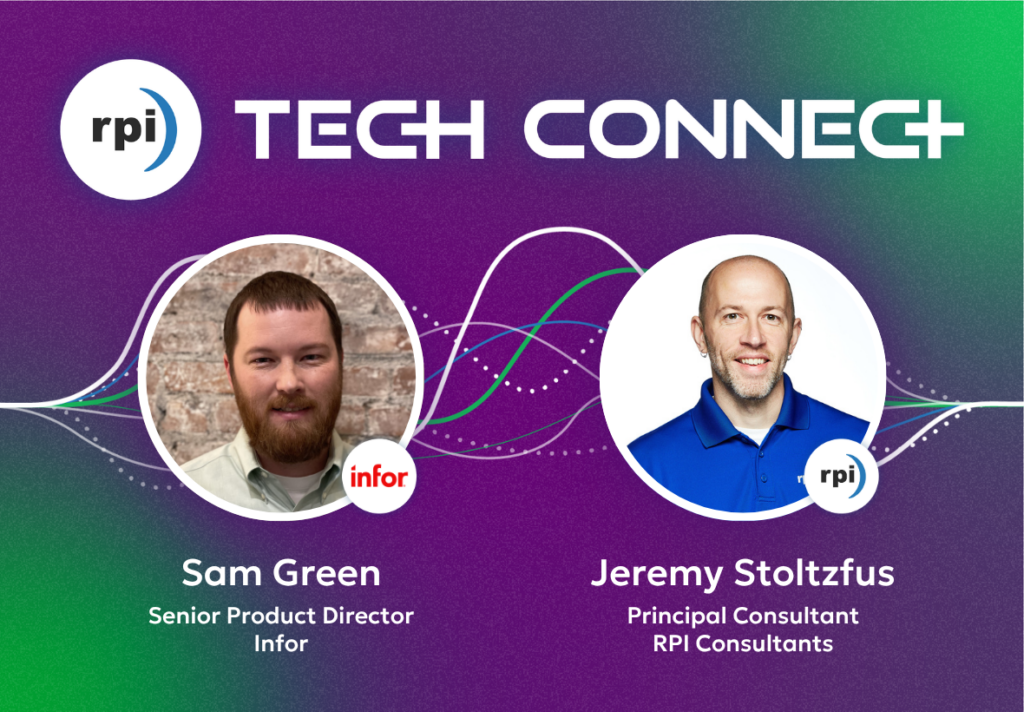
In this episode of RPI Tech Connect, Sam Green, Product Director at Infor, and Jeremy Stoltzfus, Principal Technical Consultant at RPI, get into the Infor Velocity Suite use cases available today and the idea that ties them together: see how your business really runs, then act on what you find.
Sam starts with process mining, which analyzes workflows and surfaces the bottlenecks hiding in them, giving you a clear picture of where to start. The included Gen AI assistant helps your team make sense of what that picture shows and answers questions straight from your ERP data, like the one-off report requests Jeremy used to field at a hospital almost every week.
The AI Adoption Hub then turns those insights and your goals into a roadmap in 20 to 30 minutes, so you know what to tackle first. Sam closes with what he sees as the natural next step: customers taking an idea from prototype to production on their own.
If your team runs on Infor CloudSuite and you’re curious how much more Velocity Suite can do, this episode will give you something to bring to your next planning conversation.
Interested in listening to this episode on another streaming platform? Check out our directories on the WRKdefined network or watch the YouTube video below.
Meet Today’s Guest, Sam Green
Sam Green, Senior Product Director of Technology & Innovation, has over 15 years of experience at Infor. Starting as a COBOL programmer, he advanced through roles in analytics, architecture, and integration for numerous applications.
Now in Product Management, Sam enables CloudSuite customers and partners to leverage the latest technologies offered by Infor Industry Cloud Platform to address a wide range of business challenges.
Meet Today’s Guest, Jeremy Stoltzfus
Jeremy Stoltzfus is a Principal Technical Consultant who has been with RPI since January of 2017. Jeremy is a Certified Infor Developer with technology expertise on both Windows/MS-SQL and Unix/Oracle on-premise and Cloud platforms.
Jeremy’s focus on process improvement within multiple Infor CloudSuite configurations, security, development, upgrade, and data conversion projects has helped Infor clients make the most of their ERP investment. He ensures that a client’s business requirements can be achieved using Infor CloudSuite solutions.
Throughout his career with RPI, Jeremy has worked as a technical consultant, integration architect, systems analyst, programmer, and technical lead for various implementation and optimization projects. Jeremy is also very involved with RPI’s training initiatives and enjoys teaching multi-day workshops and presenting webinars and at Infor user groups.
Prior to joining RPI, Jeremy worked as an Infor Lawson system administrator for 15 years where he led significant upgrade and development efforts. He has always been an active participant in the Infor Lawson community.
Meet Your Host, Chris Arey
Chris Arey is a B2B marketing professional with nearly a decade of experience working in content creation, copywriting, SEO, website architecture, corporate branding, and social media. Beginning his career as an analyst before making a lateral move into marketing, he combines analytical thinking with creative flair—two fundamental qualities required in marketing.
With a Bachelor’s degree in English and certifications from the Digital Marketing Institute and HubSpot, Chris has spearheaded impactful content marketing initiatives, participated in corporate re-branding efforts, and collaborated with celebrity influencers. He has also worked with award-winning PR professionals to create unique, compelling campaigns that drove brand recognition and revenue growth for his previous employers.
Chris’ versatility is highlighted by his experience working across different industries, including HR, Tech, SaaS, and Consulting.
About RPI Tech Connect
RPI Tech Connect is the go-to podcast for catching up on the dynamic world of Enterprise Resource Planning (ERP). Join us as we discuss the future of ERPs, covering everything from best practices and organizational change to seamless cloud migration and optimizing applications. Plus, we’ll share predictions and insights of what to expect in the future world of ERPs.
RPI Tech Connect delivers relevant, valuable information in a digestible format. Through candid, genuine conversations and stories from the world of consulting, we aim to provide actionable steps to help you elevate your organization’s ERP. Whether you’re a seasoned professional or new to the ERP scene, our podcast ensures you’re well-equipped for success.
Tune in as we explore tips and tricks in the field of ERP consulting each week and subscribe below.

Transcript
Chris Arey
Welcome back to RPI Tech Connect. I’m your host, Chris Arey. Today we’re going to be talking about Infor’s Velocity Suite solution, and I want to be upfront about why that is. Almost every time this platform comes up in conversation, someone describes it as an AP automation tool. That description isn’t necessarily wrong, because it does do that, but it completely misses the mark on everything else that the platform can do. So we’re going to spend an episode talking about what it isn’t, what it is, and what it will be.
And today I’m joined by two guests who’ve had a lot of time with this tool. First up, we have Sam Green, who’s gonna be talking about what the platform can do right now and where it will be going. And we have Jeremy Stoltzfus from RPI, who’s gonna be talking about how he’s seen Velocity Suite play out during implementations. So Sam, I’d like to start with you. Tell us who you are and what you do at Infor.
Sam Green
First of all, Chris, thank you very much for the invite. Jeremy, great to see you again. It’s a little different environment than, you know, sunny Temecula, California. We’re stuck indoors now, doing our regular jobs, but great to have you with us. I’m a product director at Infor, and I’m focused on AI innovation under Rick Ryder and his team. I’ve been with Infor for a little over 17 years.
I actually started with Lawson as a COBOL programmer. I’ve kind of moved around within the company, worked in analytics, architecture, did some integration work, but I’ve always been focused on tech. And that kind of led to me becoming an SME for Infor OS, and then naturally that just evolved into kind of becoming an expert on Velocity Suite as well. And my main role here is to basically enable our CloudSuite customers and our partners like RPI to leverage the latest technologies we offer as part of our cloud platform to address a wide range of business challenges.
Chris Arey
Excellent. It’s great to have you here, Sam. And Jeremy, for those who haven’t had the pleasure of meeting you, what can you share?
Jeremy Stoltzfus
Thanks, Chris. My name is Jeremy Stoltzfus. I am a principal technical consultant with RPI. I’ve been with RPI for almost 10 years now. Prior to joining RPI, I was on the customer side for about 13 years, where I worked as a system administrator. With my job at RPI, and when I worked on the customer side, my role has always been about process improvement.
When I worked on the customer side, not only was I supporting the Infor platform from an install, patches, and upgrades perspective, but I was working with my end users to do automation of simple tasks, right? And applying automation using whatever tools we could to make their jobs easier.
Once I joined RPI, that still remained my focus, just with multiple clients now as opposed to dedicated to just one client. And then moving into my first CloudSuite project, however many years ago that was now, of course the server maintenance piece of it goes away, but I still remain focused on that process improvement. And that could be development of IPA flows, it could be configurations, it could be reports, whatever it is. You know, it’s all within the Infor framework and tool set.
Chris Arey
Awesome. Thank you for that intro there. We’ve got two technical guests on the TechConnect podcast, so let’s get technical. First thing, let’s talk about what Velocity Suite isn’t. Sam, question for you: where does this idea come from that Velocity Suite is an AP automation tool? And why is that an incomplete description?
Sam Green
That’s a great question, and it’s definitely one that I’ve fielded before. I’m sure Jeremy has. I’m sure your colleagues at RPI have fielded that as well. And to understand where that question comes from, you have to understand the history of what we’ve been doing here at Infor. It was probably three, probably longer than that, probably almost five years ago when we started really building out enterprise automations, so we could showcase the capabilities of our platform.
One of the first things that we did was build out an AP automation solution. That was bundled up as an enterprise automation and became a sellable SKU. As we started evolving the platform and evolving our go-to-market strategy, that solution ended up getting bundled into Velocity Suite. So that was our big use case right out the door. There was a big need for it in the market, and we ended up selling quite a few of those deals and implementing a lot of those deals. So it was really our big first use case, and we spent a lot of time marketing that use case because we thought it was pretty good.
But then, as we started implementing AP automation, it really hit us that there is no one-size-fits-all to some of these solutions. Those solutions really have to be personalized and configured to the specific customer, and not just at an industry level, but at the actual organization level. So we started looking at our marketing, our implementation, our support, and said, okay, can we deliver AP automation and other solutions that are nearly complete but not quite tailored to the organization, and then provide the services to tailor those solutions to the organization? Because every organization is different.
If I go to hospital A and hospital B and I say, how do you handle three-way matching? How do you handle vendor statements when they come in? How do you handle returns? They’re probably all going to give me a slightly different answer. So it’s been kind of hard for us to get over that image of Velocity Suite as just invoice processing.
But it was a good journey, because it did a few things for us. It helped us prove out our tools, because we used pretty much every tool in the bag at the time to provide a solution for AP automation. And it also allowed us to really prove out the architecture, because as our cloud platform has changed, we’ve been able to swap out technology components with really little effort, because everything is so, you know, tightly integrated but loosely coupled. So it’s been great. But yeah, we are definitely not just an AP automation tool.
Chris Arey
Thank you for that story there. I look forward to hearing more about what else Velocity Suite can do. And to segue then, if AP automation is, you know, the surface of Velocity Suite, what’s beneath the surface? Can you go a little deeper?
Sam Green
Yeah, I mean, I know this is gonna be like a, you know, twenty, thirty minute podcast. We could spend all afternoon talking about everything that’s under the surface. There’s a lot of depth to it. But if I can summarize it, we’re providing a set of tools, solutions, and people that are really gonna help our customers discover insights into how their organization operates, you know, how their business is functioning.
Chris Arey
Give me the quick and dirty.
Sam Green
Help them automate processes that are going to make an impact to their business and then really personalize their adoption of the latest technologies like Gen AI. You know, succinctly put, Velocity Suite is part of our industry cloud platform, and it’s used to drive CloudSuite customers’ ambitions and their capabilities forward.
Chris Arey
All right. And Jeremy, from your perspective, I know you’ve had a lot of training with Velocity Suite and you’ve helped some customers with it. Anything you want to add about maybe some of the confusion you’ve encountered working with folks?
Jeremy Stoltzfus
No, I think Sam summarized it pretty well. The AP automation side of it was their first real use case and was how they marketed it. And the thing about AP automation is that it’s not a new concept; it’s been around for a very long time. And so there are a lot of solutions out there, and there are a lot of customers that have already implemented some other solutions. So as a customer, I hear Infor say, “We have this new Velocity Suite. It’s for AP automation.” And they say, “Okay, well, that’s nice. I already have something.” So being able to debunk that myth becomes very important.
Chris Arey
So then, let’s go ahead and talk about what Velocity Suite is by exploring some of these use cases. Sam?
Sam Green
So hopefully it’s clear: Velocity Suite is not just AP automation. We can put that to bed. As Jeremy has said, our customers have been doing this for years. We’ve had complementary solutions for a long time that have done this. And when a customer actually approaches me and says, “Well, I’m not interested in Velocity because I’ve done AP automation,” that actually gets me kind of excited, because I’m like, “Cool. Now we can work on other things that haven’t been around for like 20 years.”
But yeah, back to what Velocity Suite actually is. The way I like to position it is it’s not a set of tools, it’s not just a set of solutions, it’s not people. It’s really an idea, it’s an ideal. We want to help customers take advantage of technologies, you know, old technologies that they haven’t maybe seen benefits from, but also the latest and greatest stuff, because we want to really expand their capabilities in a personalized, secure, and governed fashion. Like, we don’t want it to be the Wild West out there.
And that all sounds great from a marketing standpoint, but what we really, really want to do is fill that gap, that value gap between what the marketing materials say, what the salespeople say, and what the actual business is going to see with ROI. So it’s a big change in mentality. Instead of shopping for tools or shopping for solutions, it’s now: we need to see what a true suite of capabilities looks like and really imagine where we can take our business with this technology and these resources.
Chris Arey
Very cool. I like how you made clear that Velocity Suite isn’t just a single tool or a single solution, but a collection of them, with the whole identity behind it being, like, here’s how you’re gonna maximize or get more value out of your CloudSuite investment. You’re gonna make business processes run more efficiently, run smoother, all that good stuff. Jeremy, have you seen this shift in mindset that Sam’s kind of talking about here? I imagine this is something that’s come up in conversations you’ve had too, or maybe through your own learning through some of the training you’ve done on Velocity Suite. Anything to share?
Jeremy Stoltzfus
Yeah, absolutely. After attending the Infor Connect conference for the past several years now, I’ve seen that shift in the customers’ mindset, where they get that it’s more than just an AP automation solution, that it’s a tool set to help them improve their processes, you know, from start to finish, right? And then also give them deeper insights into things that were harder to get to or just required some development time to be able to pull out the data that was required to do some of that. So now we’ve got a tool set where really, kind of, your imagination is what limits you in the things that you can do with it.
Chris Arey
Awesome. I always encourage people to get creative and find new ways to use the tools that they have at their disposal. Sam, you’ve mentioned personalization a lot, and that’s obviously a key differentiator with a lot of different solutions out there. Talk to me about the way Velocity Suite handles that.
Sam Green
Yeah, absolutely. It’s really what I think is going to be key to our success, to Infor’s success, to our customer success, to your success as a partner. There are a lot of solutions that have popped up recently that are very generic. We’ve all heard the term SaaSpocalypse, AI solutions that are built to replace traditional ERP. And yeah, that might happen someday, but right now those solutions are way too generic. They don’t understand the industry our customers are in, and they don’t understand our customers specifically. You’re just never going to get the value out of a generic solution that you can from a personalized one.
And that’s why, at Infor, we’ve really started with that idea of Infor industry AI. We’re trying to move industries forward, and in order to do that, we’re building on our foundation of industry-specific ERPs, whether you’re finance and supply management, human capital management, M3, LN. Those applications are basically specific for your industry, down to the micro-vertical. And instead of just throwing a bunch of AI on top of things, or throwing some AI resources at a company and saying, “Hey, they’re gonna do things for you,” we’re really partnering with our customers.
That’s where this idea of the forward deployed engineer has come up across the industry, really. And that’s not just someone who’s assigned to you with a name and a number, but someone who’s going to understand your organization, understand your needs, but then also understand where the industry is going and where you need to go as an organization.
As far as Velocity Suite goes, we’ve got some automations that we’ve built in the past, and we’ve got some proof points out there for customer success stories. So we’re bundling those automations, we’re bundling new insights across analytics, across Gen AI, and we’re also combining that with some synthetically generated use case templates. We’re adopting AI internally at Infor, and with that, we’ve looked at, hey, what are the big use cases that should be solved across the industries that we support?
We’ve got a host of solutions that we can really start off on a good foot. Maybe we’re 70, 80% of the way there with the solution. We’ve got a prototype built out. But it’s really that FDE partnership with Infor, the partner, and the customer that’s going to personalize that solution and give you the most value.
And the best thing about using those templates as a start is we’re not starting from scratch, so we’re not wasting hours building things from the ground up. We’re taking advantage of that industry context and the ERP. We’re taking advantage of Infor OS and all of its capabilities. So we’re not spending development cycles and money building things that are basically table stakes. We’re spending valuable time and effort personalizing the end user experience to just make a better solution.
And that’s really what makes Infor different: the fact that we’re not just bolting on AI to a product. It’s deeply integrated across the applications, across the stack. That was brought up in another interview that was done with Rick Ryder and Kramer ERP. Robert Kramer mentioned AI doesn’t run alongside ERP, but it runs through it. And I think if you don’t have that, you lose a lot of functionality, you lose a lot of time in getting to that value point. And you’re just not gonna be as successful.
Chris Arey
So if I’m hearing you correctly, it sounds like part of what makes Velocity Suite so valuable to customers is that it’s based off of a very industry-specific ERP, like CloudSuite, for example, in healthcare and public sector. That system was built for those industries, and Velocity Suite on top of it is like deploying templates and tools to kind of help surface ways that organizations can run a better system. Is that right?
Sam Green
Yeah, it is. Just makes it that much better.
Chris Arey
This sounds like a similar approach to what we take here at RPI. We’re industry-specific first, and then, you know, ERP second. Jeremy, what are your thoughts on this idea of personalized Gen AI that Sam was talking about?
Jeremy Stoltzfus
Yeah, well, you’re absolutely right, Chris. This is kind of our standard approach when we implement CloudSuite for a customer, right? We look at their industry, we understand their business, and we kind of know where to focus. So when we talk about Velocity Suite and bringing that to the table for a customer, it’s the same thing.
Sam mentioned all these templates that are there, right? So you stand up Velocity Suite, and out of the box you can start asking questions with the agents, right? And Velocity Suite just knows how your ERP operates and knows how to get data in and out of the system with minimal effort. So that really becomes, as Sam said, a great starting point. And then it’s just a matter of fine-tuning those solutions and understanding, okay, well, our business operates slightly different here.
We wouldn’t want it to kind of steer a user in this direction; instead, we want it to steer it in that direction. So you can always code in or add in those exception-type things, and that’s really fine-tuning the process and fine-tuning those agents that know and understand the ERP. But as Sam said, there’s a lot of them out there that are pre-built, and they are templates, right? That you can then build upon and expand upon.
Chris Arey
Thank you for that. I gotta say, I like how we’re getting into the roots and the behind-the-scenes of how Velocity Suite is actually working. I think it’s good technical context for the people listening in to understand how this tool works and how it works specifically well with industry-specific ERP. Now we should go a level up and talk about some of these different use cases that organizations can expect to deploy when they decide to use Infor Velocity Suite. So Sam, tell us about process mining.
Sam Green
So process mining is probably one of our newer offerings that we have here at Infor. And it’s probably one of the most exciting things we have going, I think, because I’m kind of… I mean, I’m a nerd, you know. I’ve done process mining manually. When I was in college, I worked on a shop floor in a manufacturing facility documenting processes by hand: this is how much time this process took, tracking parts through a system. It was super interesting because, hey, I like building things and seeing behind the curtain.
Chris Arey
Did that take you a long time to do?
Sam Green
They paid me for two summers to do it, and that was on one of their key products that they were building. And yeah, it took a long time. And the data wasn’t there. They had their own MES system, but it was old, it was antiquated, it didn’t have the data they needed, they didn’t trust it. We tried running reports and it just didn’t work. So that’s where I came in: pencil, paper, go at it. But our approach here at Infor with process mining is much more advanced than that, and it’s a few years later than when I was in college. Now we can kick off process mining basically the day somebody signs a Velocity Suite contract.
And the cool part about that, especially in our applications like FSM or HCM, is that we have tons of historical data that we can analyze very quickly. We get process mining provisioned, we turn on a replication set, and event data starts flowing into our process mining database. In a matter of a couple of days, it could take hours, but we all know it’s hard to schedule meetings with customers and get everybody organized. That’s probably the hardest part. But once we get everybody in a room, we can really show them, hey, this is what your processes actually look like.
They might have a BI statistic or a KPI that says requisition to payment takes 45 days, but they don’t really know why. Is that because people are entering requisitions and they’re getting rejected, or they’re entering POs, sending them off to a vendor, and they get rejected on the vendor side? We can get small insights using tools like BI, but we can’t really get down to the event level like we can with process mining.
Jeremy, I know you and I have talked about approvals and how those just kill some customers. They’ll say, “It takes me way too long to get this invoice approved.” Well, yeah, because you’ve got 13 levels of approvals that you have to go through. That’s not a KPI you’re going to get from BI. You’re going to get that from process mining, though. So that’s our first use case I really want to launch people on, to get that true insight, because that’s how we identify where we start.
Chris Arey
And so the process mining identifies that long approval process, and does it surface it in a way that’s like, “That’s what’s happening”? How do you consume that info? I hear, like, a replication set or something, but what does it look like from a customer perspective?
Sam Green
Yeah, it’s a lot of data, I’ll be honest. It’s super data-rich. It can be a little intimidating at times when you pop up this dashboard and you’ve got charts and graphs and all these process maps you’re looking at. So what we really like to do is sit down with a customer and walk them through the findings, because that’s that FDE partnership that I spoke about earlier.
We really want to make sure you understand what you’re seeing so that you don’t come away with incorrect assumptions. So we sit down, go through the findings, and we try to do it with IT leaders and with functional users, because there’s gonna be back and forth between “Well, IT’s configured it this way” and “Functional users need it this way.” It’s really just a fact-finding exercise to figure out, hey, we think there’s a problem here, this is what the data shows. Then let’s go do some automations, run process mining again, and see how we’ve improved. And that’s where we can measure that ROI with actual data, not just anecdotes, which is awesome.
Chris Arey
I really like that. That’s a good example. Jeremy, I wanna hear from you. When a client takes on process mining, what does that process look like to stand up? Sam, I know you said it could be very quick, but Jeremy, what’s your experience been?
Jeremy Stoltzfus
Yeah, no, Sam’s right. It’s a matter of days once you get Velocity Suite and process mining provisioned and have access to it. It’s just a few simple steps. Sam mentioned the replication set that pushes data down into process mining for process mining to be able to consume that data and put it into the format that it needs, right? And then it’s all that pre-delivered content that Infor is bringing to the table here with process mining.
As Sam mentioned, there’s a dashboard, a process insights page, multiple pages of information, and it’s charts and graphs and metrics. And as Sam said, when you first set it up and first get all that data pumped into process mining, it can build up this thing, right? Then you have to walk through that data with the customer and make sure that they understand what it is they’re seeing.
But then the really cool thing about it is right there on that insights page, the customer says, “Okay, well, I understand that this piece may be slightly a bottleneck, but is it related to a specific vendor? Is it related to a specific buyer within our organization? Tell me a little bit more about that specific metric,” right? And right there on those insight pages, you can filter down to more specific details to really fine-tune and ask the questions of, “Okay, well, this is a bottleneck, but why?” Right. And then really drill into that specific area.
The other thing that’s really cool about process mining is the Industry Process Catalog, or IPCs, which is just an integral part of that, right? So implementing CloudSuite, we should be looking at those IPCs to make sure that we’re following the prescribed process that Infor has built the software to do, right? With process mining, it shows you where those outliers are, and it’ll draw a physical diagram to say, “Hey, you’ve exited the process here to do this external step.” And so you can capture those things. And it’s really kind of cool. It’s, you know, kind of geeking out, right? You just watch it draw the line and show you a little red box here outside of the process map. And so that just, you know, is something to call attention to, right?
But then it goes even further. You later say, “Okay, well, no, that may not be Infor-specific, but that is us-specific, and we have to have that step as part of the process.” Well, with a couple of button clicks, you can then have that process redesigned to include that step. And so that’s no longer an outlier.
Chris Arey
I hear this, and I’m getting excited. I’m a technical guy, but not to the extent that either one of you are. And I think it’s one thing for a customer to be told, “This is how the process is, this is how we know it to be,” and then they think about it in their mind. But to have it drawn out in front of you with this detected outlier of, like, “This is why your process is taking so long, because you’re doing this step outside of it,” to see that, I feel like it brings to life any kind of obstacles or things that are slowing you down in a way that’s like, “Okay, I want to fix this now. Why are we doing that?”
And it’s asking those types of questions that I feel like customers need to be thinking about, and they might not be until they see it, right? It’s like, “Wow. Okay, I’m sold. I’m convinced.”
Sam Green
Yeah, exactly. Businesses are big silos, really. IT doesn’t necessarily know how the functional people are using it, and vice versa. So you end up with these disparate processes for the same business process. Even distributed customers, you know, might be in Pennsylvania or they might be in Ohio, and they’re doing things differently, but they all work in the same department. And it highlights that stuff really, really quickly.
And I do want to add that one of the things we’ve done to help make this data more digestible and more easily accessible is we’ve built Gen AI into process mining. So now, after we do this walkthrough with a customer, they’ll have a tool that they can now ask questions. Like, “Hey, I’m looking at this screen. I forgot what conformance analysis means. Can you explain to me what I’m seeing on my screen? Can you suggest areas for improvement?”
Our Gen AI knows our IPCs, it knows our industry, it knows our applications, it obviously has access to the process data. It can go through all that and just say, “Hey, this is what I’m seeing,” and highlight those things. So it really becomes self-discovery.
Chris Arey
This Gen AI assistant you’re speaking about, is this a separate type of use case customers can expect to use with Velocity Suite, yeah?
Sam Green
It is. It’s kind of a separate use case, but it’s also just pervasive across our applications, which is one of the reasons I really try to highlight it. I think of all the ways that people are using Gen AI now, just to find answers to questions. I can ask business questions to a generic AI tool, but I’m not necessarily going to get good answers because it doesn’t know my industry, it doesn’t know my ontology. So it might lead me in the general direction, but it could also lead me astray.
So what we’ve been able to do is build in a Gen AI assistant that knows our applications, it knows our data, it knows our ontology. And you can ask it very Infor-specific questions and it’s going to understand what you’re talking about. That’s helpful for pulling back data, or asking, “Hey, how do I use this screen?” for example, and it’s going to give you the instructions from our documentation.
That’s surfaced through a few different tools that we’ve developed. We’ve got our private and public knowledge hub. The public knowledge hub is basically where we have fed our tooling all of our documentation. So anything that’s out on docs.infor.com that takes too many clicks to get to, that you have to kind of dive through to find what you’re looking for, you can surface really quickly with a simple query. And that’s great, but I know that at RPI, you guys build user guides and training guides: this is how we’ve implemented your system specifically.
Well, then if I have a user that’s querying the public documentation, they might not get the answer they’re exactly looking for. And that’s where that private knowledge hub comes in. Because now you guys can upload all of your documentation that you hand off to the customer after they’ve done their acceptance testing, and they can now query that with a Gen AI assistant. So they’re getting the best information possible.
Chris Arey
I think you made a really great point there. I think about my own use of AI with, like, Claude or ChatGPT or whatever, and the output that I get working with something like that is so contingent on the amount of context and background that I give it. If I don’t put in a lot of info, I’m not going to get anything good.
Because this Gen AI assistant you’re talking about lives in your system and knows all the details about the way that you do processes and the way that your organization runs, it has access to all that really critical, rich data that’s gonna give you the informed and correct answers that you need. Right? That’s huge.
Sam Green
Yeah, and it’s tailored to your organization. It’s not something generic. Like I mentioned with vendor statements and returns earlier, if I say, “How do I do a vendor return?” well, there’s a standard way of doing it in the system, but what if you handle it completely differently? What if you don’t actually do vendor returns? You just decide, “Okay, let’s just distribute it across our warehouses.” Well, that’s a business process that’s specific to you. So if I’m using generic AI to find the answer to that question, it’s going to lead me astray and it’s not going to provide any value.
Chris Arey
That’s really good. Jeremy, any thoughts on the Gen AI assistant?
Jeremy Stoltzfus
Yeah, one thing that I think is really neat about it, and I think is a very common use case, is the one-off reporting requests. I used to work at a hospital, and I would get requests for these one-off reports almost weekly. And it was always frustrating, because we had this version of the report, we had this version of the report, and then this week they needed a different spin on it.
And so it would come to me and I would have to write some report, and then it would have to be tested and published and go through a whole big process. Well, now with the Gen AI assistant, you can get that one-off reporting information just by asking a couple of questions. And if you need to fine-tune that, right? As Sam mentioned, the Gen AI assistant is built into the ERP, it knows what a requisition is, it knows what an invoice is, right? You don’t have to tell some generic AI tool looking at your data, “Hey, in this table, in this business class, or in this area in the application.” You don’t have to give it all that context. It kind of knows that context based on the ERP itself.
Sam Green
Yeah. And more importantly, it knows what data you should have access to, right? So it’s not just an open book. I mentioned governance earlier. We can really lock that down. You’re basically taking action as a user. So if Jeremy’s asking for information that he should have access to, it should be presenting that information. If you go outside your scope of authority, it’s going to cut you off and say, “Hey, you don’t have access to this, but let’s try and reach out to someone who does.”
Chris Arey
Really awesome to hear about the capabilities of the Gen AI assistant. I wanna ask you now about automation and the AI Adoption Hub. I see that’s something you wanted to chat about. What’s the story there?
Sam Green
Yeah. So this is probably one of the coolest things we’ve been doing over the last, I don’t know, six, maybe nine months: building out a visual tool that allows our customers to really, you know, we’ve talked about process mining, to take those insights from process mining, take those anecdotes of how people think their business is operating, and dump them into a prompt.
Like you talked about context being so important, Chris, you dump them into this prompt and say, “These are the issues I’m having, these are my goals, this is where I want my business to be.” And this AI Adoption Hub starts churning, and it looks at all of the IPCs that we have for your industry, it looks at your IPCs, it looks at data, it looks at our enterprise automations, it looks at the available insights. And it starts mapping your requirements to a solution. And it tells you, “This is how we’re going to get there.”
And if I put something in that doesn’t exist yet, we don’t have a template, we haven’t thought of it, it’ll generate a new idea and say, “Okay, you’re having a problem with, say, cash reconciliation.” It’ll start designing a solution. It’ll create a prototype for you so you can actually visualize what a solution would look like if we were to build one. It’s probably one of the most powerful things we’ve got going right now, because not only does it propose these solutions, but it’ll tell you, “Hey, these are all the pieces of technology that are involved.
This is how we’re going to build it.” So it’s not like we’re going to use Gen AI and solve all these problems. It’s not just a generic smoke-and-mirrors type thing. We’re telling you we’re gonna use ION, we’re gonna use robotic process automation, we’re gonna use some Infor Document Processor, we’re gonna throw Gen AI at it. It’s telling you all of the pieces of the puzzle that are gonna come together to provide you a solution.
Chris Arey
That’s pretty powerful stuff. And I have to say, I feel like it’s the last part of the equation here. We have the process mining for identifying bottlenecks, things that can improve. You’ve got the Gen AI assistant to help you kind of make sense of that and surface up additional insight. And then you have this automation element that kind of helps you take action on those things that it’s identified and helped you understand.
Sam Green
Yeah, it’s exciting. We’ve been doing a lot of user groups since the middle of June. We’ve done Connect, we’ve shown it there. We did the Western user group out in Temecula, we did the Midwest user group in Saint Paul. I just got back from Velocity Week, and people are blown away by the AI Adoption Hub.
Maybe they don’t have insights from process mining. That’s fine. Let’s just give you a blank canvas. Tell me what your goals are. Here are a few prompts, a few questions: “Do you struggle with this? How long does it take you to close month end?” We can take all that information and kick out a roadmap in 20, 30 minutes. And then we can send that off to your team and you can prioritize those.
You can say, “Well, maybe we don’t want to focus on this solution first. That’s not as high priority.” And you can reorder that roadmap. And then that’s what ends up getting delivered to our FDE teams to basically start implementation. It’s a really awesome tool.
Chris Arey
Is this available right now, like if someone wanted to purchase it?
Sam Green
Absolutely. Yeah. Ask Jeremy, he’ll demo it to you.
Chris Arey
Jeremy, let’s hear about it. What’s your experience been with this?
Jeremy Stoltzfus
Yeah, I mean, for me it’s relatively new too. But as Sam explained everything, if you’re kind of like, “Okay, well, what can I truly gain from this system?” As Sam mentioned, you feed it a couple of pain points, you know, that you might have too many approval levels, or some areas where you might want to focus on, right? Give it a little bit to go with, and then, like Sam said, it’ll generate that roadmap and show you where you need to focus by just providing a little bit of information.
Chris Arey
Very cool. I’m impressed. Seriously. You’ve done a great job with that. So we’ve talked about what Velocity Suite isn’t, what it is. We’ve explored these awesome use cases. Tell me what’s on the way, what’s on the roadmap, what can people expect to come from Velocity Suite?
Sam Green
Well, that’s good. That means I’ve done my job. More of the same, more awesome stuff. But in all seriousness, that AI Adoption Hub, how that’s going to change how we interact with our customers, how you guys interact with our customers, it’s gonna be huge, because I think it’s really gonna drive people towards that self-actualization. Like, I have this idea in my head, I can’t quite articulate it. But I can start throwing these ideas at this prompt and it’s gonna start churning. And maybe I have to refine it a little bit, but eventually I’ll get to this idea and it’ll start building content for me. It’ll build me a prototype that I can then play with.
And then the question becomes, okay, that’s cool, I’ve got a prototype. Where are we going from there? Well, you can probably guess it’s that self-deployment model. I mean, that’s just the natural conclusion. I can build a prototype. Why can’t I build an actual product and put it into production? So I think that’s where we’re going: to go from that brainstorm, brainstorm a bunch of ideas, build your prompts, kind of refine, build that prototype, propose that to your colleagues, your leaders, and then get it into production.
I hope it doesn’t put us out of business, you know, put you guys out of work customizing things. But you know what? I think there’s plenty of work to do, so I think we’ll be okay.
Chris Arey
Really cool. And you know, that’s an exciting future. Giving people the tools to be self-sufficient and to explore what these tools are capable of, to the limits of their own imagination, is a pretty powerful thing. I like the messaging, I like the vision. Really, really good stuff there, Sam. Jeremy, after hearing that, any conversations you want to have with customers who are maybe thinking about Velocity Suite?
Jeremy Stoltzfus
Well, maybe now I don’t want to sell it so much, because I will be out of a job. No, no, no, absolutely not. Just getting there, of course. I feel like, you know, I’ve been in the Infor Lawson ecosystem for a very long time. And when I first started with Lawson in version 7 or whatever, and people would say, “I wish the system would do that,” I’d say, “Sorry, it doesn’t.” And now with the capabilities that are coming out, as you kind of said, if you can imagine it, it can probably be done now at this point. Maybe not exactly how you kind of want it to happen, but there’s always alternate paths and things like that.
So I think the advice I would give customers is, continue down the path that you’re on, but keep this in the back of your mind, and actually bring it to the front of your mind, right? And think about how you can really, really realize value from this tool. In some organizations that I work with, IT is the bottleneck, right?
Not because of bad personnel, it’s just a small IT shop. And so these tools really give customers the ability to make rapid advances. So think about it from that perspective, really. There will always be some other thing that needs to be dealt with and some other change that needs to be made, some other emergency that we need to respond to, or whatever. So there will always be plenty of work.
Chris Arey
Good advice. And actually, Sam, I don’t know if you know this, but before we wrap up on RPI TechConnect, I always like to ask my guests, if they had one actionable takeaway for the audience, what it would be. So Jeremy, I kind of heard what yours would be here. Sam, same question. What do you got for us?
Sam Green
Yeah, biggest thing: don’t wait. I don’t know where it started, but I’ve heard the quote multiple times: if you wait six months, you’re gonna end up three years behind. And I think that’s really true with how quickly the market and the technology are changing. So get out there, talk to your AEs, talk to your partners, you know, hit up Jeremy. Start asking him questions about Velocity Suite. If you’ve got a CSE, talk to them.
Chris Arey
Call Jeremy, everybody.
Sam Green
Be involved in your user groups, your industry councils, and just figure out how you want to get started, how other people have gotten started, and just don’t wait.
Chris Arey
Don’t wait. I like it. I’ll remember that. And for those of you listening in, if you need Jeremy’s phone number or email address, if you send an email to podcast@rpic.com, we will happily share that info with you. But no, in all seriousness, thank you both so much for this lovely conversation this afternoon.
For those of you listening in, if you do have any questions or you want to learn more about Velocity Suite or how RPI can help you, let’s have a conversation. Please contact us at podcast@rpic.com. Again, that’s podcast@rpic.com. This has been RPI Tech Connect. Thank you so much.
Sam Green
All right. Thank you both.
Jeremy Stoltzfus
Thanks. Bye.