Your Infor investment comes with more resources than you might expect.
RPI’s Director of Infor Solutions Hans Mueller has spent years on the Infor side working directly with customers, and he knows where to send them first. In this episode of RPI Tech Connect, Hans shares the range of Infor resources out there and points to the Release Center on Infor Concierge as the place to start. He explains how the April and October releases give teams two dates a year to plan around, with many new features arriving switched off until you’re ready for them.
Then comes AI: a no-cost assistant that multi-tenant cloud customers can switch on to get how-to answers straight from Infor’s documentation, plus Velocity Suite agents that can tell you which vendors you owe the most in about a minute, among many other capabilities. Hans also shares how customers who join Infor focus groups help shape how Infor delivers releases today. His request is for more customers to raise their hand and engage with Infor and partners like RPI to get the most from their investment. The episode also teases Hangin’ with Hans, RPI’s new call, where customers are invited to share the challenges they’re encountering.
If you rely on Infor every day and want to learn more about the resources available to you, this conversation shows you where to look and who to ask.
Interested in listening to this episode on another streaming platform? Check out our directories on the WRKdefined network or watch the YouTube video below.
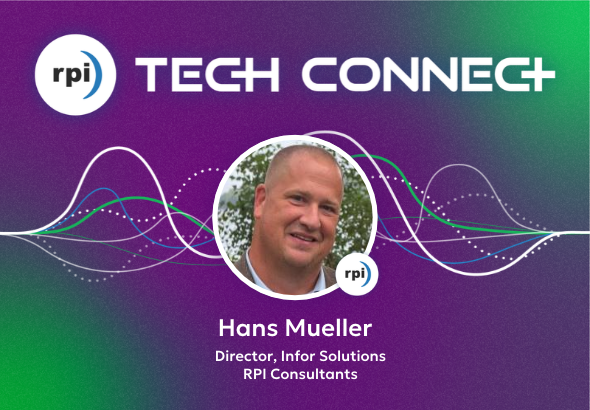
Meet Today’s Guest, Hans Mueller
Hans Mueller is RPI’s Director of Infor Solutions, a role he stepped into in 2026 after more than 25 years in the Lawson and Infor ecosystems. His background spans systems administration, ERP implementation, product management, and customer programs on a global scale. At Infor, he supported the first rollout of CloudSuite Financials & Supply Management (FSM) and personally led go-lives for its earliest customers. Having worked with ERP as both a customer and a vendor, he brings a practical view of what organizations run into during major releases and how to prepare for them.
Much of Hans’s career has been spent helping Infor customers get more from their investment. He grew Infor’s Early Adopter portfolio to 70 concurrent programs involving hundreds of customers, and he built Innovation Insights, Infor’s largest virtual customer community, which reached more than 30,000 attendees annually. He also led a two-year rollout of Infor’s generative AI program, working with more than 120 customers across six continents.
Meet Your Host, Chris Arey
Chris Arey is a B2B marketing professional with nearly a decade of experience working in content creation, copywriting, SEO, website architecture, corporate branding, and social media. Beginning his career as an analyst before making a lateral move into marketing, he combines analytical thinking with creative flair—two fundamental qualities required in marketing.
With a Bachelor’s degree in English and certifications from the Digital Marketing Institute and HubSpot, Chris has spearheaded impactful content marketing initiatives, participated in corporate re-branding efforts, and collaborated with celebrity influencers. He has also worked with award-winning PR professionals to create unique, compelling campaigns that drove brand recognition and revenue growth for his previous employers.
Chris’ versatility is highlighted by his experience working across different industries, including HR, Tech, SaaS, and Consulting.
About RPI Tech Connnect
RPI Tech Connect is the go-to podcast for catching up on the dynamic world of Enterprise Resource Planning (ERP). Join us as we discuss the future of ERPs, covering everything from best practices and organizational change to seamless cloud migration and optimizing applications. Plus, we’ll share predictions and insights of what to expect in the future world of ERPs.
RPI Tech Connect delivers relevant, valuable information in a digestible format. Through candid, genuine conversations and stories from the world of consulting, we aim to provide actionable steps to help you elevate your organization’s ERP. Whether you’re a seasoned professional or new to the ERP scene, our podcast ensures you’re well-equipped for success.
Tune in as we explore tips and tricks in the field of ERP consulting each week. Interested in joining us on Hangin’ with Hans? Be the first to know about call dates and topics by signing up below.
Transcript
Chris Arey
Hello, and thank you for tuning in to RPI Tech Connect. I’m your host, Chris Arey. Today we’re going to be talking about resources that Infor customers have available to them. There’s a lot of material out there, but it lives in a lot of different places. Here to guide us through all of it is none other than Mr. Hans Mueller, Director of Infor Solutions here at RPI and a known entity throughout the Infor and Lawson community. Hans has spent years on the Infor side running user groups and hosting customer calls, so he has seen firsthand where customers get stuck and where they should turn to. So Hans, it’s great to have you on the program. How are you, sir?
Hans Mueller
Good. Thanks very much for having me, Chris. For those of you who don’t know me, my name is Hans Mueller. I have been around the Lawson and Infor world, as Chris said, for almost three decades now. I was 10 years a customer with Friendly Ice Cream, which is a restaurant company that was located in the Northeast and was a longtime Lawson customer for many years.
Then I came over to Lawson, and I was part of Infor when Lawson was acquired by Infor. So I spent about twenty years there and just recently came over here to RPI. It’s been a great journey and a great transition, and I’m very excited about the work that we’re doing and to be on the show today.
Chris Arey
Excellent, Hans. I know that everybody at RPI is happy to have you here aboard the ship. Just hearing a little bit about your background and the trajectory you’ve made throughout your career, from Friendly’s to Lawson to Infor and now to working as a partner consultant, is super, super cool. You’ve got a lot of industry knowledge and expertise that I can’t even begin to comprehend, if I’m being honest. So let’s talk about the Infor ecosystem in terms of resources. There’s a lot out there, and sometimes it can feel overwhelming. Why do you think that is?
Hans Mueller
Well, I think what it starts with is that Infor does a really good job of producing a ton of collateral around their products. There is an endless amount of information, whether it’s product documentation, training, KB articles, blog posts, or webinar recordings. There’s just a ton going on. I mean, you have a company that has 18,000 people and multiple sets of product portfolios, so there’s just a ton of information out there in the ecosystem.
The problem is for someone who’s doing their day job at a customer, who really just cares about their particular role, the screens they go to every day, the way they work in the application, to navigate all that and find what’s relevant for me is a challenge, right? That’s the biggest problem: there is almost too much information. It’s information overload. I just want what I want, right? I just want to see what’s relevant to me. And so navigating your way through all of the madness is really the challenge for most customers.
Chris Arey
Where should they begin their journey?
Hans Mueller
Well, a couple of years ago, Infor decided to move to a biannual release cycle. That change actually gave customers a good starting point to find this information. Prior to that, we had releases that were coming out every month. Some products would release every week, some products would release every month, and some would release every quarter. You had to be on constant awareness that there might be something coming that was going to affect what you’re doing.
The change to everybody releasing on this biannual cycle allowed for some organization to be put in place. One of the biggest changes that came out of that was what’s called the Release Center. The Release Center is this great starting area out on Infor Concierge, and anybody can navigate to it. You can go to the Concierge area and click on Release Center, and it will give you the place to go for the next step and the next step and the next step, right? It points the way to where all the release information is, it points the way to where the release highlights are, and it also points the way to where training and documentation are for those specific products that you care about.
The nice thing is Infor has a ton of products, but I may be a healthcare company and I don’t have all those products. I only have maybe ten of the products that are listed on the whole portfolio of Infor’s manifest, right? So I’m only going to see those ten products that my company owns. Already I’m cutting the list of information down to where I want to be, and then from there I can pick and choose where I go next. But that’s the perfect place to start for anybody who’s trying to navigate through all of the release information.
Chris Arey
So the Release Center, regardless of your role, whether you’re supply chain or HCM or technical, you can go there and navigate the things that are important to you.
Hans Mueller
Yeah, so it’s a start. It’s not that refined yet, so there’s still a lot of work to do. If I’m an FSM user, then yes, I can now go to the FSM areas within those other parts of the documentation and training. It will take me to those areas. If I’m an HCM user, same. But if I’m, say, a supply chain customer, and let’s say I work in receiving and I only care about that particular area of the application, the Release Center is not going to take me to receiving, right? It’s going to take me to Financials and Supply Management. I’m going to have to navigate the rest of the way down and cut out the pieces that only apply to me.
So that’s the next step that needs to happen within Infor’s evolution. But the information is there, and at least now you can get to those areas where you don’t have to do all the work. You only have to do part of the work.
Chris Arey
Okay, all right. Progress. Moving in the right direction. Let’s go. You mentioned the October CU just passed. Infor moved to the biannual release, was that two, three years ago now, do you recall?
Hans Mueller
Yeah, I think it was in 2022, 2023. So yeah, three or four years ago.
Chris Arey
Okay, so let’s talk a little bit about what’s included in those releases. If they’re making it twice a year, as a non-practitioner that feels a lot more manageable, knowing that you can plan around April and October. What kind of stuff comes out as part of those releases?
Hans Mueller
Yeah, so the change was, and it is a lot more manageable now, right, that every April and October, Infor now releases the new features. New features, major changes, all those things are going to come in two releases per year. From a customer perspective, you can set up your planning cycles around that. Okay, twice a year I’m going to have to go through somewhat of a significant change management exercise. I’m going to have to test my interfaces, I’m going to have to worry about new features coming in, and maybe there are some significant bug fixes or regulatory changes that come in. Those types of major things are going to come in April and October.
The rest of the year, on a monthly basis, there are still releases that you need to be concerned with, but those are more service releases. If you think about it from your iPhone perspective, Apple pushes out a change, and maybe it’s a dot-one release, or a dot-two, and you just take it. It tells you there’s a change, you just take it, and it comes, right? It’s the same concept on a month-to-month basis. But when iOS 27.0 comes out, now everything moves around and things change. So that’s your April and October. Those are the changes that are coming in and how they’re coming in.
The other thing that’s nice now that there is a designated time to deliver these new features is that the product teams have put in place, largely based on customer request, the ability for these changes to be optional at the beginning. They’re toggled, right? So things are going to be toggled off. You’re going to be made aware of them and told, hey, there’s a great new user experience within employee and manager self-service.
We’ve redesigned the UI and we’re delivering these new workspaces, and it’s going to be great for your end users and your managers, and so on and so forth. But you don’t have to take it at that moment. The day after the October release, it’s not popping up and all of a sudden they’re having to scramble and deal with that, right? It comes in turned off, and customers can decide, hey, we’ve been testing this already, we’ve seen this, maybe we’re going to go through a couple more months of test cycle, push it out to a smaller group of users, and then toggle it on for everybody. So it gives the customers a lot more control.
But those changes are all coming in as part of those feature releases. There’s a lot more launch activity around those feature releases, so there are webinars and prep sessions and release highlight sessions and release training that’s built to coincide with those major releases. And then the ones in between, the other 10 months of the year, those are bug fixes. Hey, we have to push something in because maybe there’s some regulatory change that’s delivered because of requirements, but it’s usually stuff that’s behind the scenes. It’s not significant to the end user.
The last thing that customers need to be aware of are supplementals. If you track the release KBs that are listed in the Release Center, and you subscribe to those KBs, there’s a listing of, hey, we’re going to do a supplemental release, and it’s going to be delivered at this time, this place. Supplemental releases don’t take the system down, right? They’re delivered behind the scenes. They’re usually to fix something that’s critical, where some customer has reported there’s an issue. Say, in purchasing, they found some critical issue. We need to get that fixed, right? And so Infor will deliver that, and it should be invisible to everyone. You just continue on with your day, but the awareness is at least made that we’re fixing that bug.
Chris Arey
So those supplemental updates you’re talking about, are those a result of the known issues identified as part of the major releases?
Hans Mueller
Yes. So for anybody who’s not aware, and I’m certainly hoping that most are aware, there is a KB. There’s usually one KB that’s associated with every major set of products that Infor has. So for Financials and Supply Management, Landmark applications, HCM, there is what’s called the Known Issues KB. It’s linked off of the release KB, and the purpose of that knowledge base article is that it’s constantly being updated by the support team. The support team basically says, we’ve become aware of an issue that’s going to affect three or more customers. So it’s not every issue that’s out there, but it’s three or more customers, right?
So if we know that this issue in GL is going to be critical, and we’re working on it, we’re aware of it, part of it is awareness for customers: don’t spin your tires trying to diagnose why you’re having this issue, because we’re already aware of it. Here’s what we know, here are the symptoms, here’s the cause, here’s the message you might be seeing. If there’s any known workaround, we’ll give you that information. And here’s when we think we’re going to be able to fix it, whether it’s a week, two weeks, a month. It could be longer, but they’ll give all of that information in that KB article, and it will be constantly updated and constantly rotated.
So that’s one that absolutely needs to be subscribed to, because every time there’s an update, they’ll push a notice out to anybody who’s subscribed. So you’ll know, hey, they made a change. One of the known issues, a new one popped on, or one’s been updated, or it’s been maybe closed out, or hey, we know we’re going to deliver the fix for this, or whatever.
Chris Arey
I was going to ask you if there’s a way to subscribe or get emails about these Known Issues KBs, and you answered my question.
Hans Mueller
Yeah. So all KB articles have two functions on every knowledge base article, right? One is you can favorite it, so it pops up in your list every single time you log into the customer portal. Hey, these are the ones that are most important to me, the ones I need to check most often, right? I can favorite it just like a bookmark. The other one is subscribe, and subscribe is anytime anybody makes a change, it pushes a message out. Now, it would be nice if the message said what the change was, but it doesn’t. It says this article has been updated, and then you have to go to the article and figure out why.
Depending on the author, and most of the authors in the service industries area, financials, HCM, Landmark, are pretty good, what they put on it is a change log. So you can look at the change log and say, okay, this was the last update that was made. Not everyone does that, but most do.
Chris Arey
Wow, okay. Learning a lot of great stuff from you here today, Hans. This is awesome. Thank you. So let’s talk about some of the new stuff that just came out and maybe is on the horizon. This is a tech podcast, so AI comes up. What’s going on with AI as part of the October CU? Is there anything worth calling out?
Hans Mueller
There’s a lot. Yeah. So I think it’s been well known that Infor has been working on getting generative AI to work with all of their applications. I can tell you from my former time there that it’s been about a two-year journey of work that started at the very basic level. They released what was called… I’m going to draw a blank. Sorry, Chris. We’ll take a note to come up with that. It’s called the embedded experience. So there was the embedded experience that already came out, and basically what the embedded experience was, was you could use generative AI to help you with text fields.
So for example, if you were trying to write a job description for a new role within your organization and you didn’t know necessarily where to start from within the application, you could use generative AI to say, hey, write me a job description for a nurse practitioner with five years of experience, blah, blah, blah, this and that. And it would go out and write you a somewhat good job description, and then you could tweak it. You didn’t have to start from scratch. That capability has been around now for, I think, at least a year and available to customers, and there are various fields throughout the application that have that capability.
But that’s not where the real power was. The real power is getting agents to do work, to be able to answer questions. You know, the stuff that you and I probably do on our phones every day, whether it’s Claude or Grok or whatever, right? I know that I use it with my kids and their homework all the time. They think I know everything. Right? Okay.
Chris Arey
Hold on there, Henry. Let me get that answer for you.
Hans Mueller
I’m sorry, I was really good at math at one point in the past, but I don’t remember how to do quadratic formulas anymore. So let’s sit down and maybe we can get a quick cheat sheet on it and teach Dad how to do a quadratic formula, and I can explain it to you, right? So that kind of stuff. The other one that was really funny is my son was learning about Supreme Court cases from the 1800s, and I’m like, dude, I don’t know. But it’s great. You can pull up, tell me about 1821, US versus whatever, and it will give you a short summary of the case and why it was important to history, and all that stuff. So that’s the kind of stuff that’s going to help end users, right?
So Infor has been building different agents, lots of different agents, and they also have been exercising what’s called the Gen AI Assistant, which is that chatbot-type, back-and-forth conversational UI. When I was there, my team was running early adopter programs around that with all of the different application groups. And so now, in the October release, there are a number of things that are available to all customers.
Number one, and this is the most important thing for all customers, regardless of what suite you’re on and what applications you run, as long as you’re in the multi-tenant cloud, you can go in and turn on what’s called the Public Knowledge Hub. The Public Knowledge Hub doesn’t cost any money. It doesn’t require Velocity Suite, it doesn’t require any additional licensing, it’s just there. Basically, you have to enable it, so it doesn’t just get turned on. It’s another one of those toggled features. Then you can control it via security, so you don’t have to roll it out to every single one of your end users if you don’t want to. You can roll it out to just a group.
It’s basically using the Gen AI Assistant against all of Infor’s documentation to be able to query questions, how-to questions. Because most of the calls that come into the support center at Infor are how-to questions. How do I create a new vendor? How do I pay an invoice? Those are probably very basic, right? But you can get into more complex things: how do I set up ION for the first time? Those things are all within the documentation. It’s just, again, information overload. They’re buried out there, right? You can go to docs.infor.com and search, and maybe you could find it. Now you have the power of AI to help you go find that answer. And that’s available, like I said, to any customer for free right now. There are six easy steps in a KB article, and we could give them the link, but there’s a KB article that has six steps that they need to do, and I’m told it’s a five-minute task.
Chris Arey
And how do they turn that on again? Do you go somewhere? We can detail that somewhere else if we need to.
Hans Mueller
I believe that. Trusted sources, right? But it does have to be turned on. So that’s for everyone. Then there’s a whole bunch more if you buy the Velocity Suite. And you have to buy the Velocity Suite, right? For customers that might not know, the Velocity Suite is a set of tools that Infor has developed that are all around taking your cloud suite to the next level and applying these newer, more powerful technologies on top of your general ERP processing, right? There are about six or seven tools that come with the Velocity Suite. They all come packaged together. You get the capabilities of all of them, and many of them work together. That’s why it’s packaged together. A lot of the stuff that they do isn’t one tool exercising things. It’s three or four tools working in conjunction together to make the solution happen.
And so when you license that, you get all of the agents that they’ve developed. There are hundreds of them. There are hundreds of agents that have been developed for Financials and Supply Management and for HCM, and a number of customers have already been using these. And it’s great. I mean, you could go out and ask questions, like, hey, give me a list of my most outstanding vendors, how much do I owe them, and who are the key contacts at those sites, right? Now, you could write that query, have somebody in IT spend days writing that query, piece it all together, and give the CEO a report. Or he could just ask the question and get a list in a minute and 30 seconds to a minute, or whatever, and have that at his fingertips.
And then, okay, drill in and tell me, okay, Coca-Cola is one of them. They haven’t paid us, or we owe them a bunch of money, or whatever, right? I could dig in and say, well, show me the last five invoices. I can have a conversation and dig deeper and deeper without ever going back to IT. Most of the agents that have been developed so far are non-update. They’re just queries. But the update ones are coming. The update ones are where there’s even more power, where I can basically tell them, okay, go run a check cycle, and I don’t have to key it in.
Now, Infor is very big about wanting to keep the human in the loop and not just let the agent go do everything, right? So there are controls on these, and there are guidelines on these. You can give it as much power as you want to give it. But again, there are a lot of capabilities that are available with the October release if you buy Velocity Suite.
Chris Arey
The AI query, I think there’s a lot of value in that too, in that it creates self-service pathways for users, right? It’s allowing them to be able to do more on their own, which is good, right?
Hans Mueller
Yeah. I mean, if you think about it, most users of the system don’t want to be in the system. They need the system, but they don’t want to be in it, right? They don’t want to be sitting at a computer looking at a screen, right? Tell me my last paycheck. Tell me why my deductions changed. Tell me how much vacation time I’ve got left this year. Or, if you’re a nursing supervisor, tell me all the shifts that remain open this weekend that I need to cover. Again, you could go into the system, log in, look at a report, blah, blah, blah, but that takes time. You’re walking the floor, dealing with seven other headaches that are not at a computer screen. So these are things to just cut that time down, right?
Chris Arey
And so these features you’re talking about here, the CU and the AI components that we discussed, is this all detailed in the release notes, or where? I know you know this, but how do other people come to know this? Do they listen to this podcast, or…
Hans Mueller
So yes and no. Again, I think this partially goes back, and that’s the reason I laugh, to our issue of information overload. When there’s a major release like October, and I know October’s here, but we can talk about it for customers: here’s the October experience and here’s what you need to do, and what’s coming up for April, be prepared for April.
The first exposure that the general customer population will get, if you’re not part of an early adopter program or some kind of industry council where you get more advanced warning of these things, the first place you can go is the roadmap. Infor puts out roadmaps; they publish them. They don’t really do roadmap sessions anymore. They publish the roadmaps out on Concierge. There’s an area also within the Release Center, a separate page, that has product roadmaps. They’re supposed to be updated at least once a year, sometimes twice a year, depending on the product. It’s a slide deck, but it gives you kind of a visual of what’s coming in the future.
If you have any questions about that, you have access to people. You should be proactive and go ask, whether it’s your account executive, your customer success person, whoever. You should be asking those questions. If you see something and say, hey, that looks good, I’m interested in that, let’s have a conversation. Okay. But then fast forward, let’s talk about October.
At the beginning of September, Infor schedules what are called release highlight sessions. This is a one-day set of sessions, and yes, it’s a day. It’s like four or five hours, but it’s great content and it’s recorded. If you don’t want to sit there, you don’t have to sit there, but sign up and get the recording, or go out and listen to the recording later. It’s the product team themselves going through here’s all the things that you should care about in the release. October’s going to deliver A, B, C, D, like these 15 things, and this is why you should care about them, and this is who the target audience is for them, right? Some of them might not be applicable to you.
Now, there’s way more than 15 things in that release, but they’ve already given you the big ones. Hey, this is the stuff you should care about, and this is why it’s going to help you in your organization. So that’s the first place to go. And then from there comes this trickle effect of all the rest of the stuff. There is a complex document called the Release Report that has everything in it, which is a big, huge spreadsheet that you have to read and interpret and slice and dice and do what you need to do. You can do that. I’m not saying don’t. I’m just saying you’ve been given the starting point and the big highlights.
So when we’re talking about something like AI, that was definitely in the release highlights deck, right? It’s going to give you a whole bunch of information. These are what these agents are. Here’s how you can go get more information about them. Here’s some training you can go listen to. Here are some sessions, webinars you could have attended. All that stuff is there and made available if you were attending those release highlights.
Chris Arey
Folks listening in, add that to your calendar or be on the lookout for it leading up to April and…
Hans Mueller
So it’ll be in March. For April, it’ll be at the beginning of March. It’s the month before the release, the very first week of that month.
Chris Arey
Add it to your calendars, folks. This is something you’re not going to want to miss. I want to talk now, Hans, about different types of groups that are available for people to join and communicate with others. Reference groups, focus groups, early adopter programs. What do you have to share about those?
Hans Mueller
Yeah, so I had mentioned, in what we were just talking about, early awareness to things. The release highlights, like I said, is for the general population of customers. But there are many customers who participate in activities where you get awareness a lot earlier. From my experience working almost 20 years at Infor, it’s the same group of customers always attending those early things, always taking advantage of those early things. And there’s this whole other group of customers that either doesn’t know about it, or maybe doesn’t have time for it, which is fine, but that never seems to get into that, quote unquote, inner circle. And then they wonder why they’re not aware of this stuff, right?
All of these groups I put under the heading of customer collaboration activities. There’s a whole host of things that Infor does to raise awareness and get feedback from customers at different points in the product development cycle. And the path to all of them is through your customer success executive, right? That person works for you. You’re paying a great deal of money every year for that person to help you, so please lean on them and try to get as much information about these programs as possible.
So number one, there’s an industry council. Industry councils are just like the name describes: they’re centered around an industry. It’s usually about 10 or 12 customers, let’s say in healthcare, the healthcare industry council, and those customers meet regularly with the strategists and the product leaders at Infor, and they talk about the trends in healthcare and where the industry is going. What are the big changes that need to be addressed in the software in order to meet those demands that are going on in the industry, in the business? So it’s a great group. Now, it’s a tight group, right? It doesn’t mean that everybody who raises their hand is going to get a seat at the table, but if you’re interested in participating in something like that, you need to raise your hand and talk to your customer success executive, right? So that’s one, if you’re more about the healthcare industry. Or there’s a public sector one, there’s a K through 12 one. Those types of boards existed in Infor.
Chris Arey
A lot of what I’m hearing here, Hans, is that there’s a lot of resources out there, but part of being in the know, knowing what’s coming, and being engaged is raising your hand and being proactive, it sounds like.
Hans Mueller
Absolutely. Yes. So if you think about it, any partnership between a vendor and a customer is really a two-way street, right? You could go out and buy, let’s use a silly example, milk, right? I buy milk from the grocery store, and some vendor provided it, and let’s say it was Hood. Hood is a big milk manufacturer here in the Northeast. I take it home, and maybe I don’t like their product, and I complain about it to my wife. Or maybe I stop buying it and I buy somebody else’s, but maybe it’s the cheapest one and it’s okay. If I never talk to the vendor and have a conversation with them, I’m never going to see any changes to it, right? My views might be ignored, right? That happens all the time. But if I don’t ever raise my hand, hey, you know what, there’s going to be a milk taste testing in the future, we’re going to change up the recipe, right? It’s a dumb example, but you get what I’m going on, right?
The same thing is true at Infor, right? You have invested millions of dollars in your software that is running your organization, running your business. So maybe take a vested interest in raising your hand to be part of things that might need improving.
When I was there, a whole bunch of people would come to us all the time, because my team was responsible for a lot of customer collaboration activities. Hey, we want to run a focus group. We want to talk about improvements to the release cycle. Let’s talk to a group of customers. And I remember this exercise, right? We went out to the customer success folks and said, hey, give us some of your best customers that have been the most vocal about this activity. Let’s reach out to them and see if they’ll participate. We had a list of probably 60, 70 customers that the CSE team put together. And then we went out and asked them, hey, we’re going to put together these focus groups. Do you want to participate? Chris, we were lucky if we got 10 to 15 to participate, maybe 20 on a good day, right? So all those 70 people, and these were theoretically the 70 most active people talking about a specific subject, when push came to shove, didn’t show up at the table, right?
So show up at the table, because the ones who do influence change. There were so many great ideas, great changes that came out of that group, and they influenced how the Release Center looks today, how release KBs look today, how the release report looks today. It’s a great activity. We got great feedback. Our customers have great ideas, but they have to show up at the table and exercise those ideas, right? Don’t just throw it into the wind. Come and participate.
Same thing with early adopter programs. Early adopter programs are obviously much more of a commitment than showing up to a focus group meeting, right? You’re committing to taking early product and testing it and exercising it and validating it and making sure that it’s going to work in a real-world environment. And I understand the commitment. It’s a lot. But at the end of the day, if it’s software that you’ve been looking for, it’s filling a gap that you need filled, or if you’re ultimately going to take this software later,
Why not get in on the ground floor, help develop it, help finish it out, have a direct path to the developer who’s building it, and get your voice heard? Like, hey, Joe, I don’t like the way the layout of this works. The steps don’t make sense. I click on this and then this window pops open and this comes over here. It doesn’t make sense to me. That’s not saving me any time. That’s your chance, because when it comes out later, you’ve kind of lost that chance. Or it’s much harder. It’s much harder, right? So it’s a lot to get involved early, but there are a ton of avenues for customers to get involved early and participate and influence the product, influence change at Infor.
I just remember many, many conversations with people on the product side. They’d come and they’d say, we want to improve this area of the product, but nobody wants to sign up for the early adopter program. And so it just becomes difficult, right? They can only do so much without willing partners on the other side.
Chris Arey
So getting involved is really important here. And there are other places to get involved too, right? Across the Infor community, whether that’s with third-party partners or user groups and such. Let’s talk about how those differ from what we’re talking about here, would you say?
Hans Mueller
They’re just an extension, right? And actually, those are probably early pathways into the programs we just discussed. So user groups, for example. Lawson back in the day had this very robust user group community all throughout the country. And then when Lawson acquired Intentia, or the M3 products over in Sweden, that company had a great network of user groups in Europe. These user groups were very robust and had wide followings. You’d meet together physically in the same place, not virtually, and you’d sit in a room.
There’d be some sessions that were presented, maybe on new functionality or on tips and tricks or best practices, but most of the work that’s done at a user group meeting is in the networking at lunch or in the hallway or in the conversation that happens after the session is over. All of those conversations are where a product person and a customer can get together and start to spitball these ideas. Hey, I sat in a session about generative AI two years ago, and it was really interesting to me. I saw the value of what it was going to be for my organization, so I wanted to make sure that I understood Infor’s evolution there. And I checked in with the product manager for the next three months, six months, whatever.
And then when they opened the early adopter program, I raised my hand because I was interested, because I had learned about it at the user group meeting six months before, right? I already had that relationship created. They already knew of my interest level, and it was a pretty quick win. I could get in, I was part of the program, and now I started having more conversations, testing it out, giving my feedback, and so on and so forth. So that conversation that happened at the user group meeting opened the door to an early adoption curve that probably has that same customer now going live with that software way faster than anybody else who waited until October to get into that conversation cycle, right? So that’s really the power of the user group.
The other power is I can find other customers that are like me. It doesn’t have to be exactly like me, right? It’d be great, you know. I’m a healthcare company, I’m running X, Y, and Z business process, I work in accounts payable, and I have these business problems. And, hey, sitting in the same room in an AP session at the user group meeting, I bump into somebody who has the same problems, right? Or it could have been somebody from a county office or a city office or a school district who also has a similar problem. Maybe it’s not identical, but we have the same problem and we’ve tackled it, right? Hey, this is how we did it. I know we’re not exactly the same from a business standpoint, but we approached it with this technology, this approach, and maybe that will work for you. Maybe it won’t, but at least it gets your wheels spinning, right? Those conversations happen, and they don’t happen as easily in a virtual arena. So that’s the power of a user group.
And the user groups took a huge hit for two reasons. One, user groups took a huge hit because of the change in the product. When Infor launched Financials and Supply Management, it was radically different from Lawson and the old products. Most of the customers were running Lawson. New customers were starting to run FSM, right? But they weren’t all in the New York area. They weren’t all in the Chicago area, right? They’re not all going to go to the same user group meeting. And so there was a gap for a period of time until there were enough customers on FSM that would show up at a user group meeting.
That was a multi-year gap that impacted the user groups, right? And Infor wants to send out resources to support the user group, but they don’t want to send out resources to talk about a legacy product that’s going away, right? They want to talk about the new, exciting stuff that they’re building, and there are only five people in the room who are running that new stuff, right? So it’s hard. It was hard. And I know we’re going to talk about Innovation Insights. That’s where Innovation Insights came out of: the need to fill that gap.
But the other big hit that user groups took was obviously COVID, right? Nobody wanted to travel, nobody wanted to meet face to face, and so that just contributed to the gap. So they’re trying to rebuild now. I was just at the West Coast user group. There were over a hundred people there, and it was great. So they’re starting to build back up and become more useful, I think. Most of the customers now are on the multi-tenant cloud platform, so they’re all talking the same language. They’re all talking about the same products. So those issues are behind us. I hope that trend continues and those in-person user groups continue to grow and flourish, because there’s a tremendous value there.
Chris Arey
I’m glad you brought up Innovation Insights because I think we’re going to be kicking off some iteration of that here at RPI very soon. That’s correct, yes, Hans?
Hans Mueller
Yeah, I’m really excited. We’re going to do a new call, an RPI call. Hangin’ with Hans, yeah. And obviously we want to build off of the legacy. I mean, the Innovation Insights call continues at Infor. It’s a great tool. My old teammates run it, and I give them all credit for keeping that going. The purpose of that call, like I said, was that we had a gap we needed to fill. We needed to reach the customers who were running the new products who were not in the same geographic location. So the only way to do that was virtually.
We created a webinar series, and the idea was to interact with those customers, showcase our new products and our new features, get their feedback, and educate the ecosystem about all the stuff that was going on. If you’re not already participating in that call, I wholeheartedly believe you should be. Get out there. It’s every Wednesday. Even if you’re not running FSM or HCM products, there’s one for M3, there’s one for CSI, there’s one for LN. So all of those series are available to you, but definitely participate. And they’re all recorded, and there’s an entire library of every session that’s ever been done, right? So seven years of content that exists out in the knowledge base.
You can go back and say, hey, I want to learn about mobile supply chain management, right? I’ve been hired in this role and I need to know it. People keep telling me, I’m the new MSCM guy here at this hospital, and people keep telling me that there’s some new MSCM that was just released. It’s the LPL version, and what does that mean? What is that? Well, guess what? I’m sure there are two or three sessions on MSCM LPL out there that you can go out and re-listen to and quickly get up to speed about why it’s different than the old one, where the product is, how it’s evolved, what the value is of the new one, and so on and so forth. So you can at least get some background and better understand it and speak intelligently about it. So that’s the power of that series.
The gap that we’re going to try and fill from an RPI perspective: we have great people here. We have great people who are in the trenches every day. The difference is that when we were doing the sessions at Infor, the Innovation Insights sessions, they were largely being put on by product folks, right? Product managers, product developers. So these are the folks who are designing it and building it, which is great. They’re going to tell you how it works, why we built it that way, and so on and so forth. And that’s very important, and showcasing the product is very important. But some of the best sessions that we did on Innovation Insights were around how do I use the product, right? How do I use it in the trenches, day to day? What are my problems? How do I use this to solve my problems?
I distinctly remember we did a series with the HCM team about reporting, right? It was done throughout the year and broken into six segments, and we did this session and it was great. Pam Schneider, who was the product manager, was joined by two folks from development who answered a lot of the support and services questions when they came in from the field. These are the people who knew it backwards and forwards, right? And they would say, hey, I was out at a client site, I was trying to write this report, and I ran into this issue. What do I have to do to get past that issue? How do I fit that data into this report? How do I access it? Blah, blah, blah. So real-world scenarios, and they would walk you through how to do it.
And then they would take questions from customers for the next session. Hey, have you run into this problem, or have you run into a similar problem? How can we help you? They got into actually solving real-world problems, right? So we have these experts here at RPI, 30 years in the field, working at client sites and doing all this great stuff on the ground. Let’s leverage them and let’s do something similar, where it’s more about solving people’s problems and getting into real-world use cases of the software, not just showcasing the software as a demo, right? We want to solve problems.
Chris Arey
You really, really love to hear that. I’m excited about that. And it also sounds like what you’re talking about here with this second iteration, Hangin’ with Hans, this new call, is the root of this whole conversation today: solving problems, putting resources out there where people can just immediately know how to do something. Right? So much of what I’m hearing is that it’s a two-way street, the relationship between the customer and the vendor and partners like us. Raise your hand, get involved. There’s a lot of different entryways to do that, and you just gotta take that first step. And there’s a lot of different resources out there that you can use to make that first step, right?
Hans Mueller
There is. And I think that’s, again, going back to the comment that we made earlier: you are spending millions of dollars. You’ve invested millions of dollars in cold hard cash, number one, and in time, people’s time, energy, like all of that. You’ve spent so much in investment putting in this system to run your business, right? How do I get the most out of that investment?
So many customers… Chris, I know you’re not in the field with the customers, right? But you’ve talked to a lot of our guys. What’s the number one question they ask, right? I’m not getting enough value out of what I invested in, right? Yeah, okay, I can go on and see my time off, or I’m paying people, I’m paying my vendors, I’m doing this. But what else can I do? And I tell you that the frustration also exists at Infor, right? These are the dirty little conversations that happen behind the scenes. Hey, customer base, we gave you all this stuff. We showcased all these features, and then we run activity reports and things in the background, right? And it says, okay, these new workspaces have only been turned on by fifteen percent of the customers. Fifteen percent? Why did we spend all this time developing them if only fifteen percent were going to use them, right? Or we spent all this time developing this new module and only twenty percent of HCM users are using it.
You can imagine if you’re the product manager or you’re the developer, you’re going to flip out if you see that stuff. Why did I spend all my time building this? Why did I have to get it out the door if nobody’s going to use it? So there are so many capabilities that are available that you have paid for, that are available to you, that just require you to go turn them on and become actively involved in the conversation, right? And they can all help you with your business.
Chris Arey
You may or may not know this, but at the end of every episode, I ask my guests if they have one actionable takeaway for the audience, what it would be. I feel like I know what yours might be, but what’s the most important thing you want people to walk away with after listening to this conversation? What is it?
Hans Mueller
Get involved. Get involved. Get involved. I will tell you, I don’t want to paint with this super broad brush to say none of our customers get involved. We have great customers that absolutely get involved. There are people that I’ve come to know throughout the years that are super active. They’re super helpful. They provide great feedback. They raise their hand, they participate. Some of them don’t even have time to raise their hand. They’re like, look, we’ve got too much going on in our organization, I can’t participate in that program. But you know what, I’m still going to take a look at the documentation or take a look at the training, and I’m still going to give you my feedback, right? Maybe I can’t be an early adopter, but I’m going to give feedback. We have great customers, but we have so many customers that are not maximizing that value, right?
And yes, Infor holds some responsibility there? Absolutely, right? Us as partners, implementation partners, we hold some responsibility there. Making sure that our customers are maximizing the value, right? When we’re at an engagement, making sure that we sit down with our customers and say, hey, are you attending this? Are you being part of this? Have you checked out A, B, and C? We could all do a better job. All of us, right? But it’s not a one-way street. It’s a two-way street. It’s a partnership.
And these customers also should be raising their hands. If you’re a customer out there, right, and you have business problems, which I know that you do, right? Every customer has business problems they’re looking to solve. Nobody’s operating in this perfect environment where everything’s flowing great and I don’t need to do anything else to it. It’s great, it works, everything works. I’d love to meet you. Please reach out. But otherwise, you know, raise your hand. Get involved. Get involved.
Chris Arey
Raise your hand and get involved. I love that that’s your takeaway. And with the new call gearing up in a couple of weeks here, that’s going to be another opportunity for customers to raise their hands and get involved. So we hope to see you on that show.
Hans Mueller
Yeah, I would love it. Bring your problems. Bring your questions, bring your topics, right? You come to the first call and you’re like, okay, that was cool, but that doesn’t really apply to me, but hey, how about doing a call on this? Send it my way. Let’s go. We’ll get it set up. We have the people here, and we’ll make sure that we can address your issues and bring some value to the ecosystem.
Chris Arey
Bring your problems. We welcome them and would love to solve them in real time. So Hans, thank you for your time this afternoon. This is a fantastic conversation. I feel like we could go for days. I love your enthusiasm for this topic.
For those of you listening in, if you have any questions about today’s segment or you want to learn more about Hangin’ with Hans or other Infor resources out there, we would love to have a conversation with you. You can contact us at podcast@rpic.com. Again, that’s podcast@rpic.com. This has been RPI Tech Connect. We will see you next time. Thanks, Hans.
Hans Mueller
Thank you. See you, guys.