Migrating to a cloud WFM platform is good from a software perspective. But as UMMS discovered, it’s also a great opportunity to optimize the processes that support it.
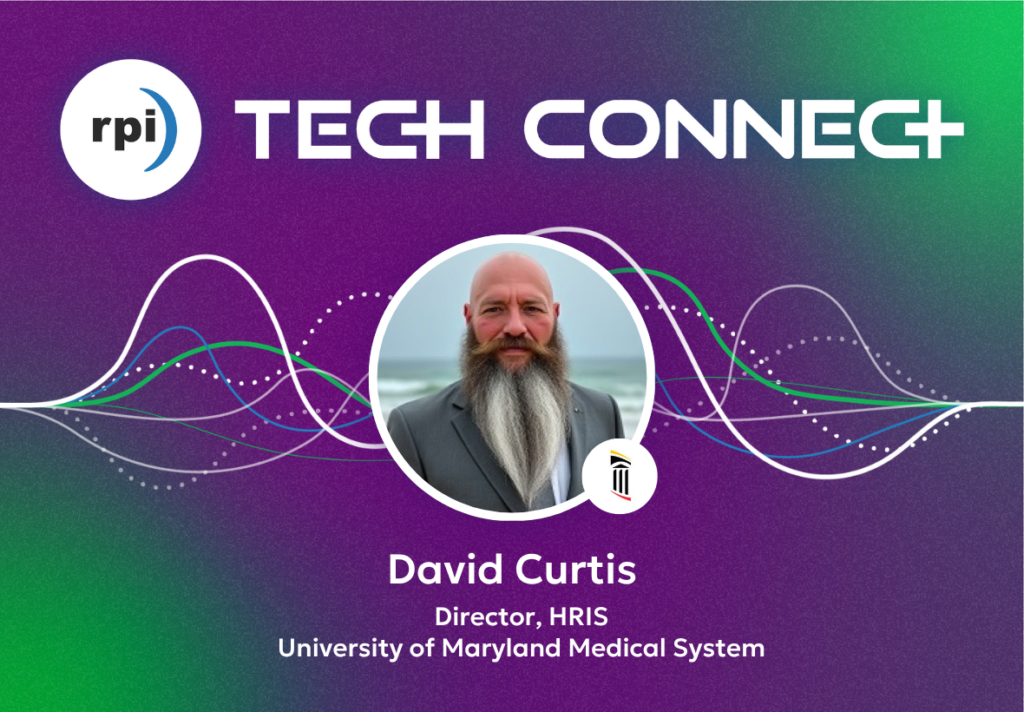
In this episode of RPI Tech Connect, Dave Curtis, Director of HRIS at the University of Maryland Medical System (UMMS), talks about their recent Infor WFM implementation—including their move from a previous time & attendance system to a real-time, cloud-based environment, with RPI supporting the build from design through go-live. Dave explains how the new system’s real-time capabilities pushed his team to rethink long-standing termination and workflow processes that only worked because of the old system’s built-in delay. He also shares how partnering closely with RPI helped his teamwork through the technical unknowns and reshape those processes to match what the new, more capable system could do.
If you’re evaluating new WFM systems and want to hear how one team turned a technical transition into a chance to modernize, this episode is for you.
Interested in listening to this episode on another streaming platform? Check out our directories on the WRKdefined network or watch the YouTube video below.
Meet Today’s Guest, David Curtis
Dave Curtis is Director of HRIS at University of Maryland Medical System (UMMS). As an HRIS professional, he maintains deep expertise across HR business functions, HR technology, and the ways both connect to the strategic direction of HR and the broader organization. He strives to serve as a go-to resource for the continuous development and enhancement of HR business processes, technology, innovation, reporting, and analytics.
Dave specializes in making things happen, drawing on a wide range of business and technical knowledge to craft solutions for challenges of every size. He has the insight to identify both the challenges and the solutions hiding within the gray areas that others often overlook.
He also excels at working across diverse groups within business operations, helping build a full-picture vision that shapes solutions tailored to the needs of the business — ultimately delivering greater effectiveness and efficiency to UMMS’s HR processes.
Meet Your Host, Chris Arey
Chris Arey is a B2B marketing professional with nearly a decade of experience working in content creation, copywriting, SEO, website architecture, corporate branding, and social media. Beginning his career as an analyst before making a lateral move into marketing, he combines analytical thinking with creative flair—two fundamental qualities required in marketing.
With a Bachelor’s degree in English and certifications from the Digital Marketing Institute and HubSpot, Chris has spearheaded impactful content marketing initiatives, participated in corporate re-branding efforts, and collaborated with celebrity influencers. He has also worked with award-winning PR professionals to create unique, compelling campaigns that drove brand recognition and revenue growth for his previous employers.
Chris’ versatility is highlighted by his experience working across different industries, including HR, Tech, SaaS, and Consulting.
About RPI Tech Connect
RPI Tech Connect is the go-to podcast for catching up on the dynamic world of Enterprise Resource Planning (ERP). Join us as we discuss the future of ERPs, covering everything from best practices and organizational change to seamless cloud migration and optimizing applications. Plus, we’ll share predictions and insights of what to expect in the future world of ERPs.
RPI Tech Connect delivers relevant, valuable information in a digestible format. Through candid, genuine conversations and stories from the world of consulting, we aim to provide actionable steps to help you elevate your organization’s ERP. Whether you’re a seasoned professional or new to the ERP scene, our podcast ensures you’re well-equipped for success.
Tune in as we explore tips and tricks in the field of ERP consulting each week and subscribe below.

Transcript
Chris Arey
We’re back on RPI Tech Connect, and as always, I’m your host, Chris Arey. Today I’m joined by David Curtis, Director of HRIS at University of Maryland Medical System, or UMMS for short. They are an RPI client who recently went live on Infor WFM and join us here to talk about that experience today. So David, it’s an absolute pleasure to have you on the show today, sir. How are you doing?
David Curtis
Appreciate it, Chris. Thanks for having me. It’s kind of exciting to be on a podcast — appreciate the invite.
Chris Arey
Yeah, man, glad to have you. For those who haven’t met you, would you mind sharing a little bit about yourself before we get into the details?
David Curtis
Sure. I know I don’t look like it, but I’ve been in HRIS for about 26 years, since 1999 — obviously, I was 12 when I started. At this point I’m the director of HRIS at the University of Maryland Medical System, and it’s been quite the journey getting to the director level. I’m the proud leader of the best HRIS team in the country — if we had HRIS Olympics, we’d come back with all gold. That’s how confident I am in my team.
Today, we — you mentioned the WFM go-live — we’re a couple of months into that, so I know that’s what we’re going to talk about today.
Chris Arey
Awesome, man. I like the enthusiasm. Before we get started, I have to ask — where are you calling in from today? That’s an interesting spot you’re in there.
David Curtis
Yeah, this is like the junk drawer room of my house. There’s a whole backstory to it — I mean, this is all COVID’s fault. Like many of you probably listening, back in 2019 you were told, “Let’s go remote for a couple of weeks.” Well, that couple of weeks extended further and further. And as things evolved here at the house, I had to move around offices — from my dining room table at first, into my family room, which then I turned into the gym, which is a whole other story. As things evolved, this became the room where my office would be. It’s a storage room I was supposed to clean up a couple of years ago and turn into an office, but as you can see, I haven’t done the cleanup.
But this is some family history — this is an actual lobster buoy. My great-grandfather was a lobsterman in Maine, and that’s one of his actual buoys. So yeah, this is my messy junk drawer office.
Chris Arey
Dude, I love the junk drawer comparison, because that’s something I have in my home — it’s been in all of my homes every time I’ve moved. So I totally get it, and I see it, like, manifest in a room.
David Curtis
That’s right — you’ve got to have one, because it’s like, you have something in your hand and you’re like, ‘I don’t have a place for this.’ It goes in the junk drawer. It just happens that this room is that.
Chris Arey
Nice. Well, I appreciate the lore in the background there. It’s hard to believe COVID was six years ago, but here we are. So, before we get into problem, solution, outcomes, I want to hear about your role as the HRIS director going into this project. What was your involvement? How did it — what can you share?
David Curtis
Yeah, so I mean, that’s an interesting topic, because WFM — obviously that’s a time and attendance system, right? So from an HR perspective, we’re kind of the sidelines support team. My team supports the technology of Infor from an HR perspective. And when we initially did the evaluation of WFM, we were like, okay, this is more of a payroll and scheduling system, which we don’t have a lot of direct involvement in.
So initially we scoped it out as, we’re the support team to help payroll with HR data. Obviously there’s a need for the HR data, and WFM was sold to us as a fully connected, fully integrated system. So our initial thought was, we’re just going to help build the logic and the setup of what data needs to go from GHR into WFM.
And then, as we started evaluating it, we realized that WFM can do absence management — so, our PTO plans. We had our absence plans in GHR, and we were pretty happy with it. But as we started evaluating WFM, we were able to see that we could have real-time PTO. One of the struggles we’ve had for years is the payout of PTO — it’s very manual on the GHR side, manually monitored, manually processed.
And it was always a pay period after the person left, so they’d get their last check, and then the pay period after that, they’d get another check for their time-off payout. We saw WFM as an opportunity to tighten that up a bit — build the absence structure in WFM, making it a real-time request system, a real-time usage system, and a real-time payout system.
So our role in the WFM project just kind of escalated once we made that decision. Not only did we help build the technology to transfer the HR profile and employee profile data, we started to build out a whole structure of absence management in WFM, and plan for that cutover from GHR.
Chris Arey
Is that something you decided you wanted to do, like, halfway through the project? What was the timeline there for that?
David Curtis
It was in the beginning, when we started the design phase — we were looking at all the different things. It was a tough decision, because we have some pretty complex PTO plans, and one of the things we discovered is WFM couldn’t fully internally manage the requirements. The data needed to determine if somebody is eligible for plan A, plan B, or any number of our other plans — there’s a lot of HR data necessary to make that determination, and that wasn’t in WFM.
We would’ve had to port over a bunch of data that had nothing to do with time and attendance to manage that. So we kind of have a hybrid — GHR controls eligibility, fed over into WFM. It did take a little bit; we were well into the design phase before the final decision was made to move into WFM for absence. But it was still early, before we started the initial rounds of testing.
Chris Arey
Nice. That sounds like a good thing then — to kind of finalize those things early on, as opposed to later, which probably would’ve made things more complicated. Is that true?
David Curtis
Absolutely, yeah. So the big surprise was the BODs, and how much involvement we’d have in that. The team was responsible for managing the data in GHR and getting it over to WFM, and we managed that with the Infor BODs — that was a bit of a surprise later in the project, just how much work that was going to be.
Chris Arey
So before the WFM implementation, what were you using previously to manage time and attendance?
David Curtis
Okay, so we were on Kronos — the UKG Kronos system — and that was a daily feed. We’d have the Infor flat file generated every night, and it would pass over to Kronos, so everything was always a lag, right? Any changes that happened in Infor would show up in Kronos the next day, or multiple days in some cases, because we wouldn’t feed the data into Kronos while payroll was running.
During that three-day period we’d put a freeze on the data going from Infor into Kronos, which is always a pain point for the leaders, obviously, because they’re operating day to day — they want to see that a person transferred on Monday, but it doesn’t show up until Wednesday, because the feed doesn’t sync the data between Infor and Kronos. It’s a nightly feed, but on hold.
Chris Arey
And you were on that system for probably many years, I take it.
David Curtis
I’ve been here since 2011, and that’s what we used since then — and before that, it was already being used in the system.
Chris Arey
So, you’d have to figure — using a tool that operated on that lag, you had defined processes around that, right? Because that’s how things were done — that’s when the data showed up, when it carried over, you built around that. Is that correct?
David Curtis
Absolutely, yeah — and looking back on it, it actually gave us a little buffer, a security we didn’t really respect at the time. You could make a change at eight in the morning, and something could come up, and you’d learn that change shouldn’t have happened — you could fix it and nobody would know the difference. Kronos wasn’t impacted, right?
Terms, for example — we’re a pretty large organization, and there’s a lot of turnover, and a lot of things move fast. Sometimes somebody will say, ‘I’m going to leave in two weeks,’ and then the leader will talk to them and they’ll say, ‘Well, I’ll stay PRN — I’m not going to quit completely, I’ll go supplemental.’ And sometimes the leader will put in the term and then notify us, ‘I don’t want that term, this person’s going to stay supplemental.’ If we were notified the same day, there was no impact on Kronos. As a matter of fact, there wasn’t an impact at all until closer to their term date, because the file wouldn’t pick that term up — it was a future term. Those types of business processes were hiding, I suppose, in the fact that this wasn’t a real-time connection to the time and attendance system.
Chris Arey
Thank you for explaining that. So when you implemented Infor WFM, what was the single biggest shift you noticed right away, compared to the Kronos system?
David Curtis
So the BODs were the biggest item. And when we first heard about BODs, I forget what it actually stands for — business object something, starts with a D. I looked it up before, so I’d know, but I’m not one to use notes, so — it’s something that starts with a D, anyway. They’re a real-time connection, right? So that was super exciting from a data perspective — to be able to make a change in the HR system and have that change show up, basically immediately, within seconds in our case, over in the time and attendance system.
That just created some excitement — that it’s real time, there’s not going to be any lag, people will be able to see their changes, their shift changes, changes in their job, those types of things. What we didn’t realize is that there are a lot of things connected to that real-time transaction that we didn’t factor for.
Chris Arey
It’s a term — as a marketing professional, ‘real time’ is a popular phrase used in a lot of places. Sounds like an easy, obvious win. But I’ve heard you describe it as, this sounds really good, but all of a sudden it revealed things — kind of like what we were just talking about, where you had this built-in lag in the process, and all of a sudden that’s gone. So what was that experience like for you?
David Curtis
Yeah, I mean, first of all, we had to figure out what it was doing. It might seem odd, but BODs are fairly new from the Infor perspective — the RPI team’s been great, and their knowledge of it is great. But even with that knowledge, there were some points where we were like, ‘Why is it doing that?’ We did a lot of testing — I mean, if you’ve done testing, you understand that you create test scenarios, and you test those scenarios. We tested those scenarios per our script, everything that we do, we tested it. The problem with testing is, you define what you want as an outcome, and you test it, and you either get that outcome or you don’t — but the goal is to build until you get the right outcome. When real life happens, it starts to flush out some of the business processes that just exist, and you really didn’t understand the impact it would have on these systems. So we’ve had to bring in Infor to answer some of the questions.
Chris Arey
The testing example you gave — you set the scenario around a condition or an outcome that you anticipate, or don’t anticipate. And when you’re in a real-life setting, sometimes there are things you don’t know you need to test for until they happen. I suppose this real-time benefit kind of revealed some of those things you didn’t know you needed to test for. Is that correct?
David Curtis
Right, yeah — the real time really got tested when we went live. We worked through test scenarios like we would with any other testing, but then, immediately when we started doing real business, it flushed out some of the issues with the BODs. I don’t know if I’d call them issues, but some of the unknowns with the BODs. Termination, again, is a great example. We get terms — the leader identifies that they don’t really want to term the person, so we’d always just put them back to active. We’d get rid of that — we’d go into the audit log and delete that future data transaction. That’s just how we’d done it. However, we found that change at the audit log level doesn’t get picked up by the BODs. We didn’t know that.
When we were testing, we didn’t know that — that was a complete miss from our testing perspective, because we didn’t understand that the audit log piece wouldn’t be picked up. So when we started doing that, within literally the first few days, people’s terms were being removed — their future-dated term — we were going in and removing it, but they were staying termed on the WFM side with that future date. So then they couldn’t schedule the person.
They’d go to schedule them past the term date they’d submitted, and the system wouldn’t let them, because as far as it knew, they were terming on that date. So we had to quickly review that, figure out why it wasn’t working. We identified it within four days and realized it was the audit log transaction that we manage.
We had to start doing a process where we’d move them into a fully termed status and then use the reinstate workflow — Infor was like, well, you have to use the workflow to reinstate them. So my team had to quickly shift how they process removal of terms — fully term, then reinstate. It was things like that — it’s really hard to test something like that, because you’re testing the scenarios you do day to day, but until you turn it on and real life hits you, sometimes there’s things that don’t get flushed out.
Chris Arey
So, would you say then, that as a result of gaining the benefit of this real-time — these real-time transactions — you had to change business processes that you didn’t know you were going to need to do?
David Curtis
Absolutely, yeah. The term is one of the examples, but we’ve also had to change how we transact in the system, to make sure the BODs are able to pick up those transactions. There’s a dependency on workflows — when we were maintaining data in GHR directly, prior to WFM, we’d just go in and change a field.
So if something needed to be changed, like their FTE or another data point, we didn’t initiate a workflow to change their FTE — we’d just go in and change it, no big deal. But some of the fields we were maintaining that way aren’t triggered to be picked up by the BODs to move over to WFM without initiating a workflow, or making some changes to the table that manages all of that.
So, in partnership with our RPI resources and Infor, we were able to make determinations on whether we should update the table that’s triggering those things, or whether we need to change a business process and initiate a workflow, do things a little differently. So within the first month of go-live on WFM, we had to make those determinations and shift as necessary to make sure the BODs were picking everything up.
Chris Arey
And you’ve been live on WFM for how long now?
David Curtis
Since March 8th.
Chris Arey
So, do you find that you’re still in a process now, discovering these unknowns and having to amend business processes to reflect the new capability you have? Or is that kind of behind you at this point?
David Curtis
We’ve been able to get through the determination on business processes. We frankly still have issues with the BODs — how they work, and transferring data. Some of it is transactional — like this morning we were talking about effective dates. Some of the items, you go out and change somebody, and we don’t change every single field on that person’s record, but what the BODs pick up is every field.
If there’s a certain field that has an effective date prior to our March eighth go-live, the BOD will throw an error and not process. We’re still working through all the ins and outs — some of it is settings in WFM that we can change to allow these transactions to go through, some of it is how we make those changes in the system, and some of it is just knowledge of how the BODs work, so that we can appropriately manage what we’re doing.
Chris Arey
For businesses getting ready to embark on a project like this — changing time and attendance, managing leave of absence in a new system like WFM — what advice or recommendations would you have for them, based on your own learnings throughout this experience?
David Curtis
I would sit with your teams that do the actual maintenance in the system, and do a deep dive into not only what they do, but how they do it. My team knows what we do — we were the ones that created the scenarios, right? We term people, we hire people, we transfer people — the whole list of transactional things that we do in Infor for the data changes. We made that full list, but what we failed to do was look specifically at how we do those things.
Do you maintain this directly on the field? Is that field maintenance — direct field maintenance — something that triggers the BOD to pick up that change? Or do you need a workflow? Do you have a lot of future transactions sitting in the audit log, waiting for processing? We had a practice of just going directly into the audit log and making edits there, not realizing those things don’t get picked up by the BODs. So, look not only at the types of things you do, but the full how of how you do them, when you’re doing your testing — so you can evaluate that before you go live, unlike us, who did it after we went live, to make any business process changes you might need to have in place to account for the BOD processing.
Chris Arey
Hearing about your experience, and now that you’re live and some of the things you’ve had to change — I feel like it’s a testament to how capable the Infor WFM solution is. You’re able to change all these things, and now that you’re live, the tool is kind of revealing — maybe ‘flaws’ isn’t the right word — but areas in your business processes that maybe you hadn’t thought of.
So, as a result of implementing this new technology, your business processes are improving as well? Both things are getting better?
David Curtis
Yeah, I definitely wouldn’t call them flaws in the business process, I guess — just designs, the way we were doing things in GHR, that don’t translate well into the WFM BOD structure. But what it’s done is given us a reason to really look at those, and start diving into the why. Like, why do we have — I didn’t really realize how many terminations we were reversing.
The way I’ve been looking at it, from my perspective as the director of HRIS, I started asking the deeper ‘why.’ We identified what we needed to change to make the BOD work, but then I started asking, well, why are we getting so many reversals on terms? What is it about our process that’s causing a leader to terminate somebody and then turn around and say, ‘Oops, no, I don’t want to terminate them’? Or, in a lot of cases, it’s also, ‘Well, I put in this date, but now it’s this date’ and in some cases it happened a couple of times.
There was one where there were four different dates submitted for that person. So I stepped back and looked at that from the perspective of, are there things we can do that have nothing to do with WFM, frankly, that are more about education? Do we need to do some kind of education with the leaders — that it’s great you’re submitting a term because you know this person is leaving, but does it make sense to pause? Don’t submit the term when they just left your office, right? If you plan on having a conversation with that person, maybe pause, have that conversation, and then submit the term when it’s a little more solid.
But it also pointed out that we have a term process — when a leader submits it, it goes through a workflow — and it pointed out some pain points that we were just managing through, because it didn’t have any kind of end-user pain point before, like it does now with WFM. My team was just managing through it and getting it done.
We’ve initiated a project to look at our termination workflow — are there opportunities to refine it to make it work better, so we don’t have as many of these? It’s really been about stepping back and asking, okay, why are we having so many of these — not just how do we make it work with WFM, but why? And that’s been an important, albeit a little annoying, thing to have to do — but it’s been important to step back and look at those things in that depth.
Chris Arey
Hearing you talk about this reminds me of something we always encourage here at RPI — from our marketing content to the actual projects, working with folks like you — this idea of continuous improvement. You go live, but it’s not the finish line. There are little tweaks and modifications to workflows, like the example you just talked about. So it’s nice to hear that’s actively going on, and that you’re looking for ways to amend and make the system work better for you and the way your teams work.
David Curtis
Right. And sometimes it’s not the system — sometimes it’s our processes.
Chris Arey
Yeah, it goes both ways, right?
David Curtis
Yeah, exactly. We’ve definitely made some changes in the system to account for our processes, because sometimes your business process is what it is for a reason. But in some cases, it’s, let’s change the business process to account for these challenges. And it’s exposed areas we can definitely improve on.
We’re still in what I call the stabilization phase, right? We designed, we tested, we tested more, we tested a little bit more, and then we went live. There’s always that period of time where — no matter how much you test, I don’t care how much you test, you could spend three or four years testing, you’re never going to identify every single scenario that could come up in real-life transactions.
You’ve got that period, and you can either dive into it from a technical perspective and say, ‘I need to make the system work the way I need it to work,’ or you can take a step back, look at it from a different perspective, and figure out if there are other changes that need to happen that aren’t technology — and shape things to get better overall.
Chris Arey
That’s awesome. You have a very positive, great attitude toward this whole thing. I love hearing your perspective on this project.
David Curtis
Yeah, well, I’m not always positive, but I try to be.
Chris Arey
We’re getting close to time here. I’d love to hear — for folks who are getting ready to do this for the first time — your thirty-to-sixty-second pitch on what you want folks to walk away with after listening to this episode today. What would you share? One piece of advice.
David Curtis
That’s a good question. As you’re looking through your implementation plan, I’d make sure you build in time for the business process review, and the deep dive into the knowledge of how it all works. Obviously, when you’re sold a product, the vendor — Infor, in this case — is going to come in and say, ‘Here are all the great things about this product.’ That’s what they’re doing, right? That’s what they do.
It becomes our responsibility to then look at it and say, okay, these are great things, but where are the little areas that we could stumble? To step back and look at it from that perspective — what do we do, how do we do it, why do we do it, and how will that have an impact on this new build.
Chris Arey
So if I heard you right, it’s making sure you factor in enough time for business process review during the early stages of the project.
David Curtis
Right, yeah. Absolutely.
Chris Arey
Awesome. Well, thank you so much, David — it’s been an absolute pleasure chatting with you this morning. For those of you listening in, if you want to hear more about Infor WFM, or how RPI can help you, or want to learn more about David and UMMS’s experience with the project, we’d love to hear from you. You can contact us at podcast@rpic.com — again, that’s podcast@rpic.com. Thanks so much for tuning in, and we’ll catch you next time.
David Curtis
Very good. Thank you, Chris.