Switching consulting partners mid-implementation can feel risky—but staying with the wrong one might cost you more.
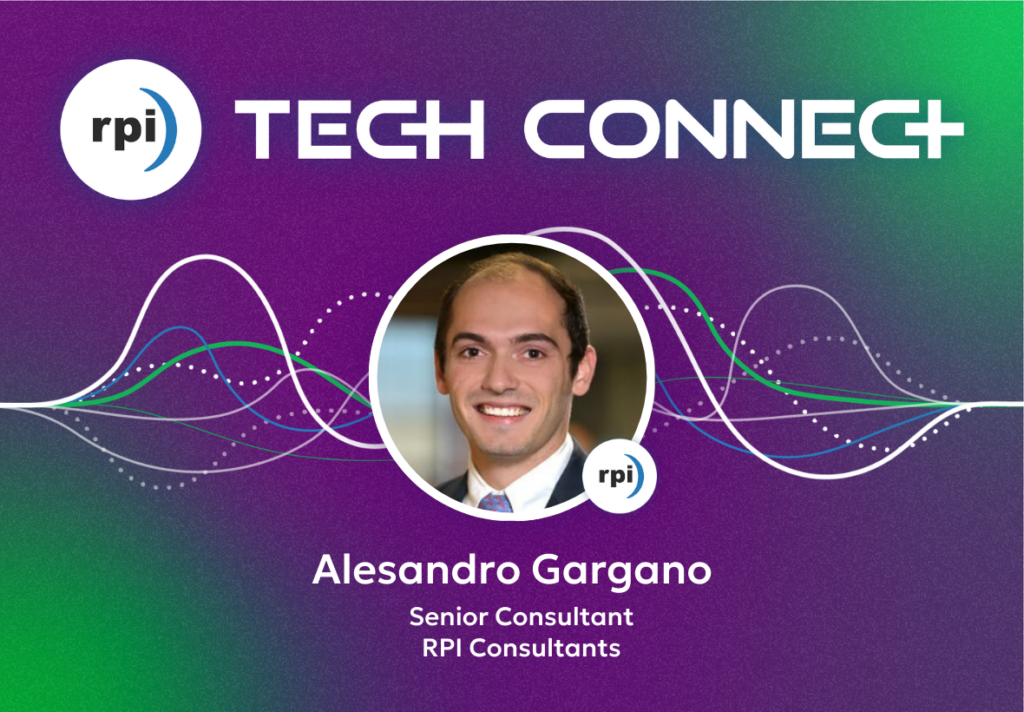
In this episode of RPI Tech Connect, Senior Financial Consultant Alesandro Gargano shares what the project recovery process looks like for customers who’ve decided it’s time for a change. From the first conversation to rebuilding momentum, Alesandro explains how the right partner earns your trust, works with your team, and gets things moving again.
If your implementation has stalled and you’re not sure what to do next, this episode is a good place to start.
Interested in listening to this episode on another streaming platform? Check out our directories or watch the YouTube video below.
Meet Today’s Guest, Alesandro Gargano
Alesandro Gargano joined RPI in 2021 and has worked on multiple projects implementing CloudSuite technologies, specifically FSM. He holds a BA in Finance and an MS in Human Resource Management, and has earned Infor Financial Certification twice, in 2022 and again in 2025. He is also a frequent presenter in RPI’s CloudSuite Bootcamp and webinars.
Alesandro is known for forming long-lasting relationships with customers, who often ask for him specifically for post-go-live opportunities and ad-hoc support. Our internal team values his ability to navigate the system both functionally and technically, often connecting the dots between the two.
Meet your Host, Chris Arey
Chris Arey is a B2B marketing professional with nearly a decade of experience working in content creation, copywriting, SEO, website architecture, corporate branding, and social media. Beginning his career as an analyst before making a lateral move into marketing, he combines analytical thinking with creative flair—two fundamental qualities required in marketing.
With a Bachelor’s degree in English and certifications from the Digital Marketing Institute and HubSpot, Chris has spearheaded impactful content marketing initiatives, participated in corporate re-branding efforts, and collaborated with celebrity influencers. He has also worked with award-winning PR professionals to create unique, compelling campaigns that drove brand recognition and revenue growth for his previous employers.
Chris’ versatility is highlighted by his experience working across different industries, including HR, Tech, SaaS, and Consulting.
About RPI Tech Connect
RPI Tech Connect is the go-to podcast for catching up on the dynamic world of Enterprise Resource Planning (ERP). Join us as we discuss the future of ERPs, covering everything from best practices and organizational change to seamless cloud migration and optimizing applications. Plus, we’ll share predictions and insights of what to expect in the future world of ERPs.
RPI Tech Connect delivers relevant, valuable information in a digestible format. Through candid, genuine conversations and stories from the world of consulting, we aim to provide actionable steps to help you elevate your organization’s ERP. Whether you’re a seasoned professional or new to the ERP scene, our podcast ensures you’re well-equipped for success.
Tune in as we explore tips and tricks in the field of ERP consulting each week and subscribe below.

Transcript
Chris Arey
Welcome back to RPI Tech Connect. I’m your host, Chris Arey. Today we’re going to be talking about a unique kind of consulting work and that is the rescue mission.
These are the projects that don’t go as planned where clients are burned out, frustrated and looking for someone to help get things back on track.
Joining me today is Mr. Alesandro Gargano, senior financial consultant here at RPI. He’s been a part of several of these turnaround projects and he’s going to be sharing a lot about how he gets his things back on track. So, Sanni, welcome to the program, sir.
Alesandro Gargano
Chris, thanks for having me, buddy. I’m really excited to be on today. Long time listener. Finally get to do it myself. I’m Alesandro. I’ve been with RPI for about four years. Worked my way up from an Analyst to a Senior Consultant.
One thing I really appreciate about RPI is that most of us tend to wear a lot of different hats. We’re never doing just one thing. It allows us to be players on any project in any situation. So that’ll kind of lend to some of the stuff we talk about today.
But yeah, I’ve been fortunate to be a part of several of these rescue projects, if you will. And they’re some of the most rewarding and challenging projects all at the same time. I’m excited to talk about what makes RPI successful in these project takeovers.
Chris Arey
Thanks for that context there, Sanni. It’s great to have you on the program and I can attest that you do wear lots of hats, both in your consulting role and here in the RPI Baltimore headquarters.
But more on that later. Let’s go ahead and jump right in. I think a great place to start with our discussion today is to talk about, when we say rescue mission, what does that really mean in the ERP world?
What are the typical situations where RPI gets brought in?
Alesandro Gargano
Yeah, so the term rescue project or project takeover, it typically means that as RPI, we’re being engaged after a project is already underway. So, that could be during an early testing cycle, during unit testing or system integrated testing, right at go-live to help the customer get over the finish line, or after go-live to help.
Maybe we’re even stabilizing a system that wasn’t ready to go live. It kind of depends on when we’re brought in. But typically, we are brought in for a couple different reasons, whether project milestones are not being hit, or the timeline seems unrealistic with where the project currently sits, or tech development is falling behind, things that have the client worried about their future on the software they’re using.
Chris Arey
So you say things like not hitting milestones or things are behind and that all sounds like probably not a positive spot to be in, would you agree? You don’t want to be there.
Alesandro Gargano
Yeah, no. No, definitely not as a customer.
Chris Arey
So when you get into this project that’s gone sideways, what’s your first move as a consultant? What’s step number one?
Alesandro Gargano
Yeah, I think the first thing is that when you show up, whether it is on-site or virtually, you should aim to gather as much intel as you can. See where the project is, where the customer is and kind of seeing where you can fit in and add value without creating any more disruption.
So, you know, usually bringing some targeted questions to calls with the project leads. Stuff like that can give you an idea of where exactly you are in your project? How are you feeling about the software and how you’re going to use it moving forward?
From there, you can kind of take a step back, think about what you’ve heard, and then decide what your next move is. But a lot of it depends, like I said earlier, on when you’re taking over the project, you know, it’s going to be completely different if you’re entering during unit tests than if you’re coming in after go-live.
In that case, you’re working with the system that’s kind of already set in stone, but you kind of go from there to see how you can best help them. I think the biggest thing by far is just listening, hearing the client tell you where they are and kind of seeing what the team morale is like, and that’s often going to tell you a lot more than the project plan would.
Chris Arey
I was going to ask you something about how you would cause approach generating value without being disruptive. That sounds like a really delicate dance there, because you’re coming into a situation where people are likely going to be a little defensive or resistant.
So, love to hear that. I was going to ask you how you go about doing that, but I think you answered the question with this listening take, which is such an underrated skill I feel these days. There are always best practices on what you can do and like sometimes it’s really something as simple as just actively listening to the people you’re working with, right?
Alesandro Gargano
Yeah, definitely. You’re not going to fix it overnight. Listening, gathering as much as you can, and then using that kind of information throughout the project, or throughout the phase that you’re entering in can go a long way.
Chris Arey
Have you found that listening has helped demonstrate to these probably frustrated folks your willingness to work with them? How do you feel that that helps break down boundaries and help forge relationships with these folks?
Alesandro Gargano
Yeah, I mean, just to take a step back for a second, if RPI is coming in, it probably means that your first relationship with your first consulting partner either wasn’t going well or you weren’t making enough progress.
So, by the time we get in the customer is typically pretty emotionally drained. They’ve invested countless hours in design sessions, testing sessions, all types of stuff surrounding the project.
On top of that, they’re still doing their day jobs. And they’re paying people to help them with this implementation. It’s not going well, they’re frustrated. And they don’t necessarily have anyone to vent to or kind of work through these frustrations together. Just taking the time to listen to where they are without jumping straight to solutioning is important.
If I’m hopping on a call with someone for the first time and they’re kind of telling me where they are and what their problems are, I’m not trying to solve the issues on the call because I don’t want them to feel like, well, you just did that wrong. You just didn’t do it right. I want them to be able to trust me, and I want to be able to teach them, ok, well, maybe you set up like this, but what if we did it this way? How might that change your day to day for the better?
Chris Arey
I like how you framed that there too. It sounds like these calls by design have different goals, and nobody wants more meetings, but at the same time, that initial call is really just to listen to them and to understand what happened, what went wrong. And then you’re not immediately suggesting solutions. It’s a process, right? These are people you just met.
Alesandro Gargano
Yeah, and that connection is really like the first real step into building trust with RPI or whoever the new consulting party is that you’re bringing in. You have to build trust with them, because it’s really hard to move an unsuccessful project forward without any trust with a new implementer, because they’re just going to lump you in with the other outside consultants that have failed.
Chris Arey
They don’t get it, they don’t know what’s going on and they’re going to tell me what to do. Not how you want the client to feel. Have you found that sometimes you try to make personal connections with these folks, not to expedite the trust-building process, but to show that you’re human and maybe kind of break down some of those boundaries. Is that something that you have experienced?
Alesandro Gargano
Exactly. Definitely. Yeah.
Chris Arey
Any that you can share or talk about?
Alesandro Gargano
For sure, yeah. One big one that comes to mind, it was the first project that I was a part of a couple of years back, a healthcare implementation. They were on the same system for over 20 years before we came in and sold them FSM.
There was a particular individual on their AP team. She was kind of their AP manager, if you will. And she was very knowledgeable. Nice, but a little bit stand-offish. You know, we were coming in and pushing change after she’d been doing the same thing in the same system for 20 years.
She was hesitant to necessarily give us what we needed to make sure it was going to be a successful implementation in the AP side of things. So, you know, we were on site for a testing cycle and she wasn’t necessarily getting her testing scripts done. I was walking around from cubicle to cubicle, checking in on people, seeing if anyone needed help. And I stumbled into kind of her corner, the cubicle section in the AP department.
Before she noticed me, I noticed on her desk, she had an Elvis calendar and an Elvis bobblehead. Me myself, not a huge Elvis fan, but had the opportunity to go to Graceland when I was in college. And before, you know, I walked over to her and, before I talked about Infor FSM or the project, I was like, hey, I noticed this Elvis stuff, and I’ve been to Graceland.
I took out my phone, and I showed her a couple pictures of me touring the house. She had never been there. She, you know, wanted to go when she retired, and hadn’t been there. It was kind of the start of her thinking of us as a nuisance or a pain, you know, she was like, like you, you are a person, you do stuff outside of work. You’re not just coming here to tell me what to do.
It kind of opened her up to being much more willing to share information with us that we needed to make sure the project was successful and her department was going to be successful after we departed. That’s kind of one of my go-to experiences. But it’s a small moment. just reminds you of how important it is to connect with people so that it builds that trust.
Chris Arey
I feel like that is the definition of good consulting. You care about this person, you’re making an effort, you’re extending an olive branch. It shows that you really want this project to go well. You are there to help this person do their job better and for this implementation to go well.
By taking that step to not talk about work and be like, what’s going on in your life? Let’s talk about that for a second. It’s going to do wonders for the project. You mentioned this was a healthcare client too. That’s an industry that’s already under a lot of pressure. When you compound that with an ERP implementation, I can only imagine that there’s a lot going on.
Alesandro Gargano
Yeah, if you know anything about AP and health care, it is a stressful department to be a part of, to manage, and to work in. So, you know, making it feel different than work goes a long way, especially with just building that original relationship and rapport.
Chris Arey
Yeah. Love to hear that. Now I have a question for you. You’ve kind of alluded to it, but I’m curious for like, you you’re trying to establish a personal relationship with somebody who’s in an understandably difficult situation. Have you found that, you know, in-person versus virtual is maybe a better medium for doing that? Or what’s your experience? What have you found to be successful?
Alesandro Gargano
Yeah, you know, I’ve done projects that have been completely remote. I’ve done projects that have been a combination of remote and in-person. I’ve done complete in-person projects. I’d say that, you know, being in person, it’s a little bit easier to build that relationship or maybe not easier, but it happens quicker because you’re face to face. You’re in person right away. You can, you know, talk about things off of calls that maybe you didn’t before.
But, you know, there are still ways when you are remote to make that, that effort and that, and create that connection. A couple of those things include, you know, if you have a call, turning your camera on so that they can see, okay, there is a person behind the voice. It’s not just somebody telling me this is how it’s going to be, you know, in the new world.
Joining calls a few minutes early, before you dive into the work, taking a second to ask the people, how’s your day going? How was your weekend? What do you have planned for the holidays? It’s important to go the extra mile to kind of make those small moments happen and build that trust, even through a screen.
Chris Arey
Yeah. Do you ever talk about football? Yeah? Is that a point of contention or are people in agreement? As a Ravens fan, what does that discussion look like?
Alesandro Gargano
Yeah, sports are a good segue into kind of relationship building. Sports are everywhere. Most people have teams that they support, baseball, football, soccer, whatever it might be. But yeah, I’m working on one of these rescue projects right now and they are all huge Bengals fans, our division rivals.
It gives us a chance to playfully compete against each other with something that doesn’t have to do with work. And then that leads into like, okay, well, Monday morning when I have our check-in call with them, the first thing we talk about is our NFL scores. And then we get into the call, and it just opens the conversation.
They trust you by telling you more, bringing you issues as they come up because they are now more comfortable with the resource that they have available to them.
Chris Arey
You probably look forward to those calls, don’t you? Especially if it was a good Sunday for Ravens. Otherwise, you have to postpone it. Listen man, not going to be able to make it this Monday. It was a little rough yesterday.
Alesandro Gargano
Yeah, exactly. I only join after wins.
Chris Arey
You know what I really love about that Sanni, is that it demonstrates that these engagements and these sessions you’re having with folks are not transactional. You’re forming genuine relationships with these people, and you’ve got to think that making that effort is going to have a huge impact on the project success, right?
Alesandro Gargano
Yeah, definitely. Because once you get in with them, and they trust and are comfortable with you, you can start to understand where exactly the customer is in their CloudSuite journey.
What are the next steps to figure out? What do we need to accomplish as a team? And how are we going to use the kind of information we’ve gathered to make sure they get to where they want to?
And then you stack on those small wins. You build that relationship. Then you kind of go into the consulting realm of, know, actually solutioning and putting stuff in front of them. Continue to build on that trust and layer it and stack until you get to a point where they’re comfortable and they can kind of put their foot on the gas and pick up where you left off on stuff.
Chris Arey
Yeah, I really love to hear that. I think you’ve answered this next question, but you know, we’ve talked a little bit now about getting a lay of the land and establishing rapport, building relationships with these folks and establishing all the groundwork for this project takeover. Once you’ve got that like taken care of, what is your next step? Is it situational depending on the project or are there some things that you like to deploy that you’ve found to be like universally effective in these types of engagements?
Alesandro Gargano
Yeah, definitely situational. You have to get an understanding of who you’re working with and how they work. It really helps me as a consultant understand how to approach the customer and how they’ll best ingest the information that I need them to.
I like setting up small calls that are just with the project lead. I work specifically with finance. So typically setting up a one-on-one with the finance lead without a project manager from either side on the phone. That can continue to build that trust with me, because I want them to come to me when they have an issue that needs solving.
Setting up those one-on-ones sometimes allows you to get information that maybe they’re withholding if a PM or someone they don’t recognize is on a call. Understanding their pain point as well. I like to have a list. I always have handwritten notes on my desk that I’ll then document on a list on my computer and then check items off one by one.
Whether it’s something big or something small, being able to deliver a solution, and being organized in that delivery, instead of saying you know, this is what I need solved, taking a minute to think, okay, do you still need to do this this way? How can we maybe build on this or change your process in the new world? Just taking a kind of a step back before you go ahead and solve all their issues for them.
Chris Arey
You said something there that I really liked, and it was this idea of understanding how the people that you’re working with like to work. You know that there are different styles of learning and all that. I like the fact that you’re thinking about it in that way as opposed to like, this is how it’s done and you’re going to listen and it’s going to go this way. And then we’re going to leave.
You want this person to be successful, you want the project to go well, and you want them to use the software the way that it can be used. That’s a win, dude. That’s a big win, let’s go.
Alesandro Gargano
Yeah. Being organized and effective in in your communication really goes a long way. Not everyone thinks the same, not everyone acts the same or works the same. You’ve got to be flexible depending on the customer.
Chris Arey
You know, hearing this, we talk about this a lot in different things here at RPI. And I’ve seen in my travels online and the internet, ERP projects are technical, but also people focused. And I’m hearing now from you as a consultant that you have technical skills in Infor FSM and the other related applications you use, but you also have some really great people skills, man.
I feel like this is like the stuff you’re talking about today is what separates a good consultant from a bad one. Would you agree with that?
Alesandro Gargano
Yeah, 100 % agree. Yeah, the human connections, the trust, it all compounds, and it makes my technical job easier because if a customer trusts me with what I’m telling them and putting in front of them, it makes my job designing and teaching them a lot easier because it builds that connection.
I want to help them get to where they want to go. That’s what it’s about.
Chris Arey
Hell yeah, man. Love it. Well, we’re getting close to time here. I appreciate you sharing all these great insights with us today. You may not know this, but before we wrap up, I always like to ask my guests if they have one actionable takeaway they want today’s audience to walk away with what it would be.
So, I’d be curious to hear what you have got for us today.
Alesandro Gargano
Yeah, you know that there are a lot of resources out there, but there are also the right resources out there. So if you’re a business that’s making the jump to FSM and your project is stalling or it’s not what you envisioned it to be, it’s never too late.
If you pick the wrong consulting partner, you’re not the only one. It happens more often than you think. And it’s not too late to reach out for help. Even if you don’t hire somebody else, just having the conversation and kind of knowing maybe what you’re missing out on or not getting from your current consulting partner, can go a long way and it’s never too late, truly.
Chris Arey
And if you call right now, you’ll be lucky enough to work with Mr. Alesandro Gargano, folks. Well, thank you for that Sanni. I think that was a great note to end on, acknowledging that there are many resources out there, but you know, some are better than others.
For those of you listening in, if you have any questions about today’s discussion or you want to learn more about how RPI can help with your project recovery, planning for the future or just learn more about our process, we would love to hear from you.
You can contact us at podcast@rpic.com. Again, that’s podcast@rpic.com. Until next time, this has been RPI Tech Connect. See you later.