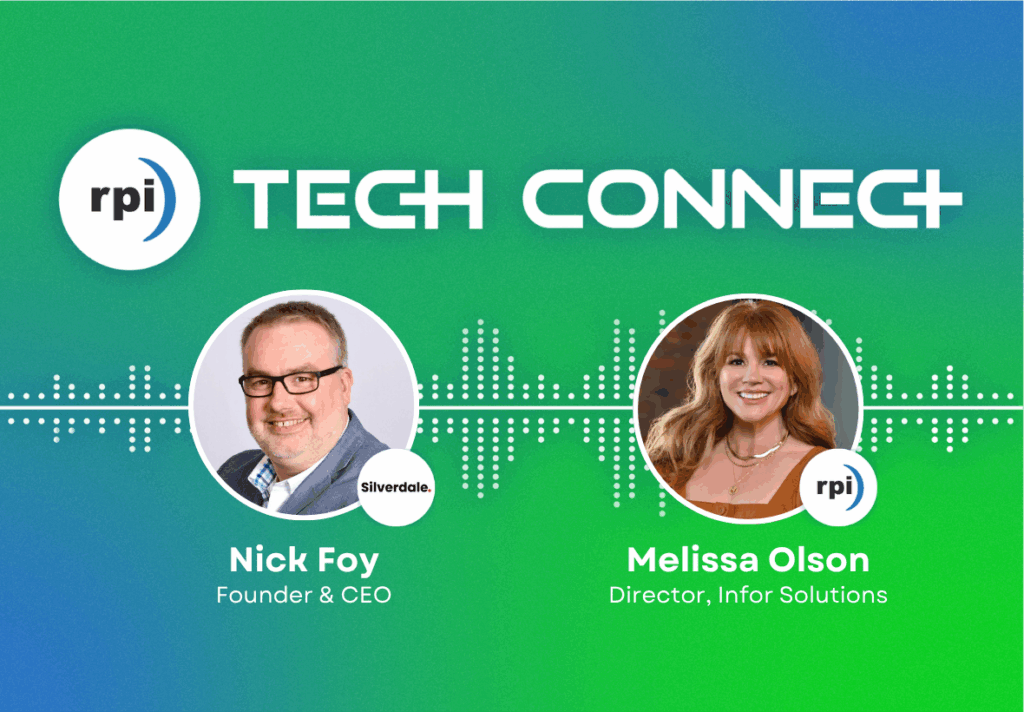
Every organization has heard the horror stories. ERP projects that spiral out of scope, stretch budgets, and leave teams questioning the value. But the great ones? They look quite different. In this episode of RPI Tech Connect, Nick Foy of Silverdale and Melissa Olson of RPI share what makes ERP projects successful and how consultants and clients can get there together.
They explore the mechanics of real success: clear processes, the right tools, full adoption, and ongoing accountability. The conversation also dives into the human side of implementation—how to handle scope challenges, set honest expectations, and rebuild trust in an industry that’s lost it. Nick and Melissa share lessons from years of ERP “rescue missions,” what they’ve learned about transparency and pricing models, and why the best projects are always built on shared ownership.
Whether you’re leading digital transformation or planning for one, this episode offers a candid look at how to turn complex ERP initiatives into lasting success stories, and what every great project has in common.
Interested in listening to this episode on another streaming platform? Check out our directories or watch the YouTube video below.
Meet Today’s Guest, Nick Foy
Nick Foy is the Founder, CEO, and Chief Evangelist of Silverdale Technology, which provides access to world-class processes, systems, and change management methods regardless of their size or budget. Going against the grain of the ERP industry, Nick and his team are ‘democratizing ERP’ with their unique perspectives, such as their standard business process library, fixed price implementation and money-back guarantees.
Nick is well placed to do so, with over 30-years of experience in business and technology consulting and leadership positions, particularly in logistics and supply chain, at Amazon, Capgemini Consulting, ModusLink Corporation, 3663 First for Foodservice, and The Glenmorangie Distillery Company.
Born in Scotland and currently living in rural Washington, USA, Nick is a frequent traveler, having made it all around the US, Europe, and Asia for work.
Meet Today’s Guest, Melissa Olson
As RPI’s Director of Infor HCM Solutions, Melissa Olson has been at the forefront of massive Infor CloudSuite and legacy Lawson implementations for well over a decade. Nowadays, you are likely to find Melissa in the role of Executive Oversight ensuring quality in HR Talent implementations and out in the community presenting, demonstrating, and connecting with clients.
Over the last 20 years of Melissa’s career, she has modified the Lawson code set as a programmer for a transportation agency, led an North American HCM implementation while tending to her day job as a HR Business Partner for a marketing and merchandising firm and built an HCM Practice with RPI from scratch while consulting.
With her unique mix of experience understanding organizational needs, deep knowledge of Infor People Solutions, and the boundaries of the Infor technical extension toolset, Melissa enjoys tackling organizational problems with solutions that are process focused more so than product focused.
Meet Your Host, Chris Arey
Chris Arey is a B2B marketing professional with nearly a decade of experience working in content creation, copywriting, SEO, website architecture, corporate branding, and social media. Beginning his career as an analyst before making a lateral move into marketing, he combines analytical thinking with creative flair—two fundamental qualities required in marketing.
With a Bachelor’s degree in English and certifications from the Digital Marketing Institute and HubSpot, Chris has spearheaded impactful content marketing initiatives, participated in corporate re-branding efforts, and collaborated with celebrity influencers. He has also worked with award-winning PR professionals to create unique, compelling campaigns that drove brand recognition and revenue growth for his previous employers.
Chris’ versatility is highlighted by his experience working across different industries, including HR, Tech, SaaS, and Consulting.
About RPI Tech Connect
RPI Tech Connect is the go-to podcast for catching up on the dynamic world of Enterprise Resource Planning (ERP). Join us as we discuss the future of ERPs, covering everything from best practices and organizational change to seamless cloud migration and optimizing applications. Plus, we’ll share predictions and insights of what to expect in the future world of ERPs.
RPI Tech Connect delivers relevant, valuable information in a digestible format. Through candid, genuine conversations and stories from the world of consulting, we aim to provide actionable steps to help you elevate your organization’s ERP. Whether you’re a seasoned professional or new to the ERP scene, our podcast ensures you’re well-equipped for success.
Tune in as we explore tips and tricks in the field of ERP consulting each week and subscribe below.

Transcript:
Chris Arey
We’re pulling back the curtain on ERP consulting: talking about what works, what doesn’t, and how we can reshape the industry’s reputation for the better.
Welcome back to RPI Tech Connect. Today we are going to be talking about a big question in ERP consulting, its perception. How do we win over clients in an industry that does not always have the best reputation?
Too often projects run over budget, miss deadlines, or leave clients wondering where the value is. So how can we change that? And how do we deliver results clients can see and trust from the very beginning?
I am joined by two fantastic guests today who bring both leadership and hands-on experience in the world of ERP consulting. We have Nick Foy, who is the CEO at Silverdale and Melissa Olson, RPI’s director of Infor Solutions. Nick, welcome to the program. Melissa, welcome back. It is great to have you both here today.
Nick Foy
Chris, good to be here.
Chris Arey
Before we jump in, where are you calling in from? We’ve got an interesting group today, so can you share where you’re calling in from?
Melissa Olson
Nick, go ahead, you’re our RPI guest.
Nick Foy
So, yeah, so I’m actually calling in from Silverdale. It’s about an hour and a half west of Seattle. Most people don’t realize there is an hour and a half west of Seattle. But we are here and we’re close enough to the big city, but far enough out of it to be on our own.
Chris Arey
Awesome. Melissa?
Melissa Olson
I’m in Austin, Texas. if anybody knows me, we were in Dallas for many, many years and we made the move down to Austin around 18 months ago.
It may be the best decision we’ve ever made. It’s a great town. I was at the grocery store a little earlier, and there was live music, a mother, son duo.
You know, we’re all about benefits and HR, and donations were benefiting this organization called My Ham, H-A-A-M, that provides benefits and wellness programs for musicians so they are able to keep doing what they’re doing and just entertaining us and not have to give up and go work for the man.
So, I love this city and love the opportunity to see live music everywhere.
Chris Arey
Awesome. Well, it’s great to hear that. We’ve got three different time zones here today. Modern technology has once again made working together easier than ever.
Let’s go ahead and jump into the meat of today’s discussion. I’ve got high expectations for us today. Let’s start by talking about what we say versus what we do in the world of ERP consulting.
Good intentions don’t work. Mechanisms do. What exactly does that mean? Melissa, we can start with you.
Melissa Olson
Yeah, yeah. So a lot of times organizations have a great internal tech staff, people that understand their processes.
Should we tackle it on our own? And then, you know, the other option is do we want to bring in some consulting help. But, you know, you have got everybody out there, from the traditional GSI, to boutique firms, to the software provider, who typically has their own consulting arm.
It’s kind of hard to determine where you go. I’ve worked both back office with a client for many years and as a consultant, and I think organizations forget about the human cost when they do it internally.
When there’s a budget and there’s a consulting cost that keeps increasing as delays happen or just scope changes, it’s harder. You draw that line in the sand and you’re like, no, we’re either going live at this time or the budget can’t change.
When internal staff are doing it, you’re still paying that cost, it’s just not as obvious when you’re using salaried folks who are not tracking the activities that they’re working on.
If you decide to do it on your own, start creating an activity and tracking your internal time. I feel like both situations call for that, but mechanisms like project plans and change management are not foreign to us.
It’s really about taking both ways of thought and figuring out how can you be the most successful and stay on budget when sometimes you think you can do it cheaper with your internal books.
Chris Arey
Yeah, great insights there. And Nick, anything to add, sir?
Nick Foy
Yeah, so mechanisms for us is a very specific thing. everything, I agree with everything Melissa has just said.
But if I may add, Melissa, some of those sound like good intentions. So I want to kind of challenge that a little bit by speaking about something that we borrowed from Jeff Bezos at Amazon.
He talked about mechanisms quite a few years ago, and we’ve employed that in every day, meeting, and every client commitment that we make.
When we talk about mechanisms, what we are talking about is four very distinct things. The first thing we are looking for as part of a mechanism is a process. Can you describe the A to B to C to D, right? What happens if this happens, what happens if that? So first, do you have a process? Okay.
Now if you’ve got a process, now do you have a tool? That’s the second part. Do you have a tool that enforces the process and stops you from doing the wrong thing. Whether it’s a project management tool, whether it’s a budgeting tool, whether it’s the ERP itself, don’t show the button that you shouldn’t be pressing, show the button you should be pressing, things like that. How do we make the tool enforce the process that you put into place?
Then the third part of the mechanism is adoption. So once you’ve got a process and a tool, do you have adoption? There’s all sorts of sentiments surrounding change management and that’s not what today’s about, but change management around adoption is very important.
Really, when you look at adoption, there are only a few reasons why people don’t adopt something. One, they’re not aware of it, or two, they do not know they should be doing it. You’d be surprised to how many times we turn up on site for projects and we’ll go, what project are you talking about?
So first of all, they’re aware of it. Second thing is, can they do it? So are they trained to be able to do the thing? Do they have access, right? And not just security access to the tool itself, but do they have access to the resources and everything else that needs to be able to be done?
The last thing is, do they want to do it? Okay, now when we say people want to do it, it’s rare that people outright put their hands up and say, I’m not doing that, right? It’s normally just because, right, they don’t understand the importance of doing it, right? So it is important to explain what that is that they’re going to be doing and why it matters.
Once you’ve got adoption, then the very last part of a mechanism is audit. How do you make sure that the process, the tool, and the adoption is still there? People will leave, people join, know, processes have a half-life after six months, what you thought you put in place suddenly isn’t there anymore.
So, do you have an audit in place that tells you whether the thing’s still happening? Without a process, a tool, adoption and audit, everything else is simply good intention, right?
Chris Arey
Mm-hmm.
Nick Foy
You’ll hear that, we do that with clients a lot, we actually call that out and we’ll actually say, hey, that sounds like a good intention, which is just, you we’re just saying it to make ourselves feel better.
But actually, do we have a mechanism in place to make sure it happens? Again, we’re looking for the four things. It’s not just a good intention; if the four things are present, then I know it’s more likely to happen.
Chris Arey
Yeah. Okay. Melissa?
Melissa Olson
Yeah, yeah, I’d love to piggyback on that because, know, once you’re getting to that process, right, defining the process, having that trusted partner becomes essential. I’m sure Nick, you’ve seen this where it’s the whole, well, this is the outcome we need and these are the steps we took.
Is the outcome really still serving them, do they understand you know, all of the process and is that why they’re bringing it forward? Because on our side we’ve been in places where they’re just not challenged.
And, you know, their partner or the project leader just kind of says, yes, it’s going to be as much as a migration or a lift and shift as we can just to get ourselves onto the cloud platform.
Every business is different than it was last year because of everything geopolitical going on. And so, so yes, I totally agree with you, Nick, it’s important to have mechanisms that challenge the process’ definition.
Chris Arey
You Melissa, I love the word the use of the word challenge there, because I think it segues into this next section nicely. We have these mechanisms, these processes for ensuring things go the way that they’re supposed to but what do you do?
I’m sure both of you have been on projects where a client pushes back on the scope, or the budget, or they’re testing these things that you’ve set up: how do you handle that?
Melissa Olson
I’ve had a lot of difficult conversations with clients, and a lot of it is around understanding we’re not out to get them. We’re not out to sabotage them. We’re not trying to make change for change’s sake or for a dollar’s sake. Wherever the edict came down from, it’s generally from leadership. And sometimes the leadership that says, you know, this is what we need.
Now we have the doers trying to push their agenda and it’s really about, let’s get everybody on the table. And if it’s calling in the one person that is responsible for whatever that project is, let’s have them bring this culture of accepting the change, of showing up prepared, of working with their consulting partner.
Nick, I’m sure you’ve encountered some of those things. Some people act more like saboteurs than we’d like, and those are people that are really afraid of change. We do what we do because we love risk and we love change. Consulting isn’t about status quo and our clients are not about that.
And we have to remember, you know, what are the things we need to tell them, give them all of the information first, and then hope to bring them along the journey. And if not, that’s where some escalation paths need to be defined and brought in.
Chris Arey
Escalation path sounds dangerous.
Melissa Olson
Yeah. There’s somebody that owns that budget and I’m telling you, it’s not the project manager nor is it, you know, the people on the project plan usually.
I know we’re kind of in different areas, industries, but I’m sure problems are the same song, different lyrics.
Nick Foy
Yeah, it’s the same circus, different clowns, right? And the reality is that I think, you know, part of the challenge is we’ve also got to ask why, okay? You want to implement a new ERP. Okay, why? Right? And you would be surprised at how many times someone can’t answer that question, right? You ask, well, why do you want to do this? Right? Why do you want to move off Gmail or Google Sheets or Excel or what, know, the thing you have been using for the last 15 years? Like, why?
What do you want to get from this? What do you expect to get from this? And sometimes, you just get the answer, well, other people are doing it. I think it’s the right thing to do. Okay, well, why? What do you want to get out of this? What are you not getting today?
A lot of times, companies will look at implementing an ERP to fix a lot of their process problems. And they think that adding in some sort of ERP systems can magically fix a lot of organizational and territorial issues or responsibility and accountability issues.
The reality is any ERP implementation is going to make those core inefficiencies worse. What we do is we go and we highlight these things. Suddenly these things that people don’t talk about internally, about responsibilities and standing on people’s toes. We go in and we just throw the spotlight on it and say, well, who? Who does that? When, why, how?
Chris Arey
Yeah.
Nick Foy
What happens next? Well, who is going to supply? Who is next? And we ask these awkward questions and quite frankly, these problems are like cockroaches, and we need to kind of put the light on behind the fridge.
That’s a problem with this type of project, it throws a spotlight on so many other issues, right? That quite frankly, sometimes leadership has not tackled right head on or, you know, somehow they’re going to use this project to tease these things out and it’s often that we’re suddenly having organizational design questions and discussions.
This is not about the system anymore, right? It’s about how the companies are organized and where the responsibilities lie. In reality, these are not IT projects, because all of the systems that we’re working with are already 80 % built.
We’re not talking about people building a system from scratch anymore. It’s about how you integrate your business into this system, right? And that’s a much bigger conversation than some clients realize and are ready for.
Chris Arey
I really like how you open that with these obvious questions that may get overlooked. Why are you doing this? Why do you want to move to this cloud system? People really need to think about why they are doing this, right? Because so-and-so said it was a good idea, everyone else is doing it. Those aren’t legitimate reasons. I am sure there are plenty of people that do it for that, but you’ve got to think deeper. Melissa?
Nick Foy
Yeah. Yeah.
Melissa Olson
They may not want it, and they may say we’ve been told we were part of this project, we like our other systems, are very confident in doing our job, and now you’re going to bring in something that I have to learn?
I mean we’re so used to doing it in high school and college when you’re in this learning mentality, but when you’re 10,15, 20 years into your job, you’re a master of what you do.
And you’re like, I’m not looking to learn these things other than the, you know, incremental changes that I need. And this is what we’re asking them. And it’s all driven by ego, right?
That, or they’re afraid or the cockroaches that have been sitting back. Nobody knows exactly what they do, but everybody thinks they’re needed there.
You know, cockroaches are supposed to outlast all kinds of world destruction. These individuals are hoping they’re going to stay there until they retire.
Chris Arey
The light is getting brighter. And bigger.
Melissa Olson
Right. They’re like, I’ve had enough. I’m just going to keep on going under the radar here and nobody’s going to worry about what I’m doing. I think, you know, the difficulty is often that we’re trying to push such a massive change while the client is trying to push quicker dates.
Let’s do it so it is cheaper. That approach creates so much information to consume and understand for the people that are actually spending more than eight hours a day working on those errors and problems.
Nick Foy
One of the things that we tend to focus on at the beginning of the change management process is to encourage the CEO of the company, the founder, whoever it might be, to really put a key statement out there that answers that question.
Here’s what we’re doing. Here’s why we’re doing it. Here’s why we’re doing it now. Okay, and what is expected of you as part of this journey, right? We’re very clear with our clients that that has to happen, right? Before we even talk to anybody else in the business, you have to be ready to send that communication, right? And whatever channel that is, however you normally communicate to your old staff, hands, whatever it might be, right?
But if you’re not willing to tell your staff as the leader of your organization that you are behind this, here’s why we are doing this. As consultants coming in, you can’t be hiding anything, right?
If that path hasn’t been laid out, there’s no sense in me putting my hands together to say, right, what’s step one, here we go. If that awareness isn’t there, then you’re really already in a hole that we’ve got to try and dig ourselves out of. That’s a really difficult position for a lot of consultants to be in, quite honestly, when that groundwork hasn’t been done.
Melissa Olson
Mm-hmm.
Chris Arey
Yeah, you must have that transparency from the top down from the very beginning and without it, you’re facing a number of hurdles. Melissa, you mentioned something there earlier about the consultants who are sitting down and helping the organization through the implementation.
There are hours involved with that. There are timelines associated with that. I want to talk about this concept of hours in the world of consulting. It’s something that recently seems to be changing with AI and shifting towards outcomes focused business model.
Nick, maybe we can start with you on this one. Elevating the conversation above hours from a consulting perspective, what does that look like?
Nick Foy
Yeah, well for us at Silverdale, we took a decision some time ago to never bill by the hour. We started doing it, billing by the hour, and it was disaster, quite frankly, because for our projects and our clients, the reality is when you’re billing by the hour, at least for us, our experience was that we just weren’t aligned with the clients.
Okay, the client wants to get it done quick, they want it done right, they want to get it done on the first time, okay? If you’re billing by the hour, our philosophy is, well, you’re completely disincentivized from doing that. I want to take it longer, I want to increase the scope, and I want to spend more time on the damn thing, right?
And spend more time fixing it. And so, 75 % of our business is what we refer to as rescues, okay? So that’s where someone’s already potentially gone down that route of going by the hour, and the budget’s already been blown and spent a long time ago.
We come in and say, no, it’s fixed price. Billing by the hour, think, is disastrous for people going forward, quite frankly. I just don’t know how people are going to deal with it.
Chris Arey
Is it disastrous without the right mechanisms in place?
Melissa Olson
No.
Nick Foy
Well, you’ve got to have the right guardrails in place. When we price a project, for example, right? You’ve got to go into it with your eyes open and know what you’re getting into, right? If you don’t, well, you shouldn’t be in the business, right?
We price by the phase of the project. So we’ll do a phase one, phase two, phase three, right? I’m not going to give you a price for phase two until I’ve done phase one, right?
Melissa Olson
Yeah.
Nick Foy
But, I can tell you somewhere between phase one and two. But let’s get into phase one. I’m not going to tell you what phase two is yet, but I’m going to give you some background. We put mechanisms in place to protect us, but equally, okay, we must have skin in the game, okay?
If we say, hey, this is going to be a 500 hour, or a 5,000 hour, whatever it is, right? If I was a client, quite honestly, embarking on one of these projects, and someone said to me, yeah, I’m going to do it by the hour, I’d run away if someone did that.
I wouldn’t do it for an electrician coming to my home, right, to do work. I certainly would not do it with a project of this importance and this size.
Chris Arey
Melissa, let’s hear the rebuttal here.
Melissa Olson
Yeah. We’re basing it on the expert that’s done it the quickest when we’re doing the hourly, because the client isn’t paying for somebody to learn.
You know, those become non-billable to get up speed, to learn. But I along with our pre-sales team, we all kind of work through building out these estimating spreadsheets, which become, you know, we talked about a little bit of transparency earlier.
I think a common thread today will just be about that trust that we’re trying to garner from our clients to say, we’re here in whatever capacity that you need us in, and we’re not going to screw you.
We want this relationship. So I create these spreadsheets, and so do our other teams: finance and HR provide their input and supply chain provides estimates of what these projects will look like. And then we just go in front of the clients and say, yeah, let’s look line item by line item.
And now you have some levers. So, if this dollar price is too much or this length of this project is too much, we’re able to walk it forward or backward based on where the client needs support because we’re also plotting it across a calendar to come up with our go-live date.
Seeing that, we want them to go to any of our competitors and be able to judge apples to apples. For that dollar, are you seeing how many hours you’re getting for testing? How many for dev? How many for documentation or training?
You should know exactly where every hour goes. So hold this both accountable. And I’m very, very adamant about creating as many scope and assumption statements as possible. I want us all to be on the same page that at the end of the day, you are getting this for this amount of money.
We’re protecting ourselves against clients popping in and saying, well, I thought you were going to do this also. Those are our assumptions. Our assumptions are X, Y, and Z. If everybody is on the same page and we get through the red lines and our scope, we’re paying for this, then we come to the table in agreement on that price.
That way, we’re not throwing a number out there and saying, mm, IPS is going to be about 1.2 million. There is a science that takes weeks for us to get to the numbers. And we are very happy to get that spreadsheet in front of our clients and go through so they can say, ok, I need a little more of this and a little less of that.
Nick Foy (25:30.146)
I think Melissa, if you’re going to do hourly billing, that’s the way to do it. Unfortunately, that approach is rare. It’s a lot of work. There is a lot of backwards and forwards. In my experience and doing all these rescues, I’ll tell you that level of transparency and communication and buy-in from the client and the consultant is rare on hourly billing.
Chris Arey
Yeah.
Melissa Olson
It is. A lot of work in lot of organizations don’t have.
Nick Foy
What tends to happen is they produce a rate, okay? They don’t set an expectation in advance to say, hey, here’s the block of hours for this, here’s the block of hours for that, that doesn’t happen in most cases, right?
They just say it’s $150 an hour, and then here’s an invoice for this week and next week and next week and next week and next week and next week, it never ends, right? And then you can imagine, like these poor clients, they get to a point, right, where they’re like, well, my budget’s bent, okay?
Melissa Olson
Yeah.
Nick Foy
I haven’t gone live yet. What do you do? Okay. Do you keep going and keep spending every week with no end in sight? Do you jump ship and go somewhere else and have to start again?
Do you have to go to your board and get more budget? I tell you, some of these clients, what a terrible position they get into. Right? And I’ll tell you, in my opinion, it’s real estate agents, used car salesmen, ERP consultants are next. Right?
Chris Arey
Yeah. Hahaha.
Nick Foy
That’s what we’re up against as an industry and if people don’t approach it in that way, it’s terrible.
Melissa Olson
Man, I need to quit today, Nick.
Chris Arey
That’s why we’re having a discussion like this today to bring new light and a new perspective to an industry that is being lumped in with used car salesmen. Because we are not those people.
Nick Foy
Right, right, I hate this industry and that’s why I’m in it, okay? If I’m going to change it, I want to be in it, I want to be in the middle of it and change it from the inside out, okay? I was on the outside of this industry for so long, right, on the customer side, okay? And then I went on to the inside of it and it was just as ugly on the inside as it is on the outside, right? Which is why we do the things that we do here and why we were so determined to do something different.
But I’ll tell you, this isn’t a Silverdale solution, it’s not a Silverdale problem either. This is an industry problem, right? We all have a stake in it and we’ve all got to have a way of solving it, whether it’s an hourly or fixed price. That level of transparency and buy-in is very rare.
Chris Arey
Yeah, Melissa, I have to say, I really loved the level of detail that you shared in our RPI methodology and the fact that you’re really sitting down with the client and being super transparent.
Like you’re getting this for that. If you need more of this instead of that, like we can update that price in real time. That’s fantastic. And that was great commentary you had there. So, thank you.
Melissa Olson
Of course.
Chris Arey
Today’s episode is about this reputation thing, right? ERP consulting. Both RPI and Silverdale, a lot of our work comes from rescue missions. What are we doing that the big companies are not doing? I think we’ve talked about that a little bit here today, but I’m going to be real direct.
How do we flip the script here and make it so that like, instead of 75 % of your work being from rescue missions, it’s three quarters net new customers who are going through their first implementation.
Nick Foy
Well, I’ll jump in first here. I think first of all, this is a we project, okay? It’s not a you versus us. And Melissa said that well earlier as well, right? That sometimes things can feel quite combative, right?
We’re trying to get things done that quite frankly nobody wants to do, right? They can feel quite combative, right? The first thing to remember is that we’re there to help you achieve the project that you wanted to do.
Sometimes it doesn’t feel like that. Sometimes it does feel like it’s a project being done to them, right? That they don’t have a stake in this whole thing, right?
As the client, it has got to feel like it’s being done with you, right? It can’t feel like something is being done to you, right? I’ve seen it so many times where, you get in, get out before you get found out, okay? A lot of people play that game, okay?
We say to every single one of our new clients, we’re going to come in and we’re going to behave like we’re going to be with you for the next 20 years. This is not just a one and done and get out of the door.
If we make a mistake, we’re the ones that are going to have to fix this in a year’s time. So, guess what? We’re not going to make that mistake. Like we do for our clients, for example, we do a free upgrade for our clients every two years.
So if I mess something up today because I want to take a shortcut or not implement the best practice or agree to do something that I know long term is not good for you. Well, I’m going to have to fix that in two years’ time on my dime.
So again, that’s my skin in the game. But again, a lot of people don’t do that. They get in, get out before you get found out. On the contrary, Silverdale does something similar to what Melissa was describing on the spreadsheet.
We make sure everyone’s walking into it their eyes open, right? If something changes, it’s an intelligent conversation that says, hey, we talked about this and we said this was going to be the case, but look, there’s a whole other warehouse here you didn’t tell us about.
Let’s take a moment and have an intelligent conversation about that, okay. What does that mean, right? It’s not like it’s one price and done. Things come up and we make choices, but it’s a we project, okay. Not an adversarial.
Far too often, it becomes adversarial. And you know something? I think sometimes clients kind of expect things to be adversarial, right? They kind of approach it in that way as well, which I think is weird.
But I do see that from some clients, as they want to pick a fight and find a way around it and find a reason why not to go live, or not to pay the bill, or whatever it might be.
But this has to be a we project, not an us versus them. If you can get that established right from the word go, you’re going to have a much better project.
Chris Arey
Fantastic. Melissa?
Melissa Olson
Yeah, I mean on our side we try to define some of the basic questions that clients need to be asking their implementers, such as is your implementer, who is your partner, and you know, who do they have on staff?
On our side, this is always how we’ve operated as a firm. And Chris, you had asked about how this cannot happen. Well, Nick and I both work with smaller, more agile boutique firms, so we don’t have a lot of the red tape and we don’t have to do exactly what’s prescribed based on whatever the project is.
We’re able to be flexible with the client. We’re able to meet them where they are. I think, you know, understanding who you are getting for that? Whatever the rate is, you know, is it some independent that that company is bringing in, or is it somebody that’s a W2 employee?
Over 95 % of our company is W2 employees. We don’t do offshore. We want all of our consultants to work the hours of the client. We are going to be having multiple time zones. Even if they happen to live in a different time zone, they are working in the same time zone as the client.
There are certain questions you can ask to find out who you’re getting into bed with when you’re signing this. The industry needs a proposal, right? Here is $1 million and here’s who we’re giving you for your million dollars.
You really want to pick a partner that you want to work with, people that you would hire internally. If we get the opportunity, we also love to pick clients and stay with clients that we love to work with and respect, because I think respect is one of the biggest key things here.
They may have had no trust with consultants if they were in a bad implementation, and now they see all partners as they’re going to fail. So we’re very used to being put through the paces and proving ourselves.
We need to prove ourselves to you, because as an organization you shouldn’t blindly trust anybody. If I have a takeaway, it’s to do your homework, ask questions, and pretend you’re interviewing them for an in-house position.
Chris Arey
Yeah.
Melissa Olson
And know exactly the bios of the people who will be on your project if your project’s going to be starting in the next, you know, six, eight months.
Nick Foy
I love that. It’s great to have your clients ask themselves: is this someone they want to work with, right? Like you are going to be with this person for months, if not years, right?
Is this somebody you can spend eight hours a day in a room with?
Melissa Olson
And have a beer with afterward after going through 12 hours of testing. You want to find people that have that same kind of mindset. It’s about working hard. It’s about ensuring that your success is their success. And that is really, you know, what you need to convey, is that if you’re failing, we’re failing our reputation.
We’ve spent more than 25 years building our reputation and one poor implementation can just knock us down in this in our industry.
Chris Arey
Yeah. Melissa, thank you for sharing your takeaway. Nick, I don’t know if you know this, but at the end of the episode, I always like to ask my guests if they have one actual takeaway for today’s audience, what it would be.
Melissa, thank you for yours. That was excellent. Nick, what do you have for us, man?
Nick Foy
All right, okay, so I already gave you mechanisms. I gave you process, tool adoption and all that. You can have that one for free. I always like to give you something for free.
I think the last takeaway I want to leave you with is the true role of a consultant. Okay, precision, understanding, and detail. Now traditionally, that’s something consultants are not particularly good at, okay?
Like being precise in describing what you’re seeing, what the outcome’s going to be, what happens, who does it, when and how, right? I think that you absolutely need that level of precision. The understanding of why it’s happening end to end, what happens next and why, right?
Understanding all the impacts of something you’re doing. You need that excruciating level of detail. As a consultant, I think the tendency is to skim across the surface and stay at a high level and take a helicopter view, right.
I think if you want to take a helicopter view, you should become a pilot, not a consultant, right? Get to the precision, the detailed understanding that the client needs, because if you don’t get to that precision understanding in detail before day one, guess what?
You’ll get to it on day one whether you like it or not. Okay? Because the user is at that level of detail, you should be as well. Don’t skim across the surface. Precision, understanding, and detail at an excruciating level.
Chris Arey
Awesome. Yeah, I really like that. And I like it in combination with Melissa’s takeaway. You know, we’ve covered a lot of ground today, from mechanisms to how to manage tough clients and, you know, trying to shift the perception on our industry.
I think we did a really good job of doing that here today. It’s been a lot of fun. For those of you listening in, if you have any questions or follow up for either Nick or Melissa, we’d love to hear from you.
You can email us at podcast@rpic.com. Again, that’s podcast@rpic.com. This has been RPI Tech Connect. Thank you again to both of you for joining me. For those of you listening in, we’ll see you next time.
Melissa Olson
Thank you.
Chris Arey
See you guys.