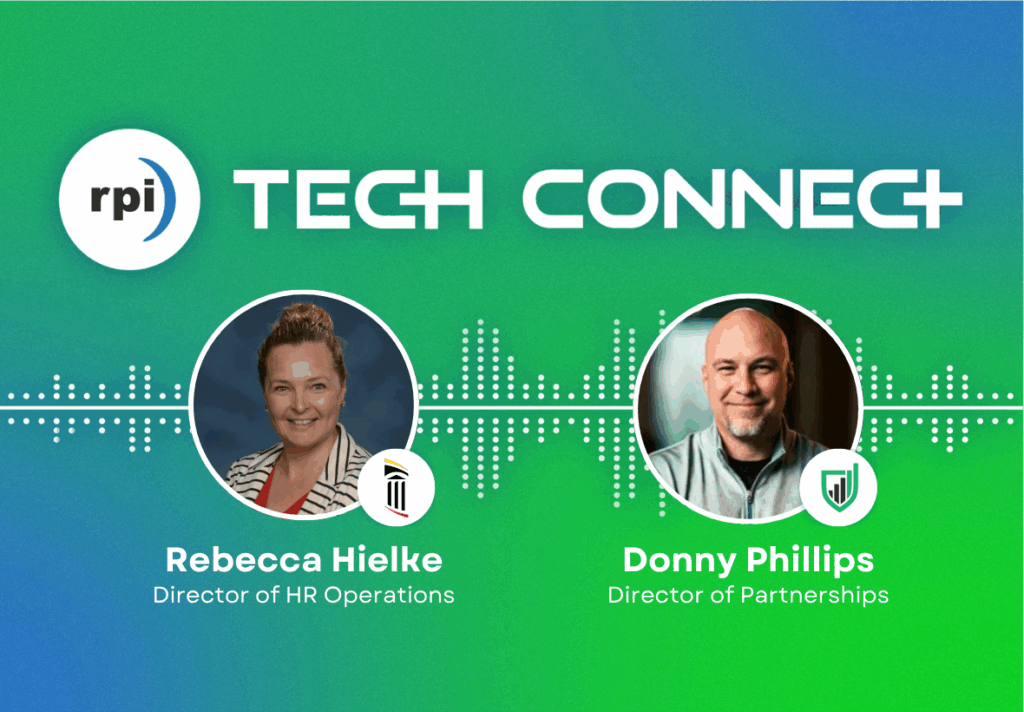
In this episode of RPI Tech Connect, host Chris Arey speaks with Rebecca Hielke from the University of Maryland Medical System (UMMS) and Donny Phillips of Vault Verify about how UMMS tackled a frustrating, time-consuming employment verification process—and turned it into an automated, efficient workflow with real-time visibility.
With help from RPI, UMMS successfully integrated Vault Verify with its newly implemented Infor CloudSuite ERP, creating a smart, API-driven solution that reduced manual effort by more than 50% and set the stage for even broader ERP success.
Whether you’re exploring ways to modernize HR operations or curious how UMMS made the leap from manual process to measurable impact, this conversation is a must-listen.
Interested in listening to this episode on another streaming platform? Check out our directories or watch the YouTube video below.
Meet Today’s Guest, Rebecca Hielke
Rebecca Hielke is the Director of HR Operations for the University of Maryland Medical System. As Director of HR Operations, Rebecca oversees the HR Service Center, the File & Records team, and the HR Project Management Office.
She reviews the processes and systems that HR uses to help identify efficiencies or a better team member experience. She recently celebrated her 10th anniversary with UMMS, having previously served as the Director of Employee & Labor Relations at the University of Maryland Medical Center in downtown Baltimore, MD.
Meet Today’s Guest, Donny Phillips
Donny Phillips is a 29-year industry expert who has served in leadership for multiple human resource and payroll service providers, including some of the largest third-party administrators and employment and income verification vendors.
During his career, Donny has consulted with and provided services to employers of all sizes from the largest of the Fortune 100 to local small businesses as well as local governments and federal governmental agencies. Donny is passionate about helping clients optimize programs while focusing on doing the right thing for all stakeholders.
Meet Your Host, Chris Arey
Chris Arey is a B2B marketing professional with nearly a decade of experience working in content creation, copywriting, SEO, website architecture, corporate branding, and social media. Beginning his career as an analyst before making a lateral move into marketing, he combines analytical thinking with creative flair—two fundamental qualities required in marketing.
With a Bachelor’s degree in English and certifications from the Digital Marketing Institute and HubSpot, Chris has spearheaded impactful content marketing initiatives, participated in corporate re-branding efforts, and collaborated with celebrity influencers. He has also worked with award-winning PR professionals to create unique, compelling campaigns that drove brand recognition and revenue growth for his previous employers.
Chris’ versatility is highlighted by his experience working across different industries, including HR, Tech, SaaS, and Consulting.
About RPI Tech Connect
RPI Tech Connect is the go-to podcast for catching up on the dynamic world of Enterprise Resource Planning (ERP). Join us as we discuss the future of ERPs, covering everything from best practices and organizational change to seamless cloud migration and optimizing applications. Plus, we’ll share predictions and insights of what to expect in the future world of ERPs.
RPI Tech Connect delivers relevant, valuable information in a digestible format. Through candid, genuine conversations and stories from the world of consulting, we aim to provide actionable steps to help you elevate your organization’s ERP. Whether you’re a seasoned professional or new to the ERP scene, our podcast ensures you’re well-equipped for success.
Tune in as we explore tips and tricks in the field of ERP consulting each week and subscribe below.

Transcript
Chris Arey
Welcome to another episode of RPI Tech Connect. I’m your host, Chris Arey. Today, we’re telling a story about how smart partnerships and the right technology can have a measurable impact on HR operations.
I’m joined by two guests, Rebecca Hielke, Director of HR Operations at University of Maryland Medical System, and Donny Phillips, Director of Partnerships at Vault Verify. Rebecca, Donny, thank you so much for being here today.
Before we dive in, tell us where you’re calling in from.
Rebecca Hielke
I’m calling in from Maryland, and I’ve been with the University of Maryland Medical System for nearly 10 years.
My work anniversary is next month. And I spent much of that time actually in the employee and labor relations space at our academic medical center. But I transitioned into HR operations about 18 months ago, and that’s the role I currently hold.
Chris Arey
Very exciting. How was that transition for you? Has it been a fun one?
Rebecca Hielke
It has been a fun one, but I do miss some of the employee and labor relations work. That’s where some of the fun stuff happens, but I’ve been pleasantly surprised at the fun stuff I’ve encountered in HR operations.
Chris Arey
Awesome. And Donny, what’s going on with you, man? Where are you?
Donny Philips
Hey, hey, good afternoon, Chris. Thanks for having us on. First of all, I’m calling in from Lancaster, Ohio, which is in Central Ohio, about 30 miles southeast of Columbus.
Just some quick background: I’ve been in this outsourced HR space for almost three decades.
Chris Arey
Wow.
Donny Phillips
I think it’ll be 29 years later this fall, which is pretty scary to think about. And yeah, I’m really excited for our conversation today.
Chris Arey
Awesome. Well, thank you both again for hopping on this afternoon. We’ve got some exciting stuff ahead of us. So, I figured we could go right ahead and jump into it. For context, RPI and the University of Maryland Medical System, or UMMS, as we’ll refer to it throughout this recording, we’ve partnered with Vault Verify to do some work for employee employment verification.
So there’s some background for you, Rebecca. I’d like to start this discussion by hearing a little bit about what the employment verification process looked like at UMMS before this engagement, and what kinds of challenges you were seeing.
Rebecca Hielke
Yeah, absolutely. So our process at UMMS was pretty inconsistent, very manual, which made it very time-consuming to do verifications. It was extremely challenging for employees or verifiers to know where to go to request verifications. And my team was then generating requests manually, which is pretty inefficient to begin with.
But about 18 months ago, right around the same time I joined the HR operations team, our organization switched to Infor for our Human Capital Management System. That meant that our employee data was housed in two different systems, which made pulling employment verification even more challenging, because our team had to occasionally pull prior data out of old systems and then add that to our new system. So, it continued to be inefficient and extremely manual.
Chris Arey
Okay, so after that transition happened, did you have visibility into the metrics and verification process, or was that situation like?
Rebecca Hielke
We didn’t have great visibility into metrics. We weren’t really tracking our volume. We were going purely off vibes. It was taking a lot of time for people on the team to do this work because we didn’t have a consistent process, and we weren’t tracking how long it took to turn something around.
We were up to multiple days because we had a decent volume. And then, wading through all of that manually was taking us a while.
Chris Arey
Okay, so that doesn’t sound like a great experience, especially after going live in a new system. I’m sure there are a number of things that could explain why that was happening, but I figure at some point, your team is saying: we have to find a better way to do this. I assume you started looking for a better solution. What drove that decision?
Rebecca Hielke
What drove that decision was a little bit of restructuring of our internal team once I joined. We formed more of a core HR operations team, and I hired an HR operations coordinator. She came from our service center, which was the team that had been handling our verifications.
And she was going to take that responsibility for the verifications solely in this new operations coordinator role. Once that became a one-person task, we had better visibility into how much time it was taking out of that one person’s day.
She was spending around 40 % of her time just doing verifications. The whole intent of forming this core operations team was to take on more work, do some additional standardized processes, and then have her support some projects we had going on.
She couldn’t have done that work if 40 % of her time was spent doing verifications.
Chris Arey
Wow. Previously, the employment verification process was shared across the team, and it was nebulous in the sense that the responsibility sometimes shifted. And then you had this new coordinator role, who was doing it 40 % of their time. Is that right?
Rebecca Hielke
Yes, so we have multiple employees as part of our HR service center, and it was a rotated task that anyone could take on, and we would assign it out. From 2 to 3 p.m. on Monday, it would be X person, and then the next day it would be Y person. And so that also contributed to that lack of visibility on volume because the information was so widely disseminated among personnel.
Chris Arey
Yeah, you’d only see it so often. One Monday, you do it, and then you won’t see it again for another three weeks or something,
Rebecca Hielke
Right, well, probably more frequently than that, but still, not often enough for certain tasks to be assigned out individually. It was so frustrating when I wanted to assign more work to our coordinator, and she was caught in so many verifications.
Chris Arey
Real quickly, it became evident that this is a full-time job, and you needed a solution for it. So enter Vault Verify. Yes.
Rebecca Hielke
Yes, so enter Vault Verify.
Chris Arey
Donny, was that engagement like? What happened?
Donny Philips
Yeah, I mean, I think the stars aligned from a timing perspective, and it’s eye-opening to hear that a FTE was spending 40% of their time on this process. I think it’s important to point out that this was an already outsourced service.
UMMS had a solution in place, but there was some lack of configurability, some challenges around just the overall model. And when I say the stars aligned, we quickly got engaged with the UMMS leadership team.
And I think the message resonated pretty strongly around our overall data engagement model. I won’t go too deep down the rabbit hole today, but we’ve got a very unique approach to how we minimize data engagement and how we’re always pulling up fresh information for every valid request that comes through the door.
The important thing that those two things drive is efficiency or client program efficiency, which results in a massive reduction in potential risks. As Rebecca just outlined, her team was dealing with a ton of manual efforts, and we were able to offload some responsibility.
I’ll say virtually 100 % of that. I mean, there are still some unique requests that come in where we don’t have access to the data that we need, so we may have to reach back out to Rebecca’s team and say, hey, could you help us fill this. We still do our best to own the process, but we may engage them occasionally for those unique types of requests. But yeah, I think it was good timing, good messaging. We just landed with the right folks at the right time.
Chris Arey
Awesome. I love to hear that. So we’ve heard a little bit about how UMMS and Vault Verify got together. I want to talk now about the how. Implementation is everything. What role did RPI play in this? How were we brought in? What can you share? Donny, that one’s for you.
Donny Philips
Yeah. Yeah, Chris. And I’m going to start a little bit earlier in the process because it is meaningful, and then talk about how we got RPI in the mix. First and foremost, we love to talk about implementations here at Vault Verify. And it’s not because we’re twisted individuals.
Chris Arey
Haha.
Donny Phillips
It’s because we do have a great implementation model. Our data integration process is one where we do virtually all the heavy lifting. We engage our customers to help with validating our setup and configuration, and reporting rules.
But the actual technical build, we typically do as much of a lift as possible. I wanted to set that ground floor. Now, this is a little bit of a different situation here, because when we got engaged with UMMS, which had just moved to the Infor platform, we didn’t have a real-time integration built with Infor. We had it for most HCMs, but not for Infor. So this was going to be a ground-floor build, which we know we’re capable of. We’ve done it time and time again.
But as we got engaged with UMMS, we’re like, we’ve got these great partners over here at RPI. They’re the Infor experts. As we were getting down the path in the conversation with UMMS, we started engaging the RPI team. We did some of the preliminary due diligence, starting to understand the API connectivity, the vast array of endpoints that are out there. We quickly started to see that it was going to be pretty overwhelming.
So we’re like, again, we’ve got this partnership with RPI. Let’s leverage it. So we got engaged with the RPI experts to do that initial due diligence in preparation and expectation of getting this green light from UMMS to begin.
Basically, once we got to that point where it was ready to kick off, we were able to hit the ground running. We worked with the RPI experts to help streamline those endpoints, of which there are a couple thousand, maybe more, to get to the right ones and do so efficiently and effectively without burdening Rebecca and the UMMS team with helping us identify those fields on there.
We worked with RPI, and it streamlined the process for us.
Chris Arey
I love hearing about that smart partnership there, right? You’ve got this alliance already established. You’re going into a new situation. Let’s call in the people we know who know this software and get it done and get it done right without burdening the client, right? Love to hear it. Rebecca, from your side, what’s it been like working with the RPI team?
Donny Philips
Yep. Yep.
Rebecca Hielke
So I was so impressed with how smooth the process was. As you all mentioned, there are so many uniquely titled fields in Infor. And had Donny come to our team to ask which fields we were supposed to be accessing? My answer may have been, I don’t know, because at that point we had only been on the platform for not even a year at the point we started this conversation.
Chris Arey
Haha. Yeah.
Rebecca Hielke
We were still learning the tool ourselves and figuring out the right fields. So it was so helpful to have experts involved to provide that guidance and not put that burden on our team. And my team certainly felt unburdened by the process.
Chris Arey
Sure. That’s the goal right there. I’m glad to hear that. Thank you. Donny, anything from the implementation process that stood out to you?
Donny Philips
Yeah, Chris, I would say there are probably three angles here that stood out to not just me, but the Vault Verify team. First, I would say that we’re very proud of how quickly we were able to move through this. We were right about 60 days from initiation of the build to service activation for UMMS. So again, 60 days is largely unheard of.
Chris Arey
Wow.
Donny Philips
I won’t repeat some of the RPI responses when we said we’re live now. It was very enthusiastic, and Chris, I don’t want you to have to tag this as explicit. So we won’t talk about the actual quote.
Chris Arey
Thank you for the warning.
Donny Phillips
Yeah, we won’t, I won’t deliver the actual quote, but again, very proud of that. I’ve already mentioned, I think we can confidently say we did this without burdening the UMMS teams too heavily beyond the validation work that we all, we’re always going to request the customer to validate for us.
We need to make sure we’re delivering data in the way that’s most meaningful and accurate for the customer, so it always requires their input. And then the last thing, and I don’t know that we’ve ever talked about this even with you, Rebecca, but it stood out to me just talking about how we’re able to quickly optimize processes.
When we launched this service for UMMS, initially, our integration was running pretty slowly. It was averaging just over a minute in terms of the times we were seeing from the API end to end to gather that one record for that one report and retrieve the data. The average response time was over a minute.
We clued our technical team in very quickly. Now we’ve got the integration running, let’s optimize by implementing a few clever improvements in how we’re connecting with the Infor platform. We very quickly got that response time down to under two seconds. And we’ve held steady for 90 days.
We’re under two seconds, which is meaningful when we talk about some of the more technologically advanced verifiers that are out there and connecting electronically. They have SLAs. We’re in really good shape for meeting some of those SLAs that are out there. So very proud of the work that our team did on that.
Chris Arey
I’m really happy you ended on that last point there, Donny. It speaks to the level of customer service that your team is providing and how it’s not enough to just get the client live. It’s like, now that you’re live, what can we do to make it even better for you?
And I think that segues nicely into this next section here. Rebecca, I have a question for you. You know, fast forward a bit. You’ve been live for a little over three months now. What are you seeing from an employment verification process? Any nice metrics or quality of life improvements you can share?
Rebecca Hielke
Yes, absolutely. I am a big data person, which is somewhat surprising coming from the employee labor relations space. So, it was difficult for me not to have good, solid metrics prior. We love the Vault Verify dashboard, where we can see in real time what’s coming in. It’s really pretty. It just looks nice. And we are constantly in it.
It just tells a nice story of what we’re doing. And we were able to use that to track volume, to potentially identify patterns or potential concerns. But it was so responsive, if we say something that looks odd, it can tell us more about this.
The expertise, experience, and giving us feedback on what we were seeing and what it might be attributed to helped us kind of identify if it really was an issue to track or not. So we’ve been impressed with the metrics. And I did pull some data in preparation for this, because I do love the data.
Chris Arey
Ooh. Yeah, data tells a good story. What can you share?
Rebecca Hielke
So previously, I looked at a week before implementation and then a week in time post-implementation. And our volume went down as well by more than 50 % of what we were seeing. And the things that we are getting now, like Donny said, there are still some unique requests that we resolve internally, but the rest are resolved by redirecting to Vault Verify, and that redirection has been really smooth.
And we have gotten zero negative feedback about the experience, which in HR, that’s a high bar. We’re not aiming for positive feedback at this point. You’re just aiming for no negative feedback. That to us is a success story.
Chris Arey
Yeah, that’s a major win. And Donny, quick question, kind of a technical question here, but curious about the relationship between Infor and Vault Verify during this verification process. What does that data feed look like?
Donny Philips
Well, there’s actually no data feed. So that’s one of the unique differences with the Vault Verify model is we’re connected to the Infor platform via API. Rather than extracting every employee record, every pay period, which is the industry standard, we’re retrieving one employee record at a time in real time once we’ve confirmed a valid request for information. So I see a eureka on Chris’s face there.
Chris Arey
Okay. Yeah, that’s awesome. Go ahead.
Donny Philips
Yeah, at the end of the day, it’s more than a 99 % reduction in potential risks because the data is just not moving. We’re not duplicating UMMS’ database and putting it in our platform. There’s no reason for that.
We only need the one piece of information from the system of record to fill that output report. Also, after that, we don’t store the data, Chris. We keep a copy of that report partially masked for 90 days, and then it’s gone. The data’s not saved after that.
Chris Arey
Wow, it just sounds like such a better way. Why would you pull data for employees that don’t need to be verified?
Donny Philips
Yeah, Chris, it’s like you’re singing our song there. That’s exactly our message.
Chris Arey
Fantastic, I love to hear that. So, follow-up question for you here: what do you think makes UMMS such a great success story?
Donny Philips
Wow. So I could probably sit and try to outline some stats and some commentary around what we’re doing, but I don’t think I could tell the story any better than what Rebecca has shared so far.
Ultimately, that’s how we define whether we’re successful or not. It’s customer feedback. So when we hear Rebecca’s story, I think we feel pretty good about things. And just in this conversation, I’ve already made a couple of notes.
And Rebecca, I’m sure you’ll hear from our client experience team in the coming weeks about how we’ve reduced your workload by more than 50 percent. Now, what’s the remaining 50? Let’s get that down to where you’re spending just a couple of minutes a week. We don’t want you to spend much time on this process. Once we can continue to iron out, I’m sure that we’ll get this down to where you’re like, it’s almost non-existent on our plates now.
Rebecca Hielke
That would be ideal, Donny. I have big things for my operations coordinator, and I can’t have her bogged down in verifications.
Donny Philips
We’ll do what we can to enable that for you, Rebecca.
Rebecca Hielke
Fantastic.
Chris Arey
Donny, and Rebecca for you too. You know, I think what is great about this story, too, is hearing about the involvement RPI had in developing the API between Infor and Vault Verify. Like that, that’s good to go now, right? Like going forward for any other organization on Infor, it’s like a plug-and-play.
Donny Philips
Yeah, yeah, great, great question, Chris. So I would say, you know, again, it took us about 60 days on that first build. The next one will probably be 40 days. Number three, we’ll get it down.
For other platforms where we have fully figured out this API based integration, we average 20 to 30 calendar days for a full project, after about three hours of effort for the client to do the validation work. We do everything else. I wouldn’t claim that we’re there after one, but we will be there after two or three.
Chris Arey
Mm-hmm. Okay.
Donny Philip
And that’s the cool thing. Each customer going forward, it’s going to get easier and easier, maybe not easier, quicker and quicker.
Chris Arey
Love to hear it. Always improve in the process. So Rebecca, thinking back on this whole experience working with RPI and Vault Verify, was there anything that surprised you or anything you can share?
Donny Philips
Absolutely.
Rebecca Hielke
So I was surprised at how smoothly this process went. We were still getting acclimated to Infor ourselves. Knowing that this was going to be this integration, we were a little nervous. And like Johnny said, this went quickly. This didn’t require a lot of lift for my team.
Chris Arey
Sure.
Rebecca Hielke
We were guided through the process the entire time. Everyone was so responsive. So I was surprised by how easy it ended up being.
Chris Arey
I love to hear that. And that’s something that we’ve talked about here at RPI in several different webinars, blog posts, and other things of that nature. Once you’ve gone live on a new system, it seems like you’ve made it, but there’s this date, we call it day two initiatives, and those are the things that you do after going live.
There are stories like the one that you’ve told today, where you went a step further, and maybe it surprised you how smooth it went, but the success that you’re seeing now, and the fact that you’re taking that extra step to build a foundation, is great.
That’s where the true return on investment comes from, making a big migration to new ERP software and such. I love hearing that you were surprised that it worked out so great, and for those of you listening in, the same can be true for you.
Well, we are getting close to time here, but before I wrap up, I always like to ask my guests, if you could share one actionable takeaway for today’s audience, what would it be? So I’d love to hear what each of you would have to share. Rebecca, we can start with you.
Rebecca Hielke
Yeah, absolutely. I always recommend asking clarifying questions in a situation. I know people say there are no stupid questions, and sometimes, sometimes there are, but if you’re asking clarifying questions, you probably, I just don’t think anyone should go into something assuming that they are on the same page.
You should ask those clarifying questions to confirm that you are saying the same thing. I have encountered many scenarios in which I thought I was 100 % aligned, but when you start teasing things out, you realize, oh, we weren’t saying the same thing. So I’ve learned a lesson that way.
Chris Arey
You know what they say about assumptions, right? I won’t say the word, but I think we both.
Rebecca Hielke
Yes, I do. I mean, you have the explicit word there.
Chris Arey
Fantastic advice. So often, guests on this podcast will talk about the value of communication, and I think the idea of asking clarifying questions is a critical component of that, leaving nothing unconfirmed. There’s no second-guessing as to exactly what was communicated, what’s owed, et cetera. So love that advice. Donny, what’s the big reveal?
Donny Philips
Yeah, I mean, so I have two things. The first is a professional-related one, and so it is very interesting to hear Rebecca’s, because mine goes hand in hand with that. Mine would be to focus on active listening when you’re having these conversations. Sometimes the words themselves aren’t really what you should be hearing.
It’s really just focusing on some of the nonverbal cues. Think about the context of the conversation. There’s probably more to be picked up on than just the literal words in a discussion.
So again, I think that it’s interesting that Rebecca’s was on clarifying questions, and mine is to make sure you’re listening to the answers when you make those clarifying questions. Now the second piece is not work-related necessarily, but you know, we like to have a little fun here, and we’re coming up on a holiday.
I was kind of thinking about whether there was a piece of advice outside of the work environment, it’s the idea of living a little.
When you’re on a vacation, do the helicopter tour. Spend the money. Seriously, do the helicopter tour. Did it with the family a couple of years ago. Still gets rave reviews that we did this on our vacation. And we’ve watched the video of it multiple times. It’s like a 52-minute video. So, not work-related at all, but do the helicopter tour.
Chris Arey
I wanna hear about that. Like, does it take you on a view of the town or what? I wanna hear more.
Donny Philips
Okay, so I won’t get too deep into this, but we did a family vacation in Hawaii two years ago. It was my dad’s dream vacation, so we were able to take him. So if you guys have ever watched Magnum PI, it’s one of the Island Hopper helicopters, and we did the doors off tour. So no doors on the helicopter. It was cool, and we flew around the island of Hawaii.
It took us up into the woods and flew over where they filmed part of Jurassic Park. It was a stunning, amazing experience and well worth it. And Chris, if you’re really into it, I can send you the YouTube link if you want to watch 50 minutes of a helicopter tour. Awesome.
Chris Arey
Very cool. I would like to see it. I’m going to include it in the show notes of this podcast, too. So please do. Well, thank you both again so much for hanging out this afternoon. This has been a fantastic discussion.
For those of you listening in, if you have any questions about Vault Verify, want to learn more about UMMS’s success story, or about how RPI can help you make better use of Infor, we’d love to hear from you. You can contact us by emailing us at podcast@rpic.com.
Again, that’s podcast@rpic.com. This has been RPI Tech Connect, and we’ll see you next time. Take care, guys.